Gravel Biking over Snoqualmie Pass

I didn’t really know what I was getting into. I’d never ridden a gravel bike before, nor biked long distance on a gravel trail. But how hard could it be? The answer – a whole lot more work than riding smooth road surfaces!

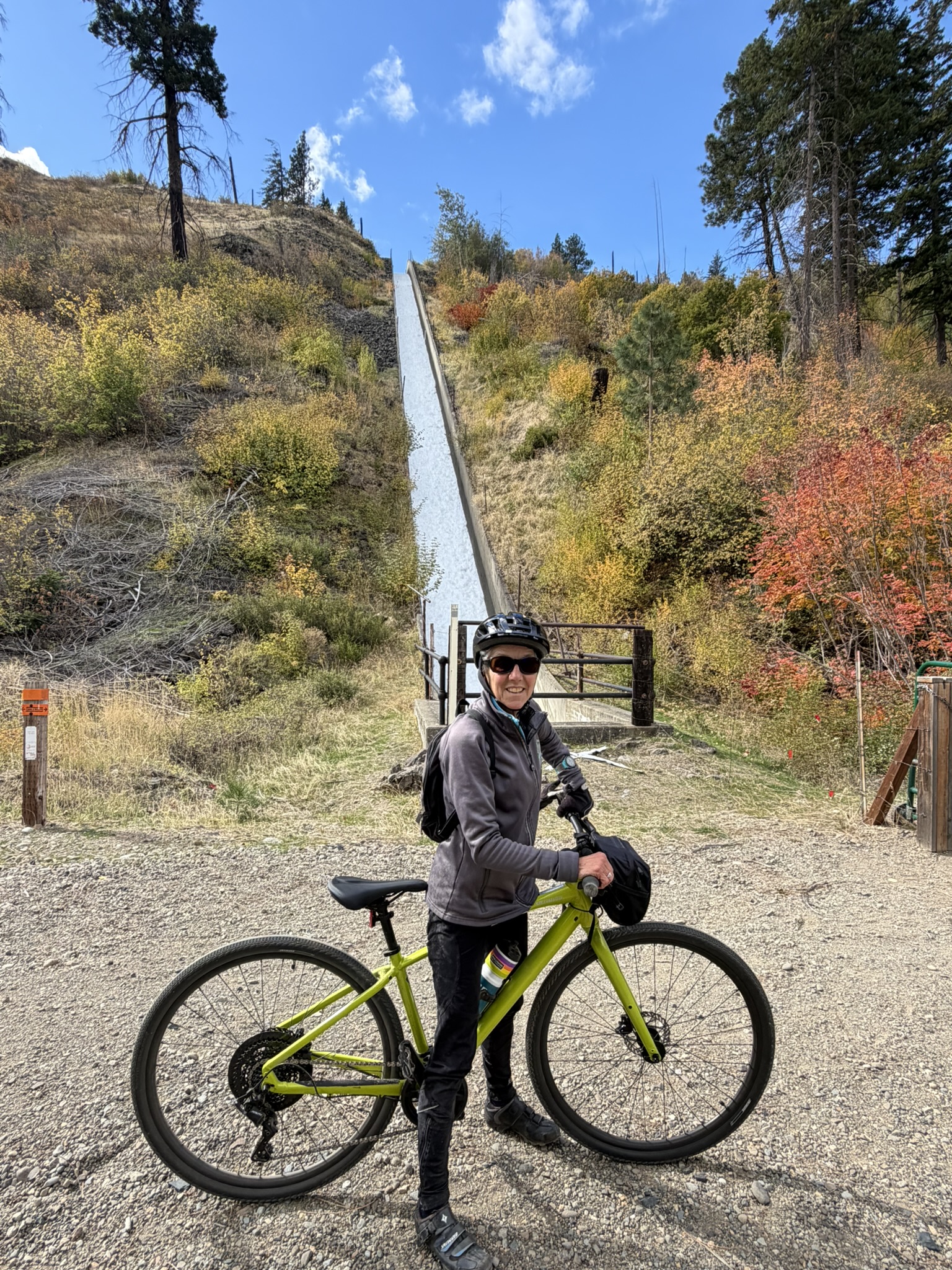
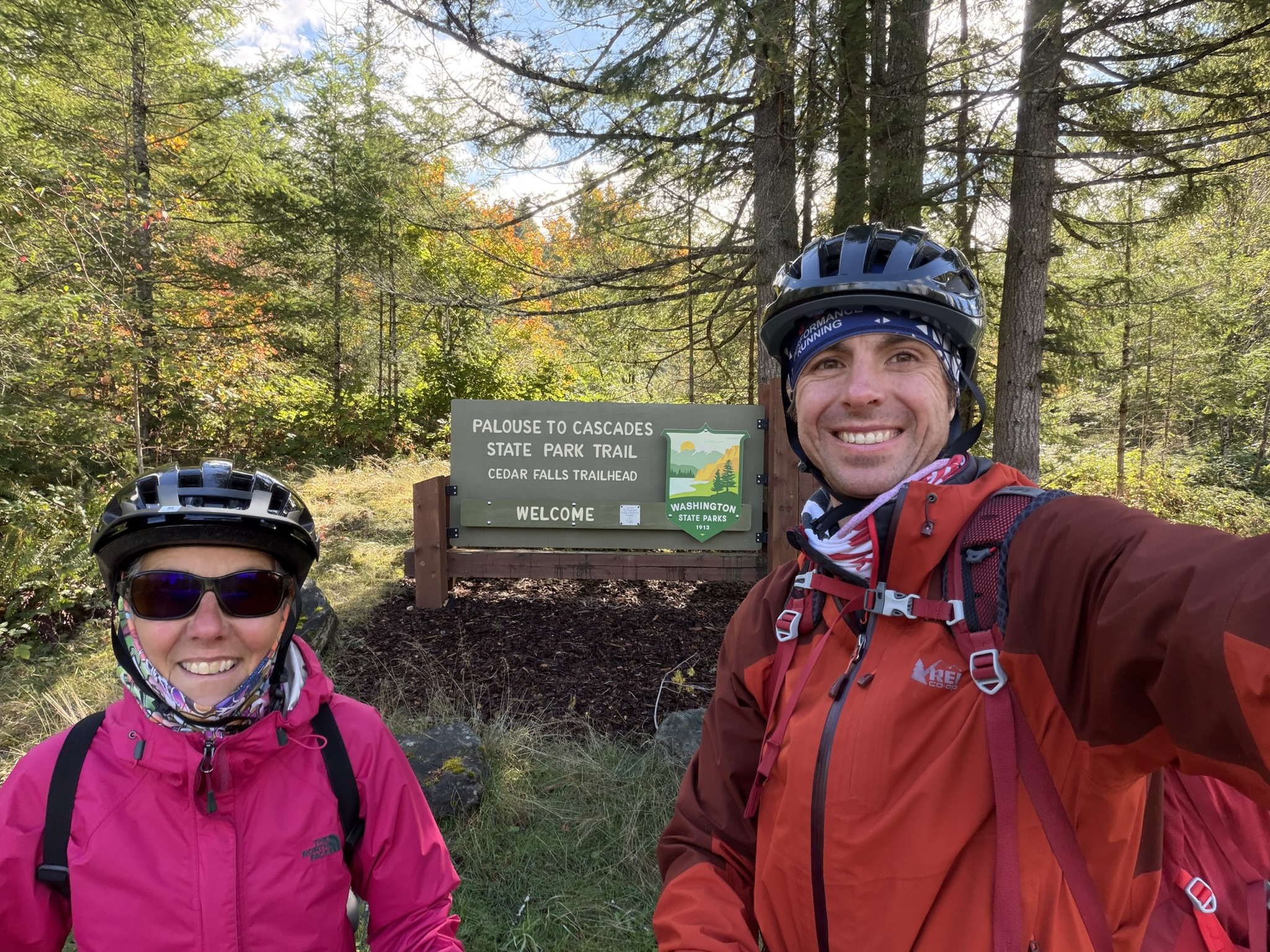
After conquering the San Juan Islands by bicycle over the last three years, my son Erik proposed we ride the Palouse to Cascades State Park Trail (PtoC) from Ellensburg WA back to his house in North Bend. It would take us up and over Snoqualmie Pass, but being a rails to trails path, the grade is 1-3%, very doable. I was all in!

The best decision I made was to rent a proper gavel bike. Erik found a shop that had bikes with straight handlebars, another critical element to being comfortable riding the bike. Erik made do with his heavier mountain bike. A nod to his youth!

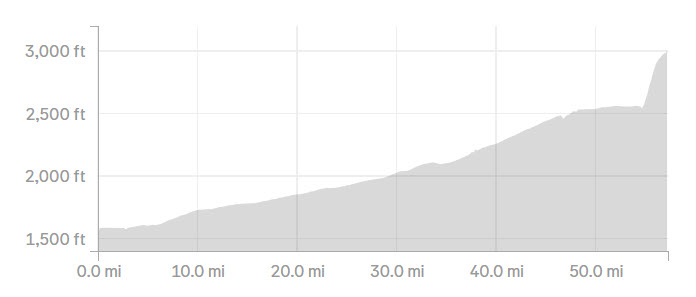
The plan was to ride the 85 miles in two days, staying overnight at Snoqualmie Pass. That meant that day one would be 57 miles all uphill, day two 28 miles all down. After being dropped off in Ellensburg, we set out on a cool but bright sunny day. Confident and eager.
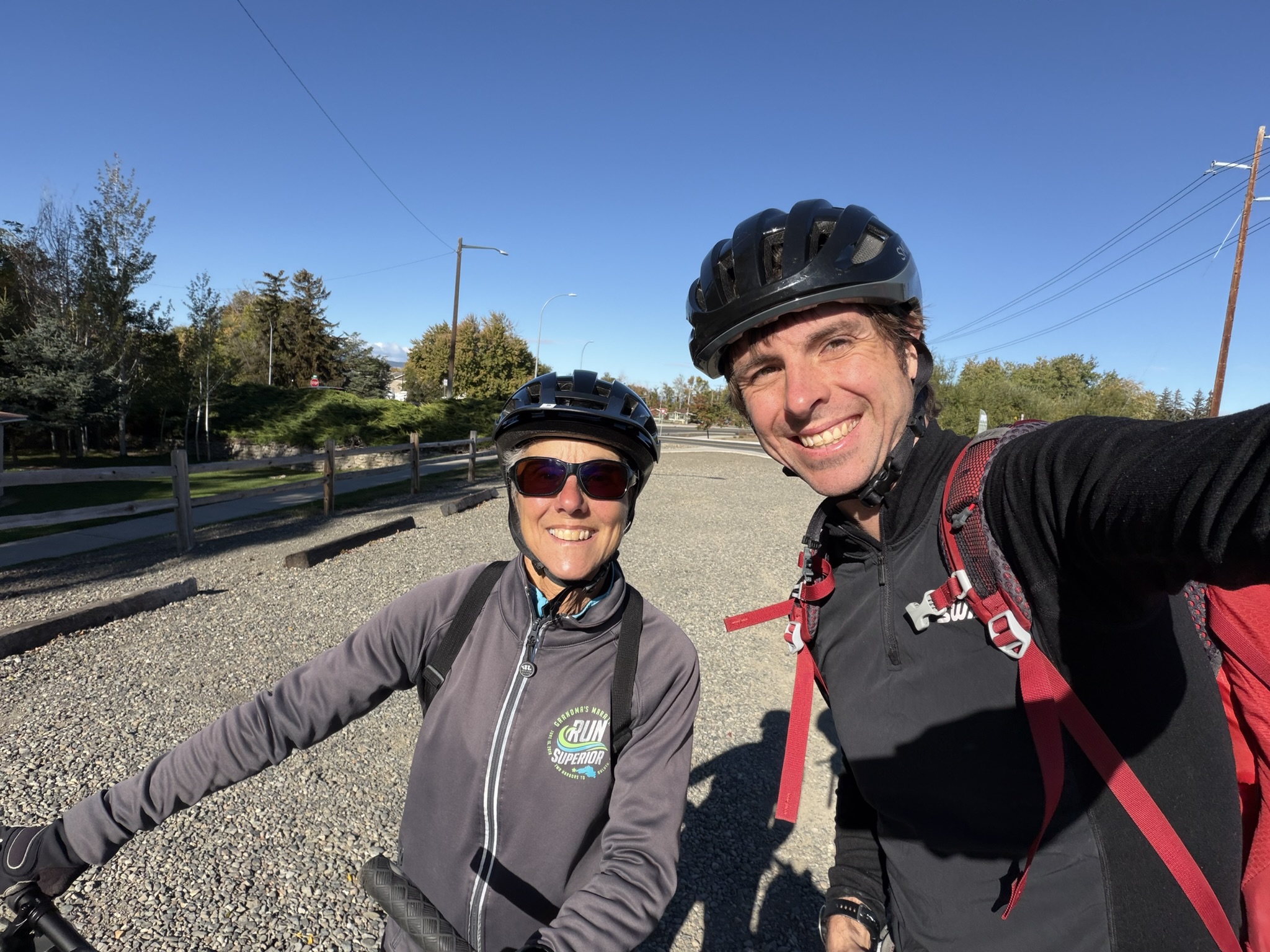
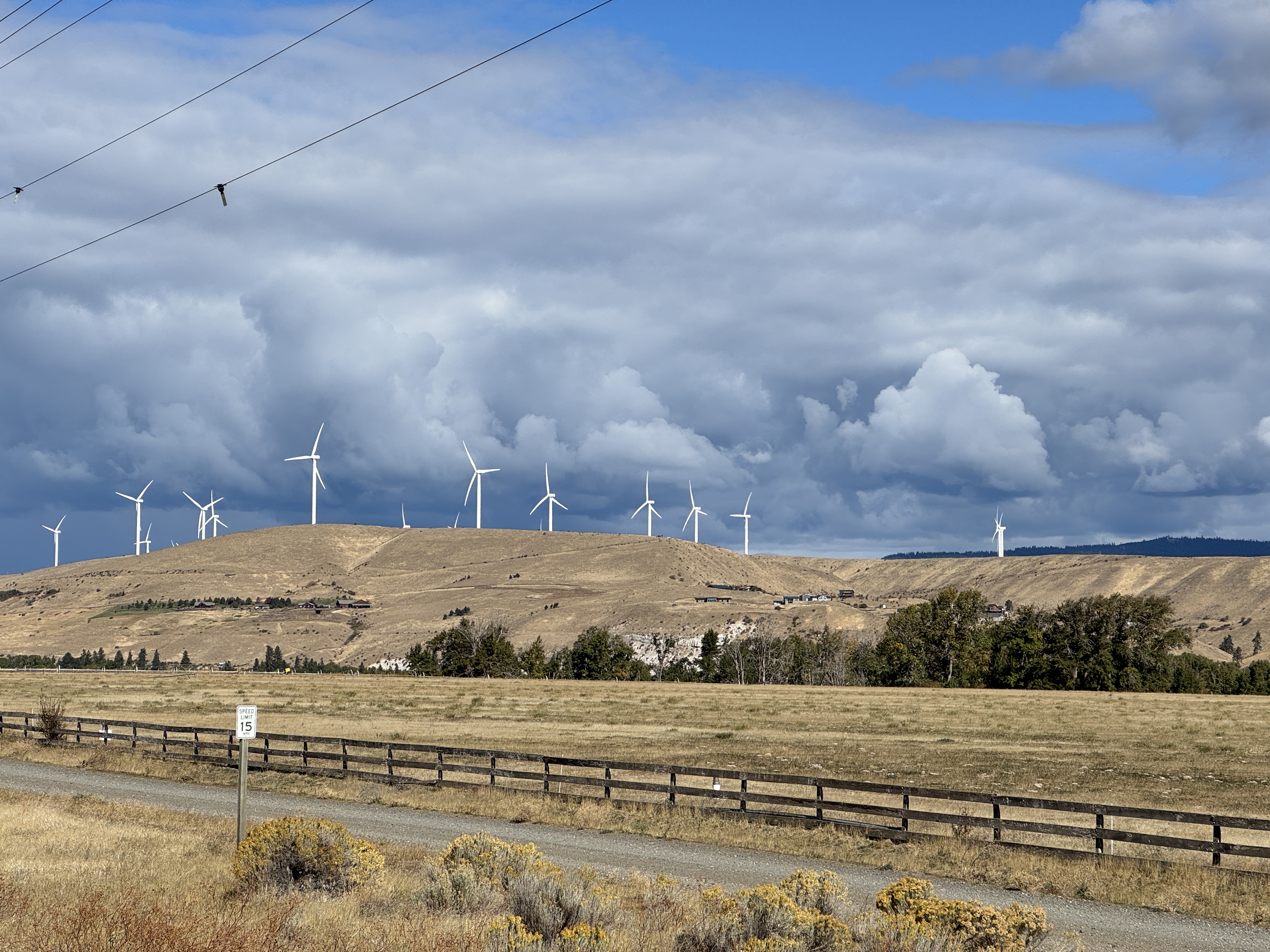
That far out from the pass, we were in farmland, surrounded by open fields that did nothing to stop the headwind we hadn’t noticed. It made sense when we saw the wind farms on the hillsides. Still bubbling with excitement, I forged ahead only to find the gravel a bit of a “challenge.” I bounced around and slid in the loose patches and found my shoulders and arms tightening as I did my best to navigate the terrain. My teeth were on edge as I wondered if this was such a wise choice after all. But I mustered on. As did Erik, who had the added burden of all our extra layers, snacks and overnight clothes in a large pack on his back.
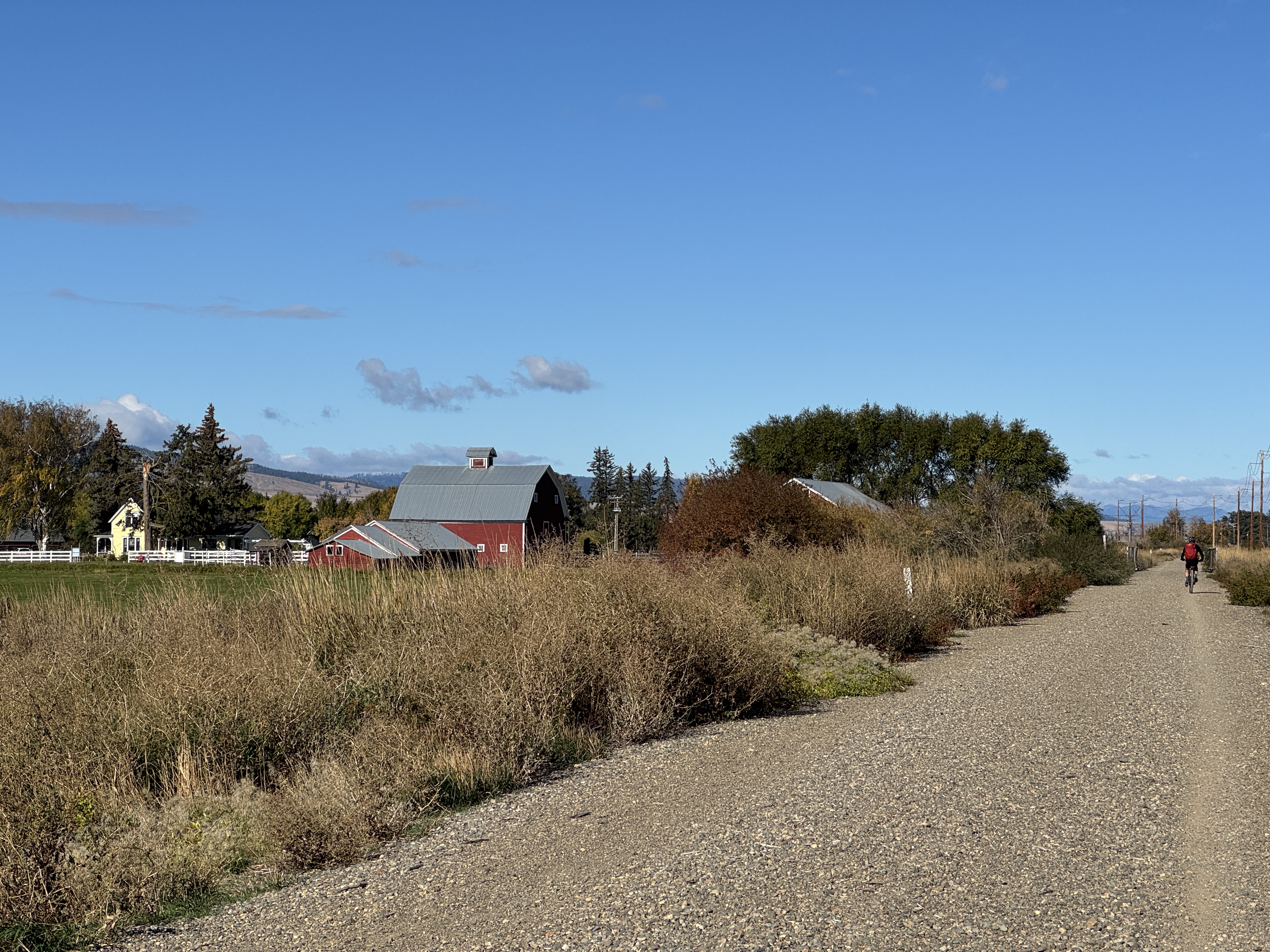
When the foothills began to rise around us, they provided some protection from the wind and miraculously the gravel surface improved at the same time. Between that and getting a better feel for gravel biking, things were looking up! The scenery was a great distraction and became more picturesque the farther we went.
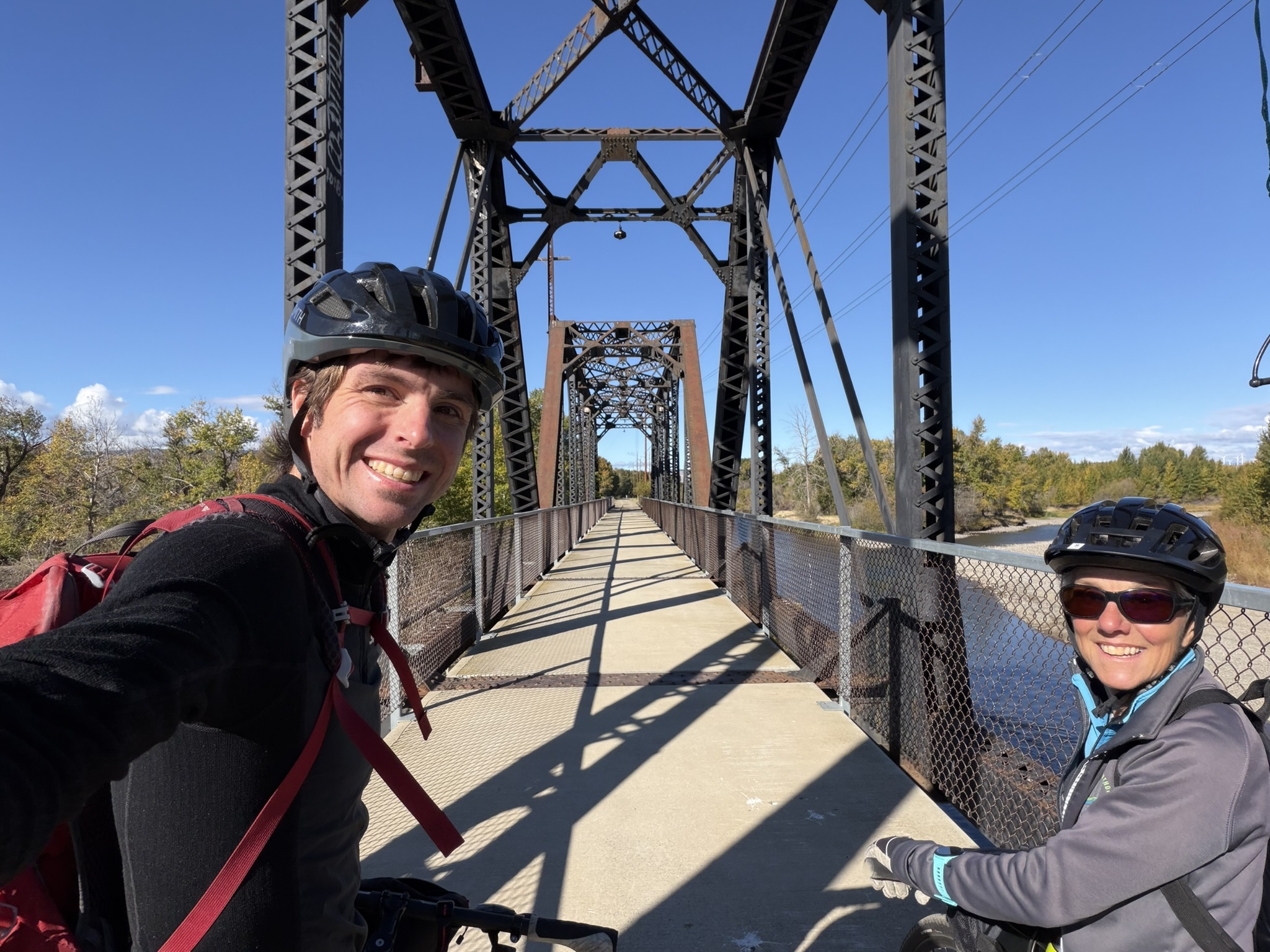
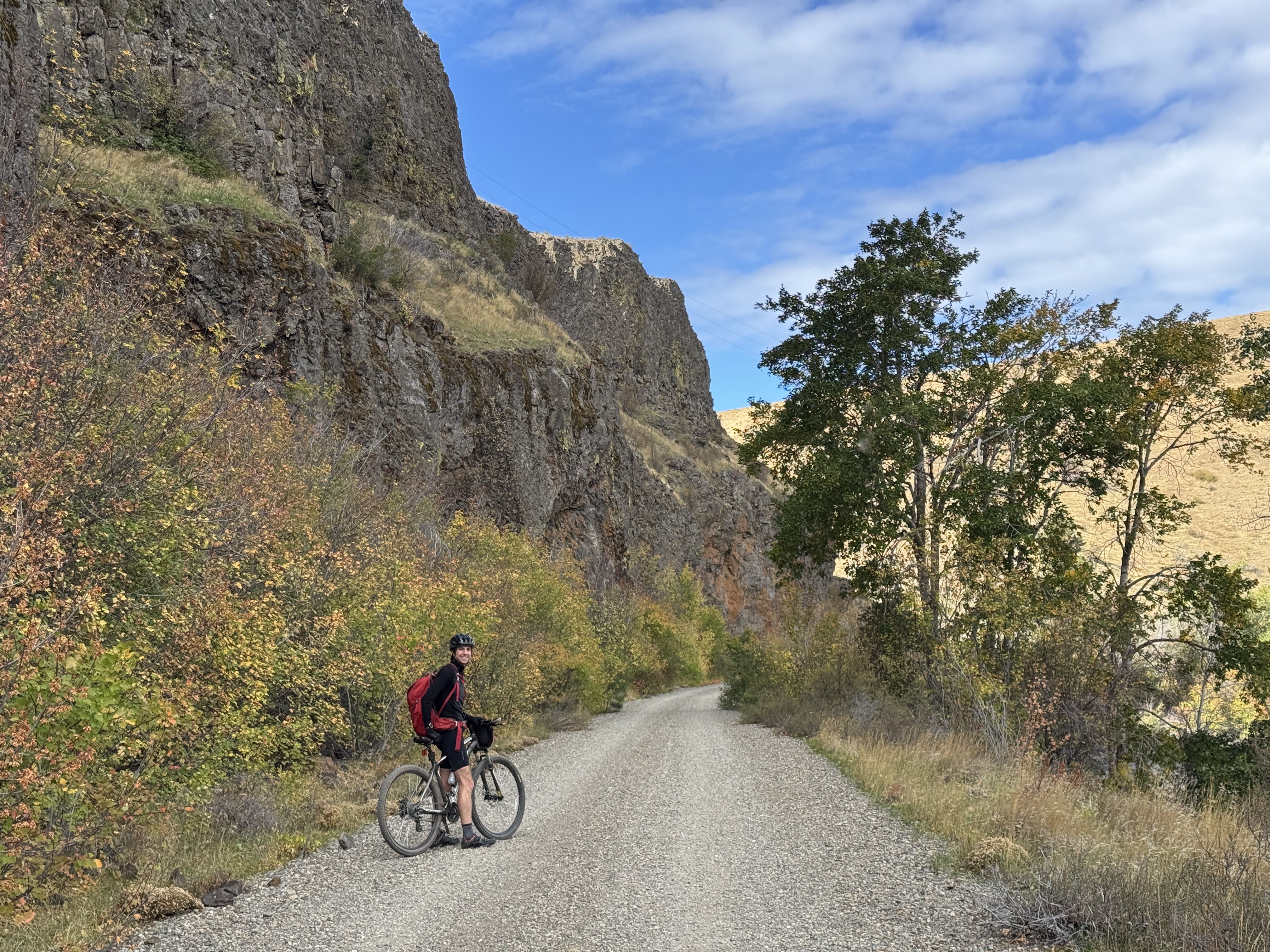
We hit a patch of really good biking surface, more packed dirt than gravel. We took advantage of that to make tracks and get as many miles under our belts as we could!  Pressing on and on I began to lag and feel a bit spent – Erik too.  That’s the only time it felt monotonous and like the trip was going to last forever.  The end seemed impossibly far away as we were not even half-way to the pass yet.
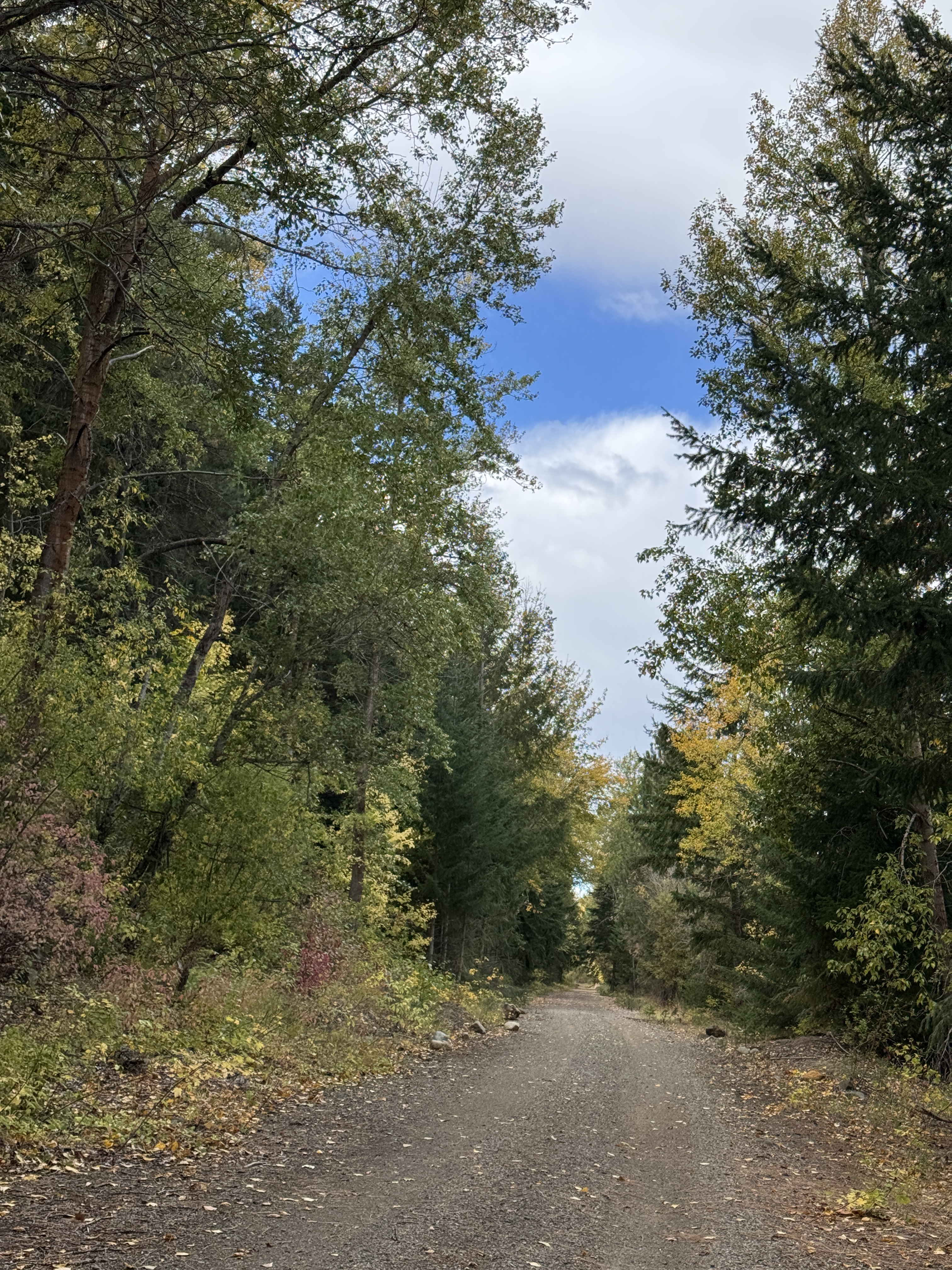
Reaching Cle Elum we concurred that it was time to stop for lunch. Settling into two cozy rocking chairs on the deck of a coffee shop we gratefully consumed the sandwiches and fruit we’d brought, supplemented by a trail bar from the shop. The well-timed stop and sustenance replenished our energy and spirits as we returned to the trail.
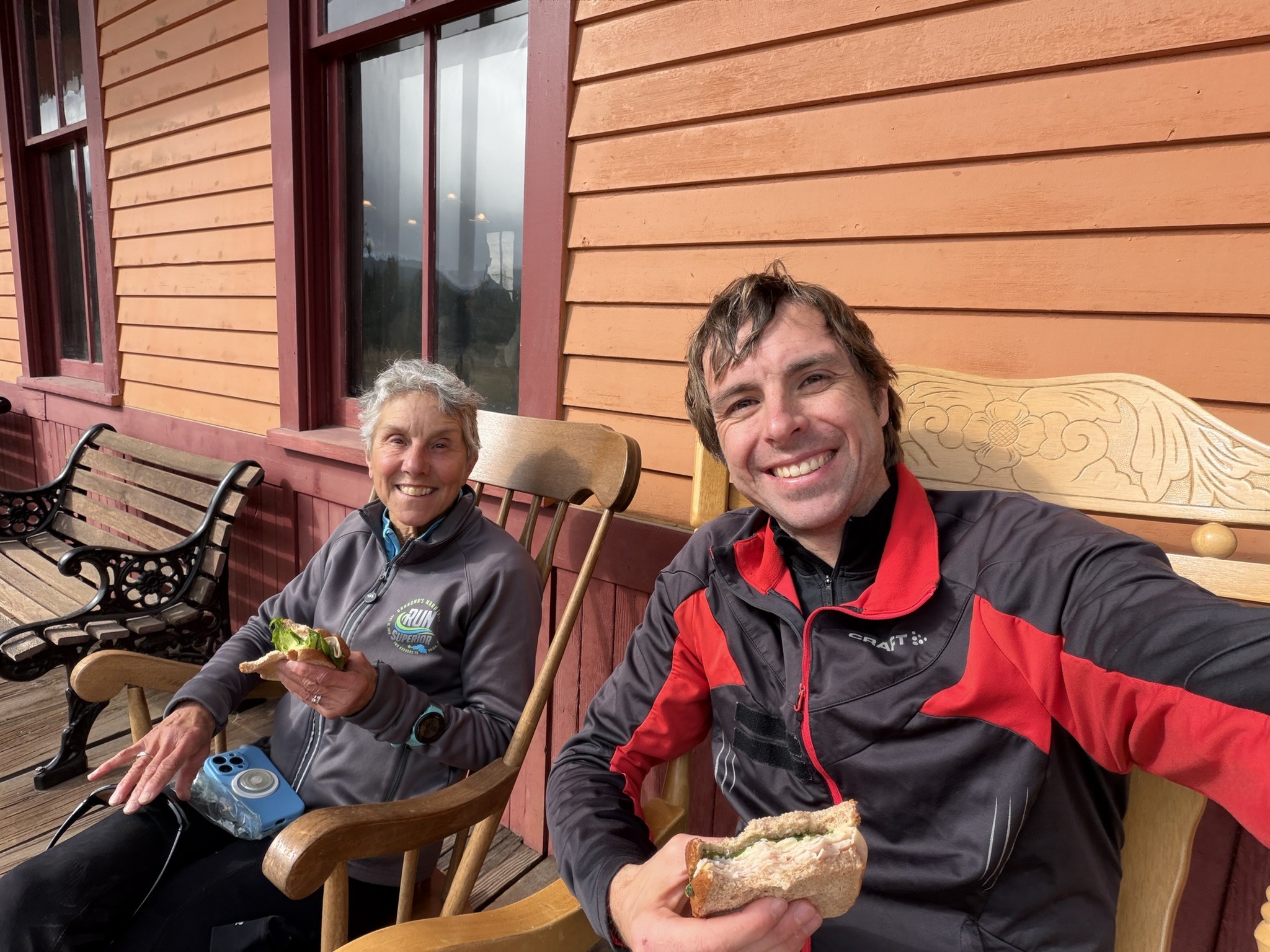
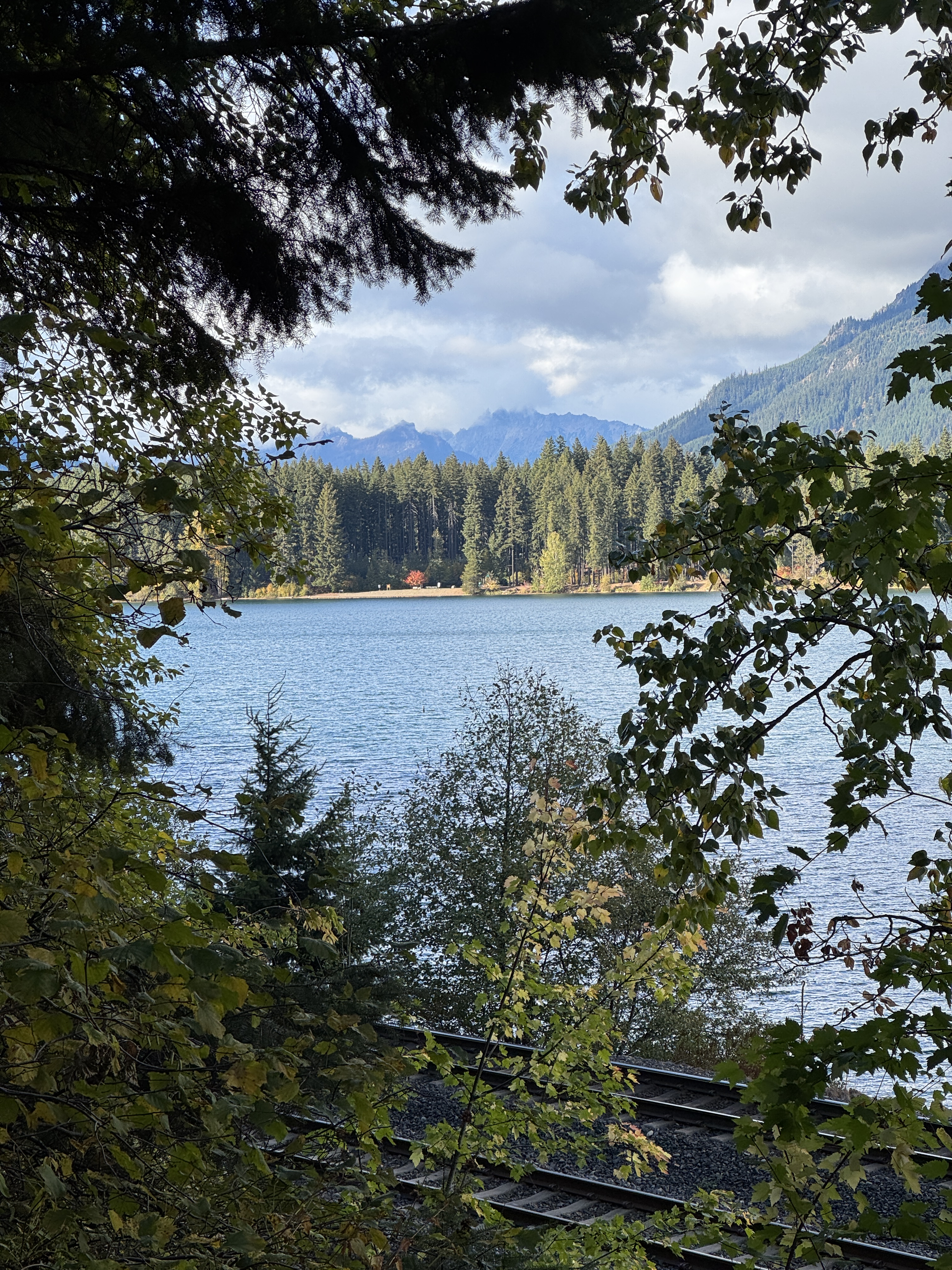
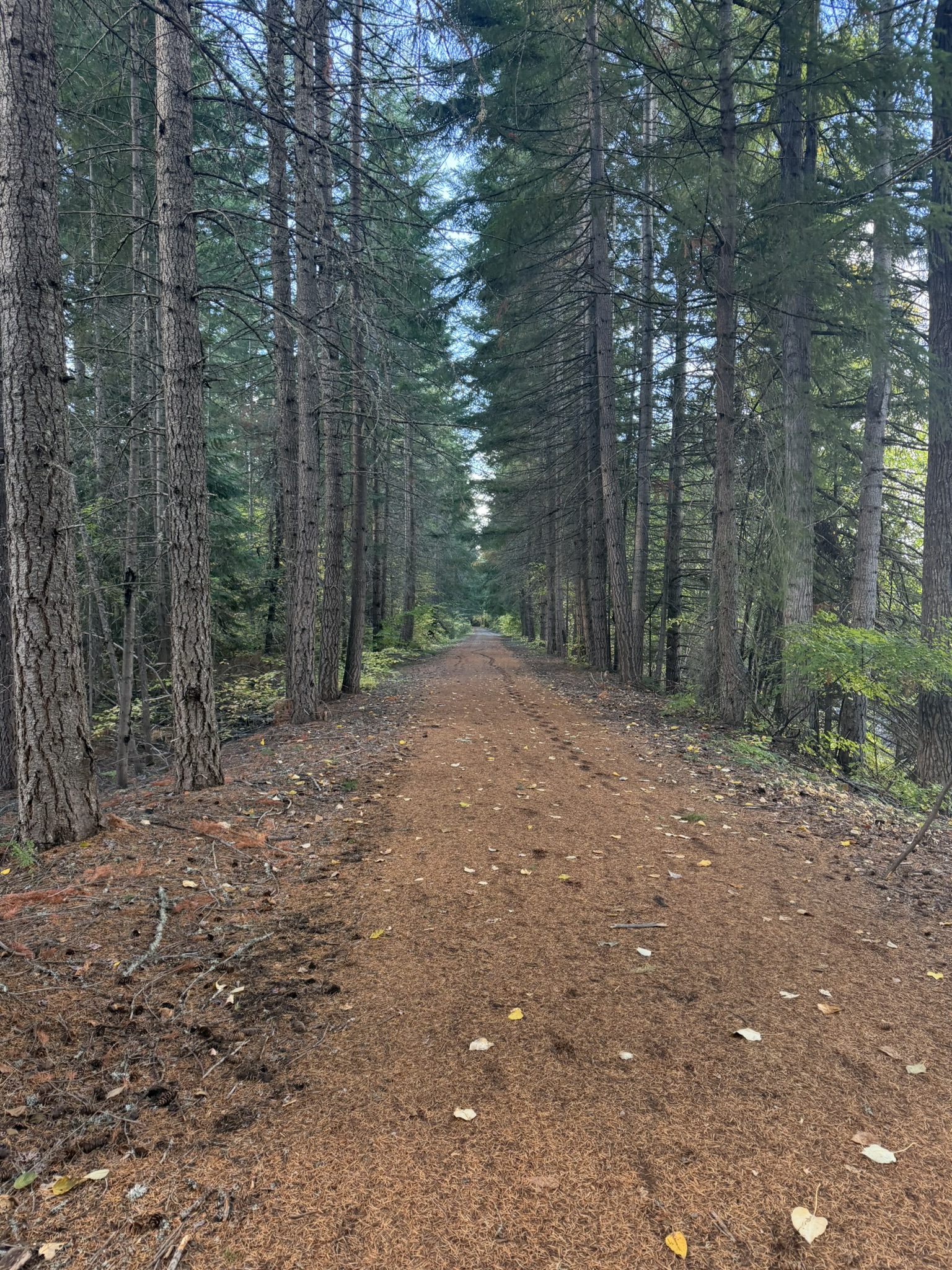
The scenery only improved from there. We passed under tall deciduous trees, rolling over colorful leaves on the trail. In the Easton area there were tall pine trees lining the trail, which was then covered in orange pine needles.  Rolling through Lake Easton State Park, the lake was to our right, glistening in the sunlight. 
We passed through four short railroad tunnels that day. They were fairly short, and none were lit. We attempted the first without our headlamps. Seeing the light from the other end we didn’t think we’d need them, but that hid the deep darkness in the middle. I panicked, tensed up and slid in the gravel, my first slow fall of the trip. No harm done, but it did teach us to use our headlamps in the remaining tunnels!
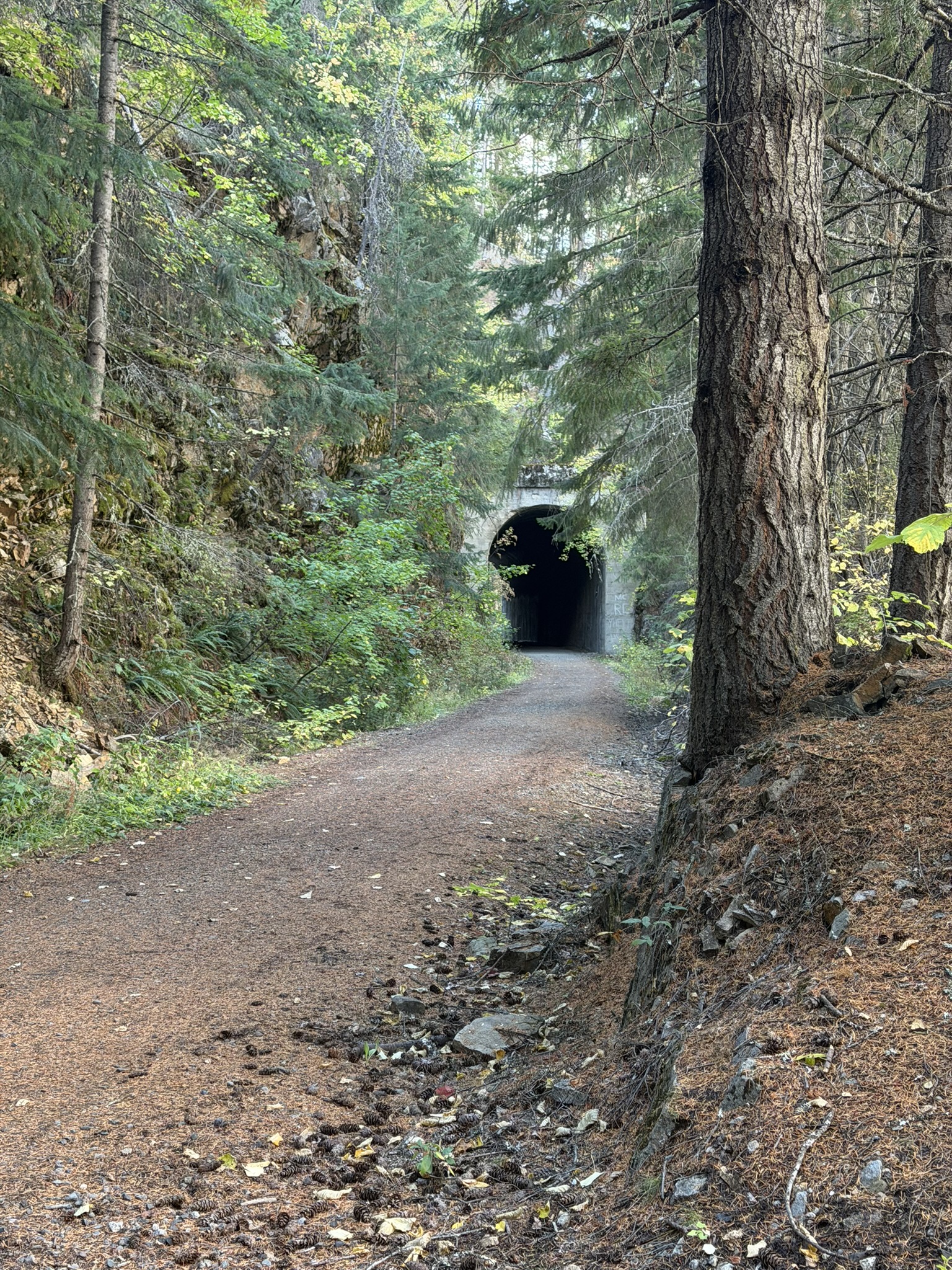
By late afternoon it became clear that it was going to be a long day. We would be lucky to finish by 7pm. Just about then it began to mist, and we donned our rain jackets and better gloves or mitts for the dropping temps. It soon became serious business to reach the finish, and between the diminishing light and our focus on the destination we took no more pictures! After passing Cabin Creek, where Erik trains on his cross-country skis, I recognized Keechelus Lake. The trail there is groomed for skiing in the winter, and I’d skied that stretch a few years back. The best part was that we were nearing our destination at the end of the lake.

Our final two miles were the off-trail. On the elevation graph of our route, it appeared to be almost straight up as we rode up the frontage road to the ski motel. But cycling on real pavement turned out to be a breeze! We powered up that road in the pitch dark, thankful for the wide shoulders and Erik’s powerful headlamp. Despite temps in the 30s that numbed our hands and feet, I was a hot sweaty mess by the time the Summit Inn sign loomed out of the darkness. We cheered and eagerly dismounted at 7:20pm! Quick hot showers and dinner at the restaurant across the street were welcome comforts before we both crashed for the night.
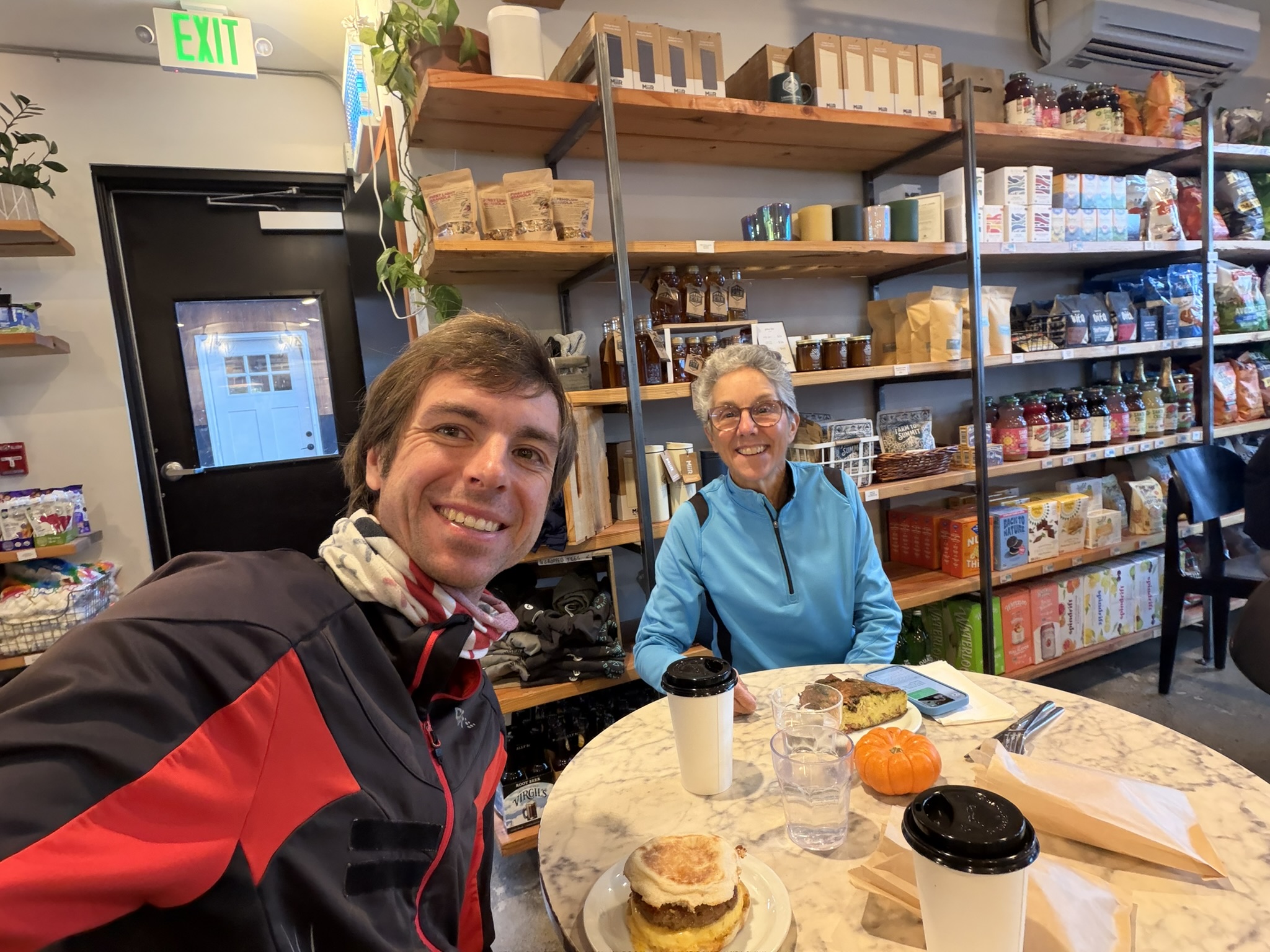
Day two dawned foggy and 33 degrees at the pass. We lingered over a delicious marketplace breakfast to let it clear, then froze as we whizzed down the road back to the trail.
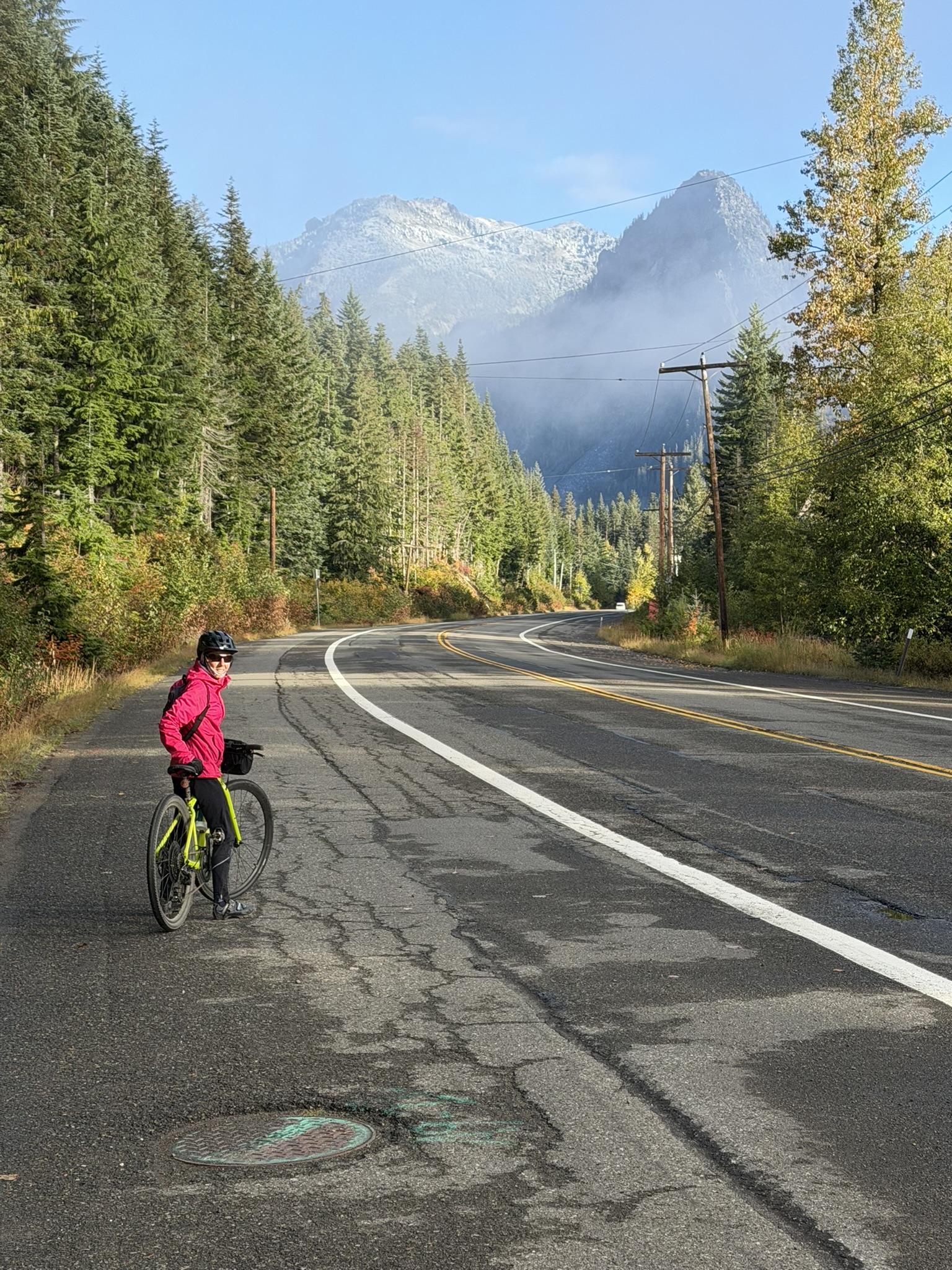
Once back on the PtoC, we came to the famed 2-mile long unlit tunnel. It was eerie to cycle through the darkness for that distance, but we were very surprised to be able to see the “light at the end of the tunnel” from almost the beginning!
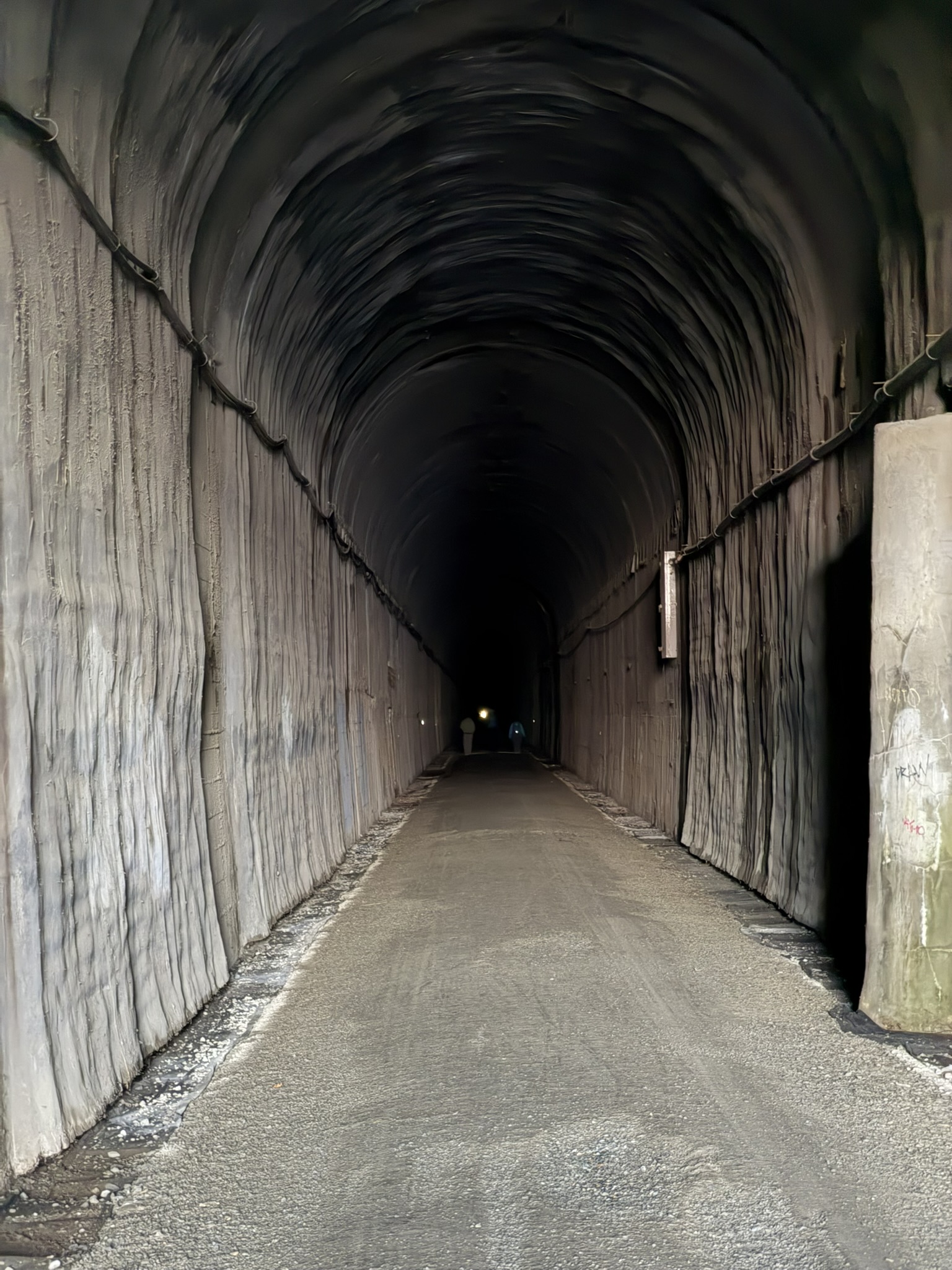
Out the other side, we quickly learned that it was a much more popular section of trail. While we’d seen only a handful of other cyclists and hikers the day before, we found numerous people on the trail including some rock climbers immediately adjacent to the trail. The scenery held more mountain views, and perhaps due to its traffic the trail surface seemed smoother. Going downhill meant we weren’t generating as much heat, so we remained bundled up for the duration. But it had its advantages too, our bodies appreciating the reprieve after the long miles the day before! And knowing we had a shorter distance, we were able to relax and enjoy our surroundings.
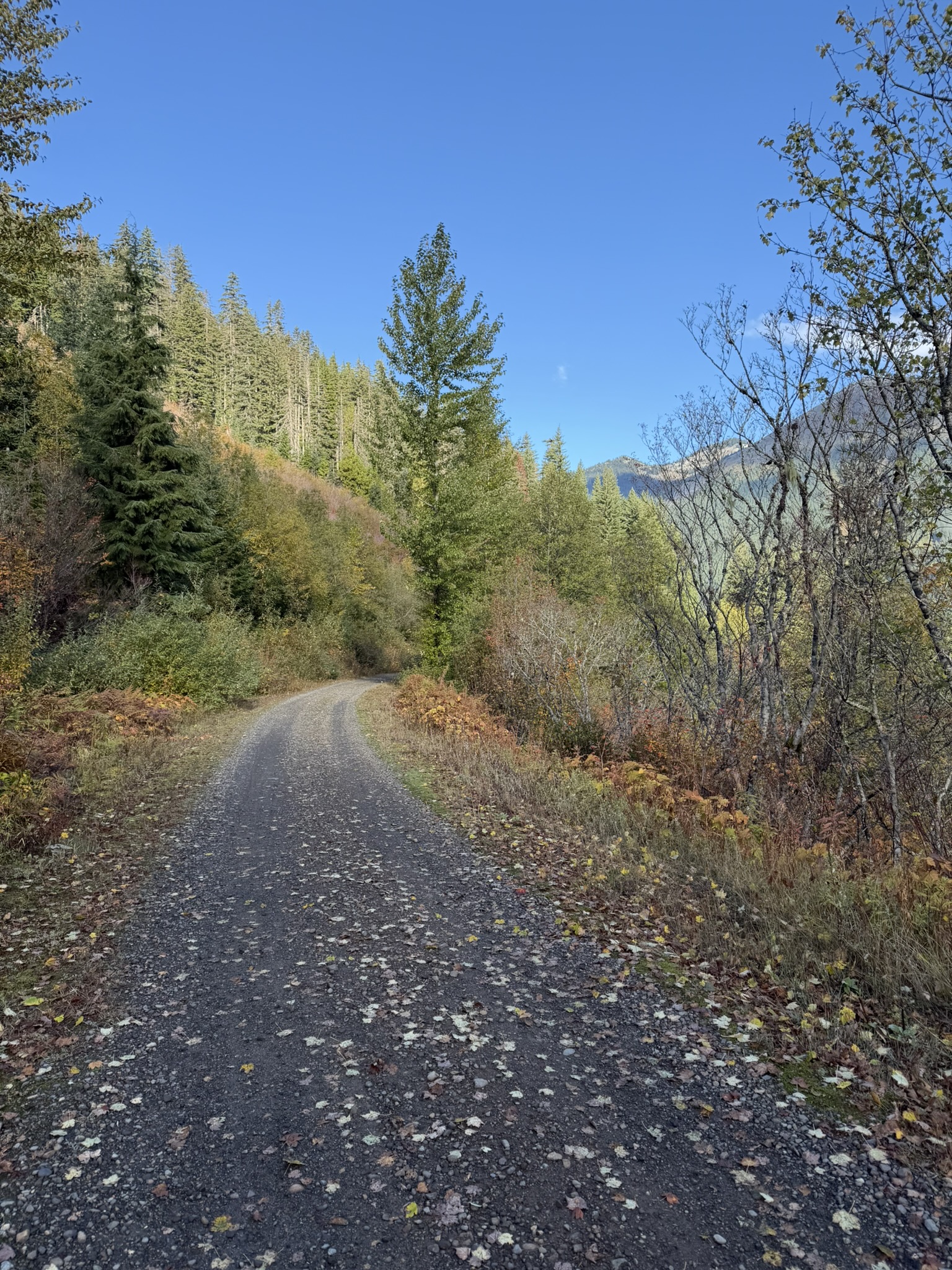
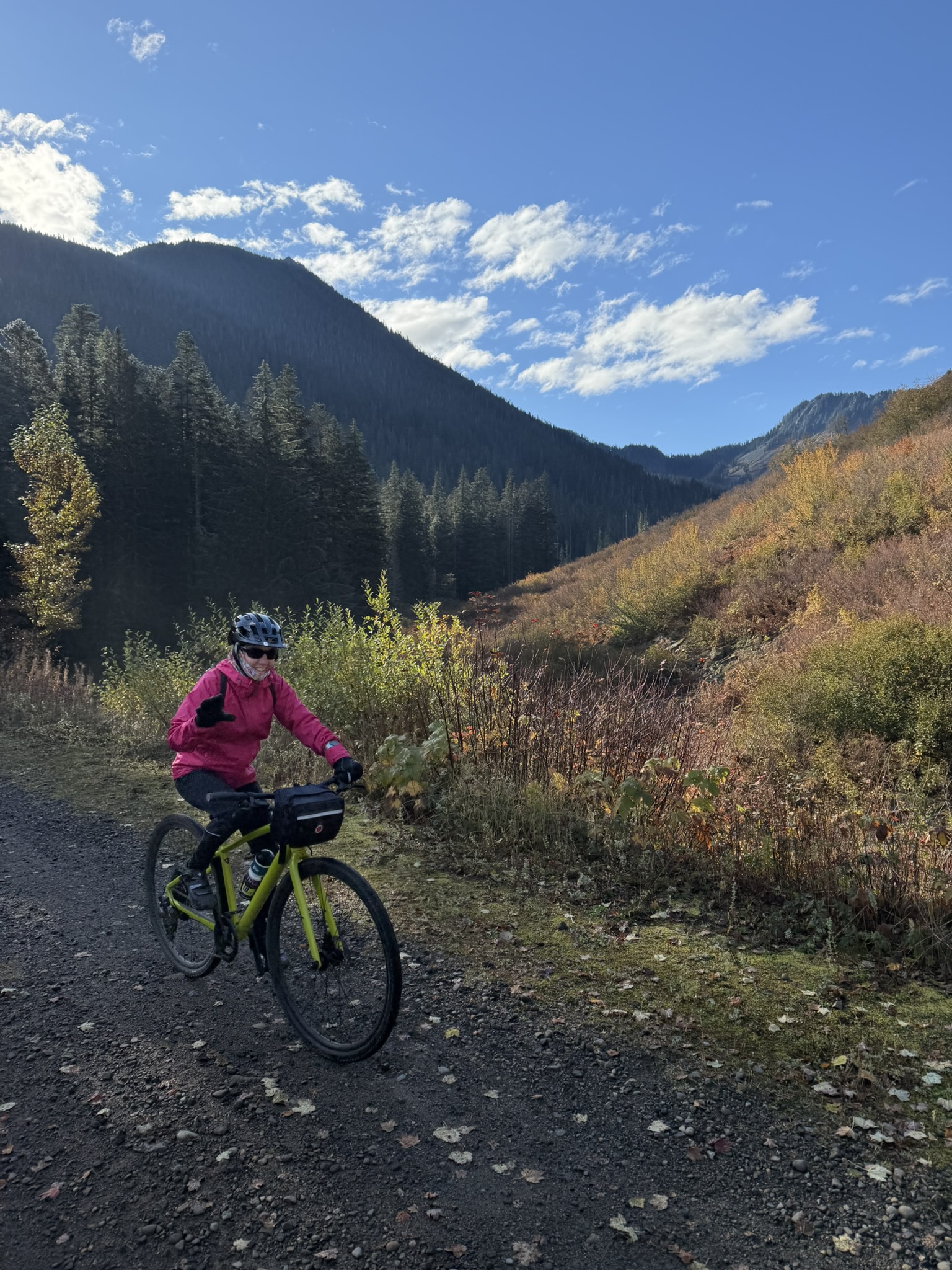
We came to a detour where the land had completely collapsed, caving in the trail. It was hard to see how they were ever going to be able to fix it, and some enterprising biking clubs had chipped in funds and labor to build a narrow side detour through the woods in order to reopen that section of trail.
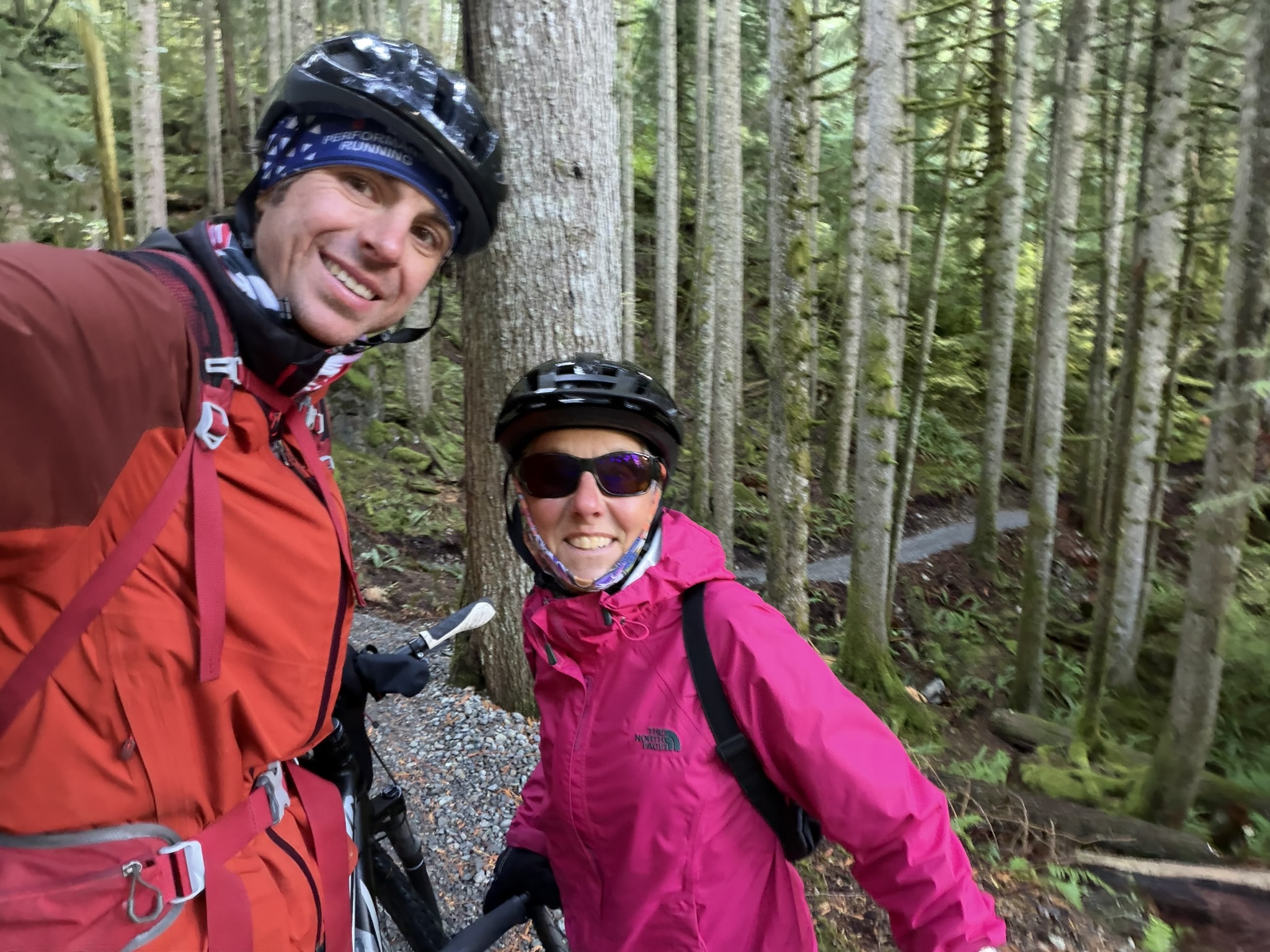
Reaching Rattlesnake Lake we felt like we were on home ground. It was just over six miles from Erik’s house, and we’d both done training runs up to the lake or beyond and back again. Those final familiar miles whizzed by and we were soon back in Erik’s driveway – our trip complete!
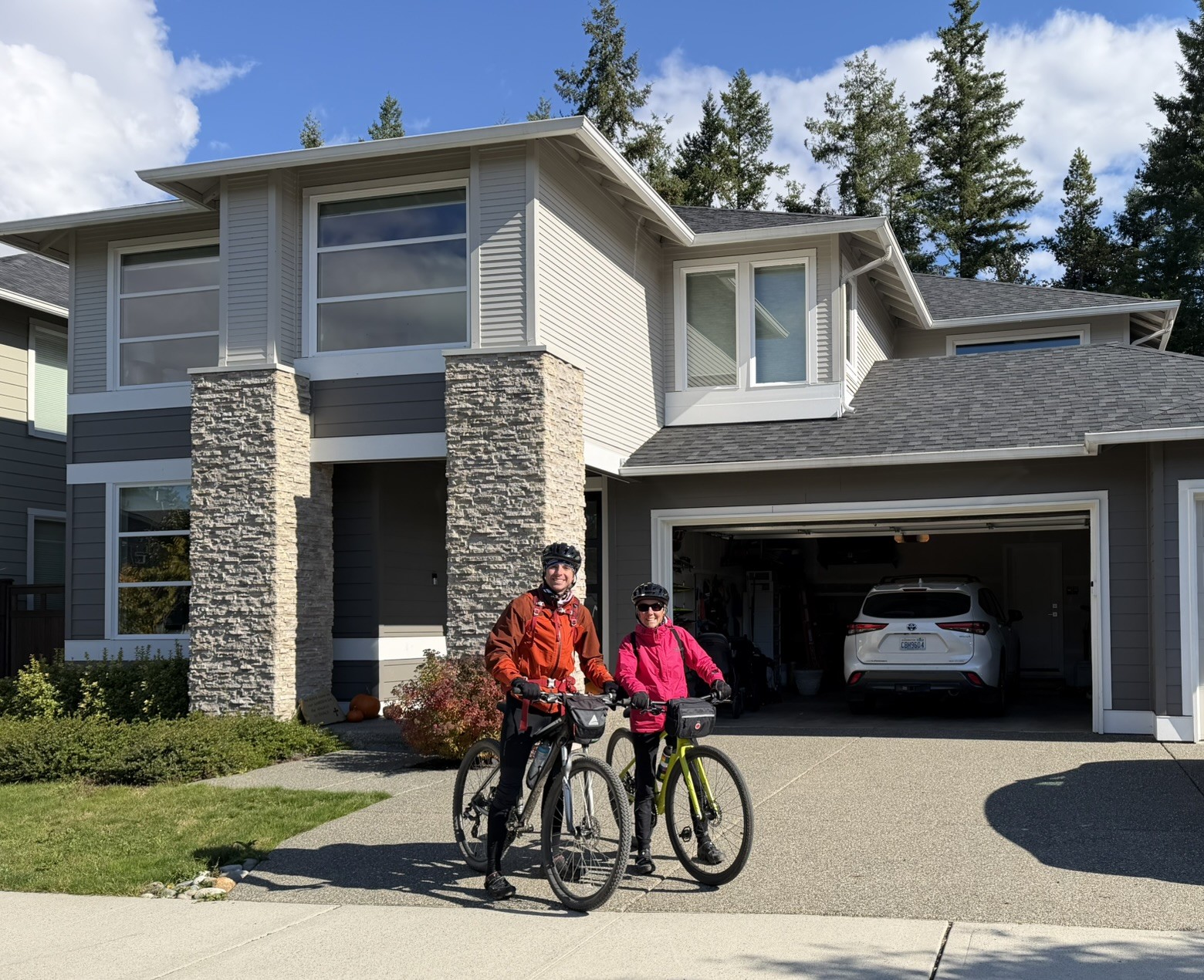
With another successful mother/son bike trip on the books, we’ve already begun scheming a destination for next year’s ride. The times we have spent together on our bikes have been so precious and memorable for me, I’m forever grateful to be able to still be out there doing it, and for Erik’s willingness to make it happen. I’m one lucky mom!
The Gifts of Mallard Island

I wake up to the sound of thunder, and lightning flashes illuminate the house.  It is strangely exhilarating, music of the night that accentuates my remote surroundings. After the heat of the day, all the windows are open, bringing nature inside.  When next I wake, it sounds like a big fan, but instead is the wind and waves bouncing off the shore. I can hear it on all sides, being on a point nearly surrounded by the lake.

I am on Mallard Island in Rainy Lake, a unique haven once owned by Ernest Oberholtzer, a trained landscape architect who dedicated his life to wilderness preservation and took particular interest in the indigenous peoples, their culture and traditions.  He first summered on the island in the 1920s and over time oversaw the construction of buildings that he designed to be in tune with the natural environment using native materials.  The result is an eclectic collection of buildings that blend into the landscape, feature outdoor spaces to sit overlooking the lake, and are lined with shelves for his extensive collection of books.  Ober, as he came to be known, established a charitable trust, the Ernest C. Oberholtzer Foundation in 1965 which has governed use of the island since his death in 1977.  Its mission is “to foster Ober’s legacy and North Woods island home as a source of inspiration, renewal, and connection to Indigenous Peoples, kindred spirits, and the natural world. Gi-bezhig-oomin”

Today the foundation hosts week-long retreat opportunities on the island for two months during the summer, some led by the foundation, others open to applications from groups seeking time to live simply and pursue interests in keeping with this mission.  A writing friend invited a group of 9 women she believed would be interested in this unique wilderness experience to rejuvenate and foster their creativity, and I was lucky to be included.  So here I am!

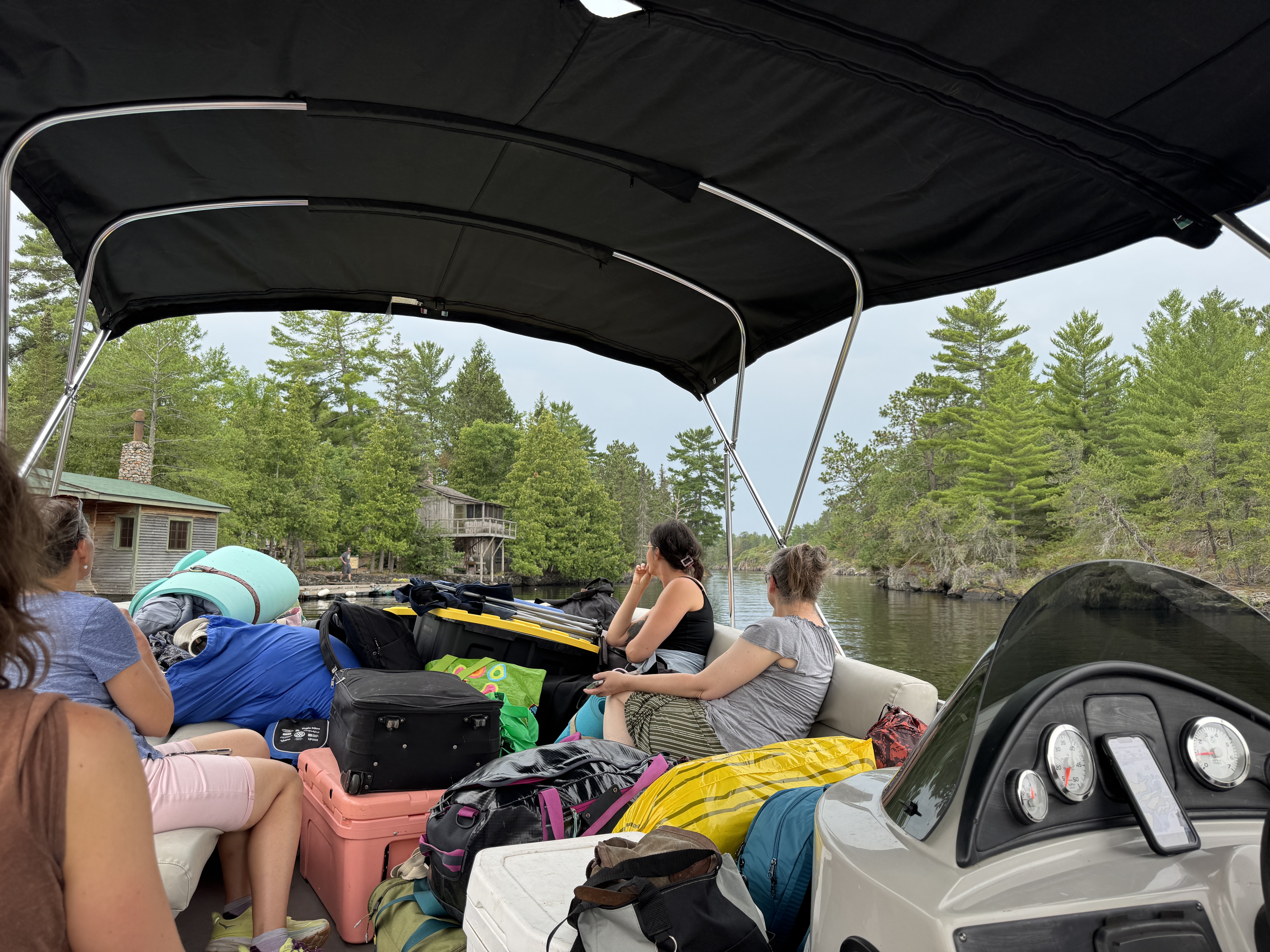
Although I knew the basics of what this week entailed, I really wondered just what I was getting into!  I only knew three other participants, the rest I met as we carpooled or boarded the pontoon that delivered us and all our gear to the island.  Upon our arrival, the two caretakers walked us around the ¼-mile long island to see all its buildings and find our assigned homes for the week, while filling in details about the place, how to live in this space, and practical advice.  I was immediately grateful for these knowledgeable volunteers who would spend the week with us.

Approaching Mallard Island
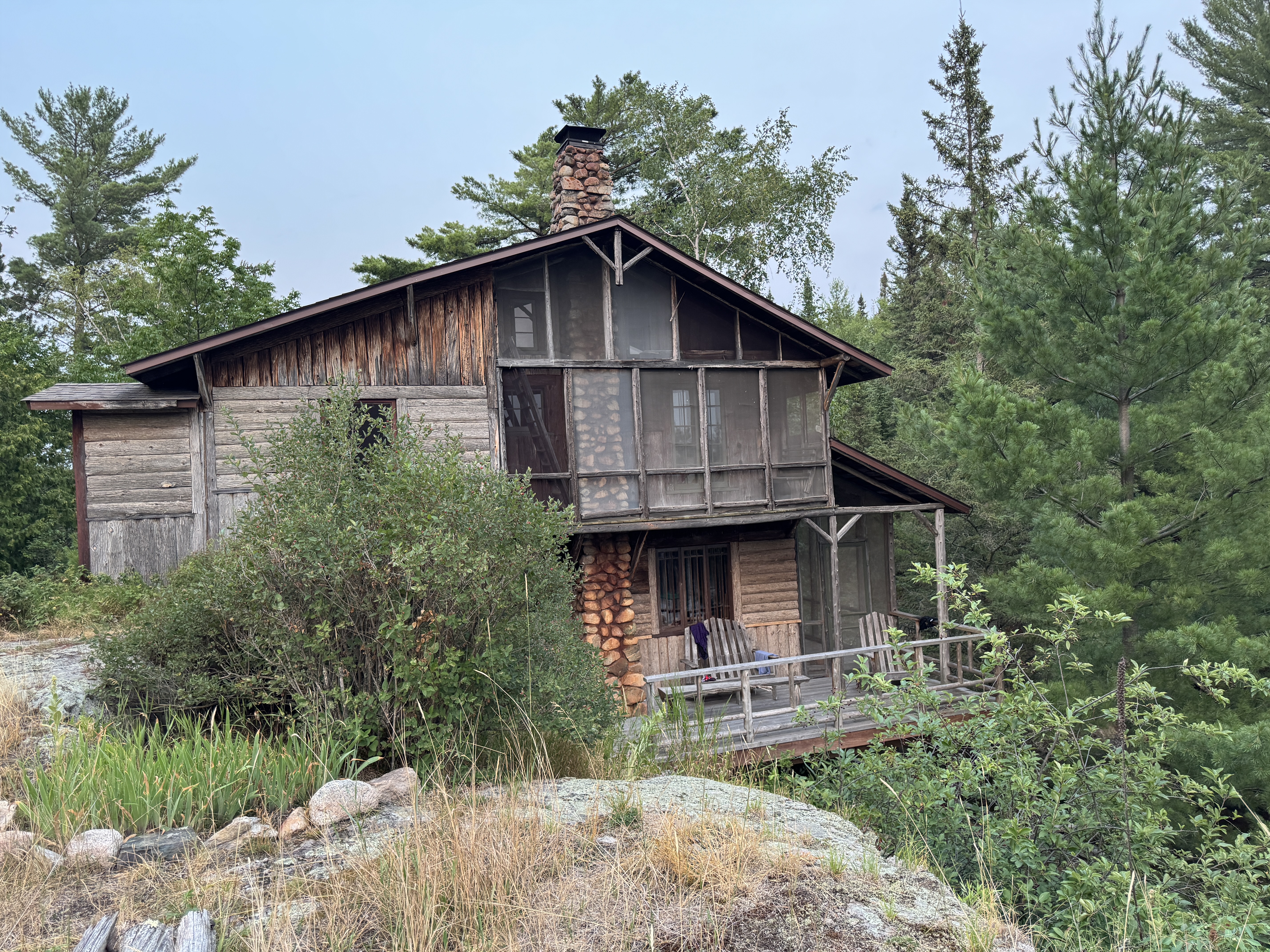
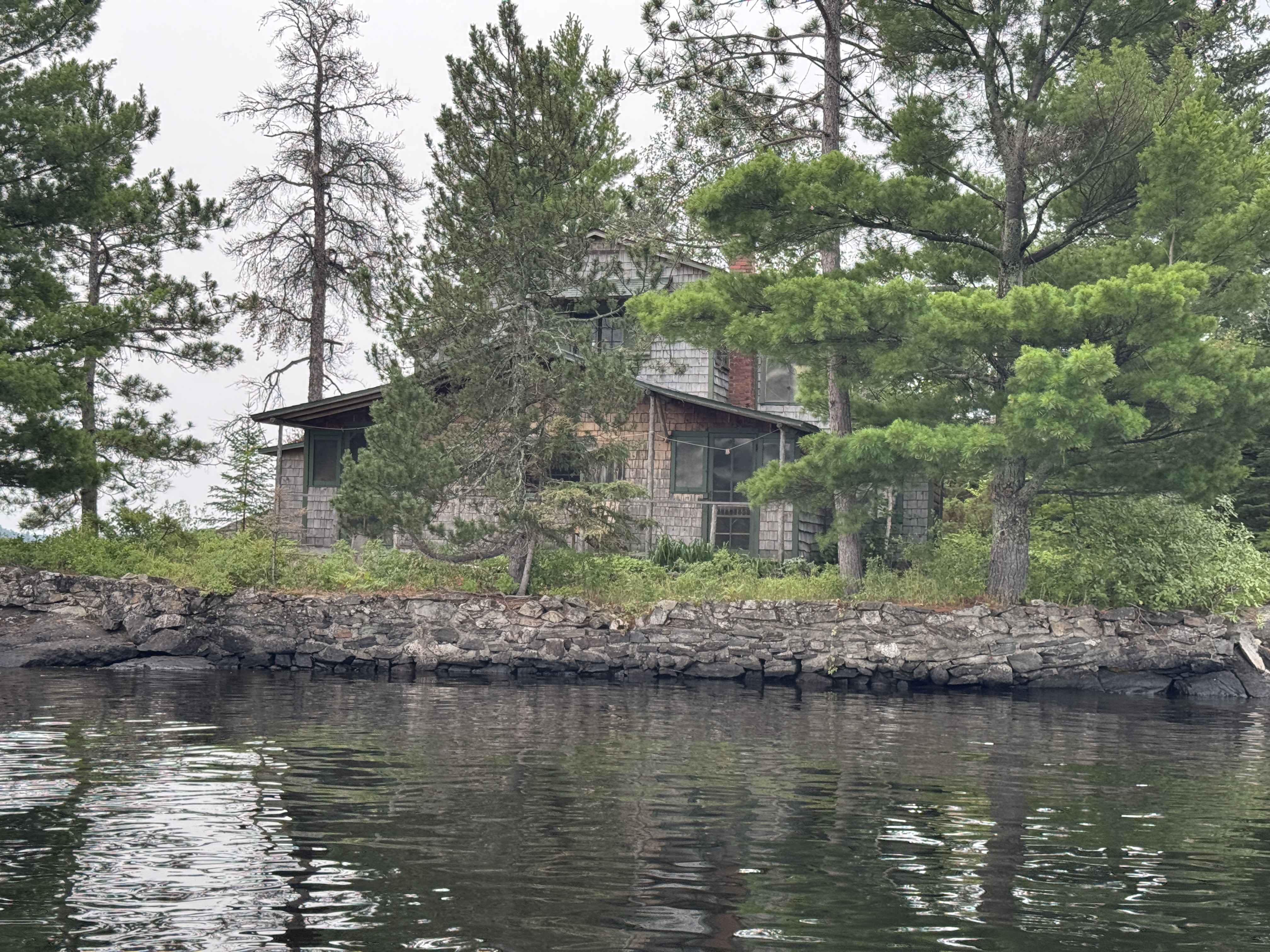
My first view of Front House where I will stay
Bird House – bottom level document storage, top 2 levels living spaces
Ober’s Big House
Japanese House – available for meditation, writing or other use

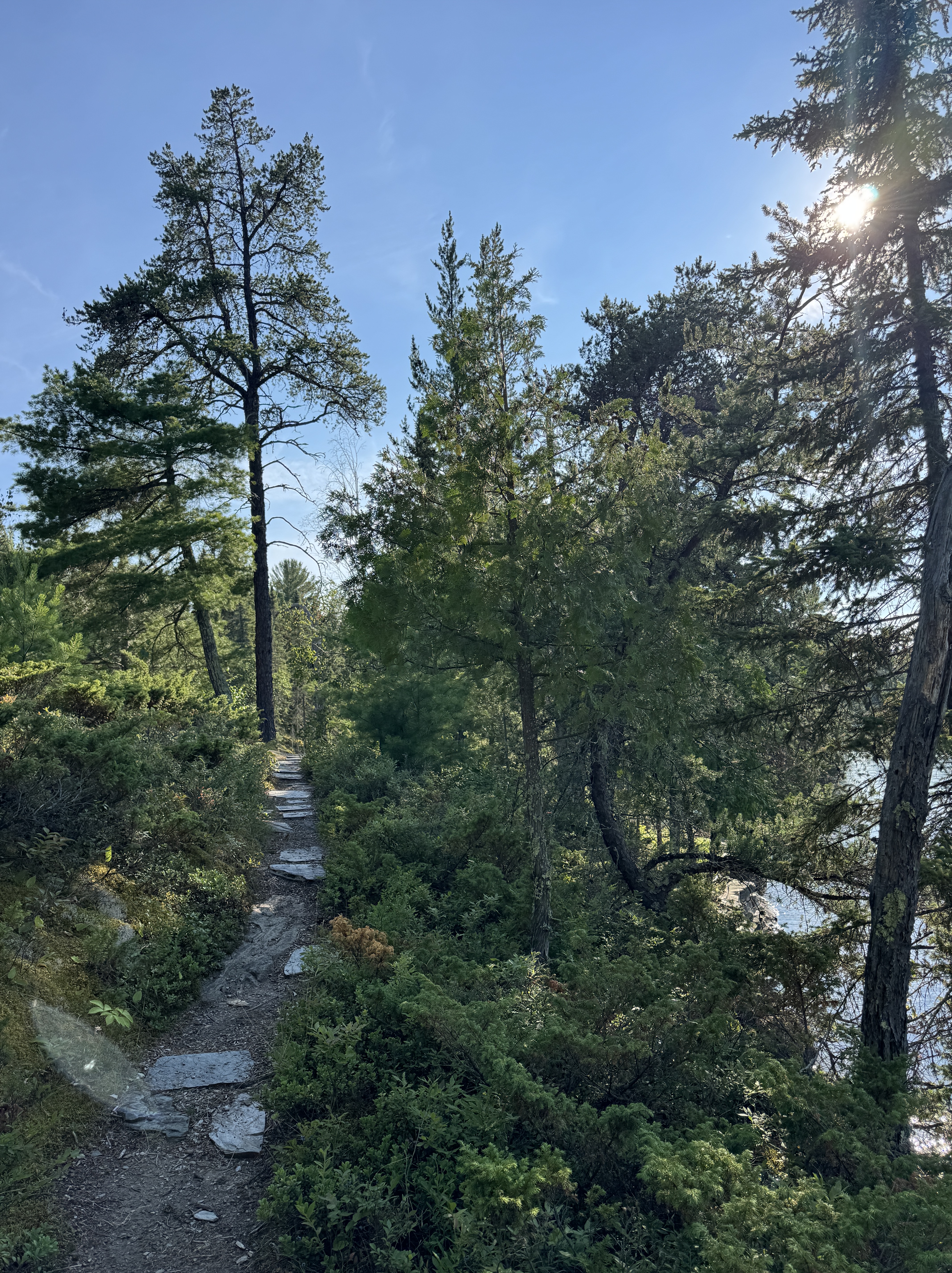
For someone as active as I am, I was apprehensive about how I would survive a week limited to the paths that wove from one end to the other on this island!  But I took it as a sign that I needed to let go, to let the island dictate my days, and live in the moment.  I would soon learn that it was going to be the island’s gift to me.

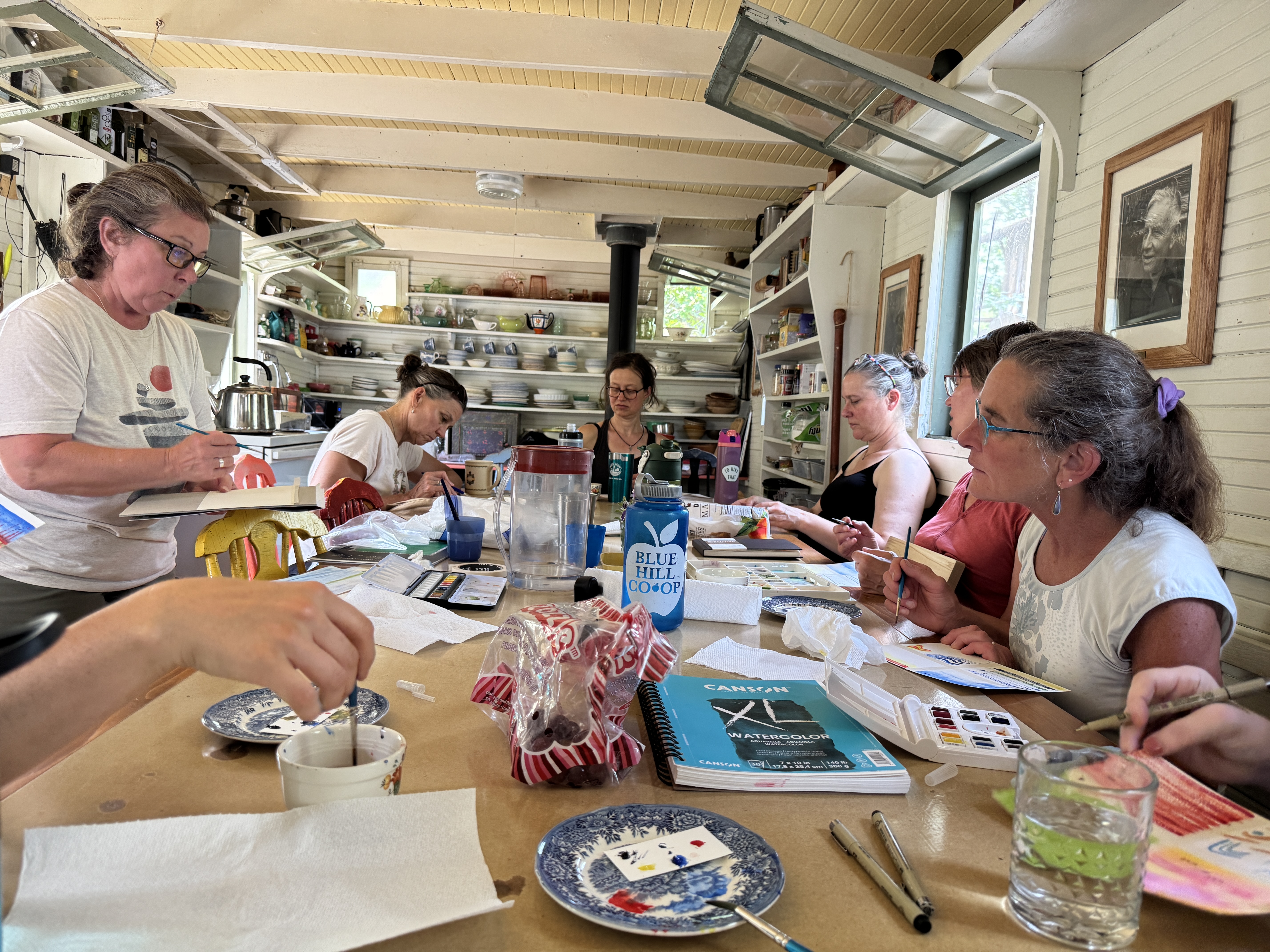
The idea of this week was to pursue our own creative interests.  To have the time and freedom to indulge in them as we saw fit – or not, if just rejuvenating our spirit was what we needed.  We represented a range of crafts, including writing, drawing, watercolors, nature, movement, needlework, and paper arts.  The longer we were there, the more I learned about the talents hidden within our group.  Each afternoon, we took turns sharing our passions – purely optional, of course, but despite my initial reservations about presenting, I found it very satisfying, bonding over our creativity and learning to look at the world in new ways.

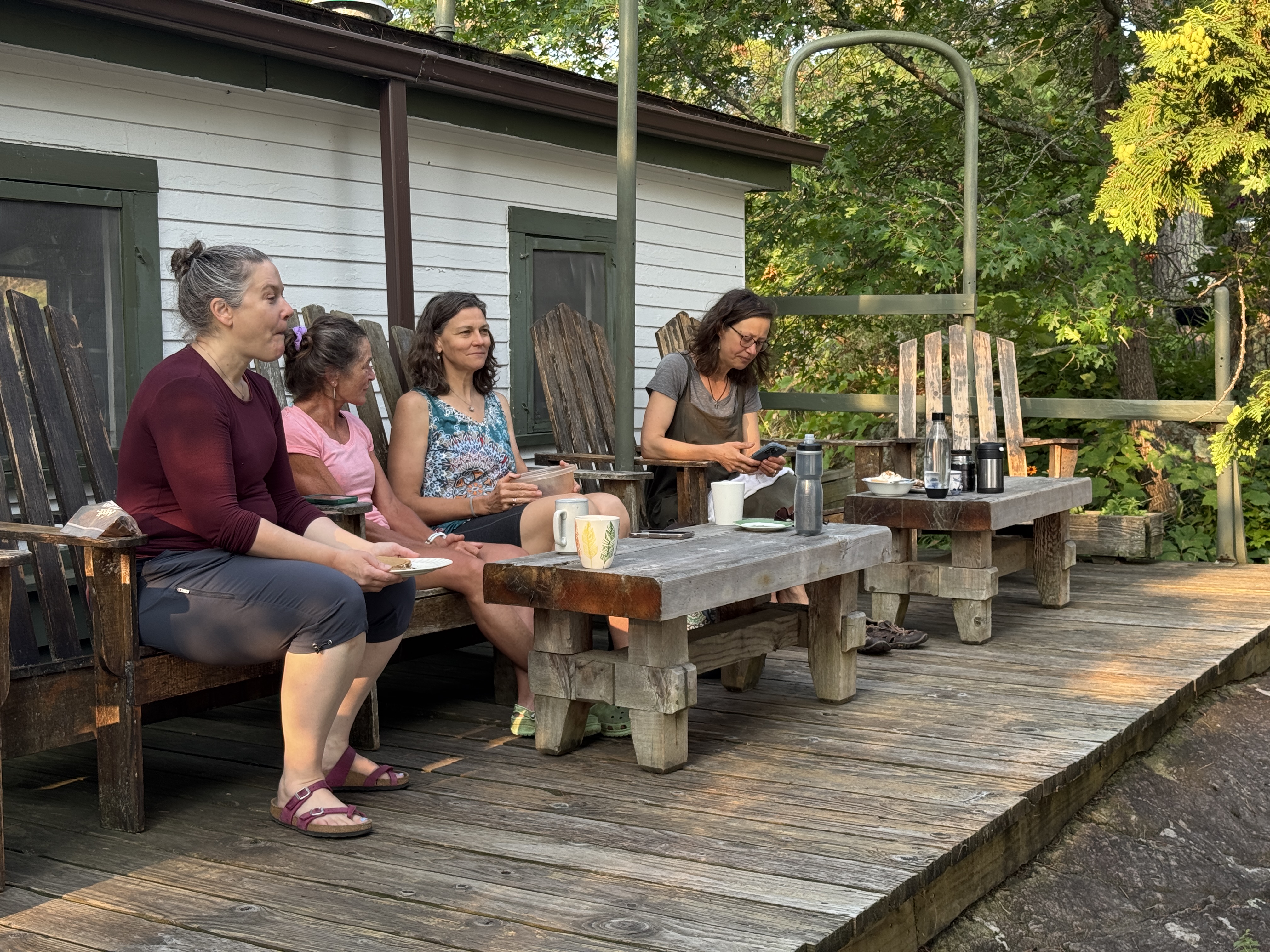
The only other routine in our days was dinner time.  The Wannigan is an old cooking barge that originally served as a floating kitchen that followed the log booms.  Relocated onshore, it is a well-outfitted kitchen with a long narrow table that seats up to 12 diners. The caretakers prepared dinner for us that first night, as is the custom, and we took turns cooking in pairs for the remaining dinners.  Breakfast and lunch were on our own, to prepare and eat when we pleased.  At any time, it was common to find spontaneous groupings sitting in the Adirondack chairs on the deck out front, chatting over coffee, lunch or just because.

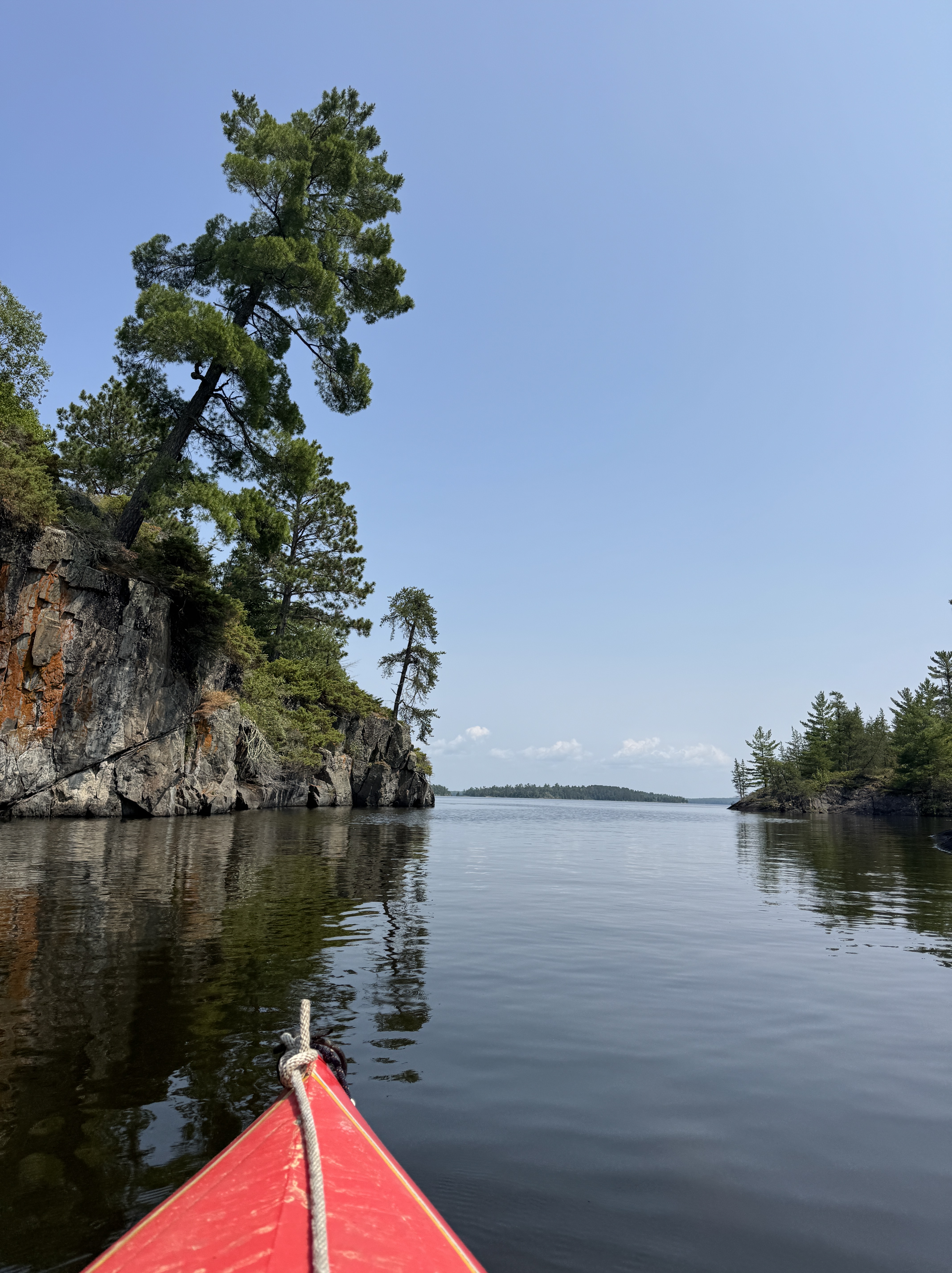
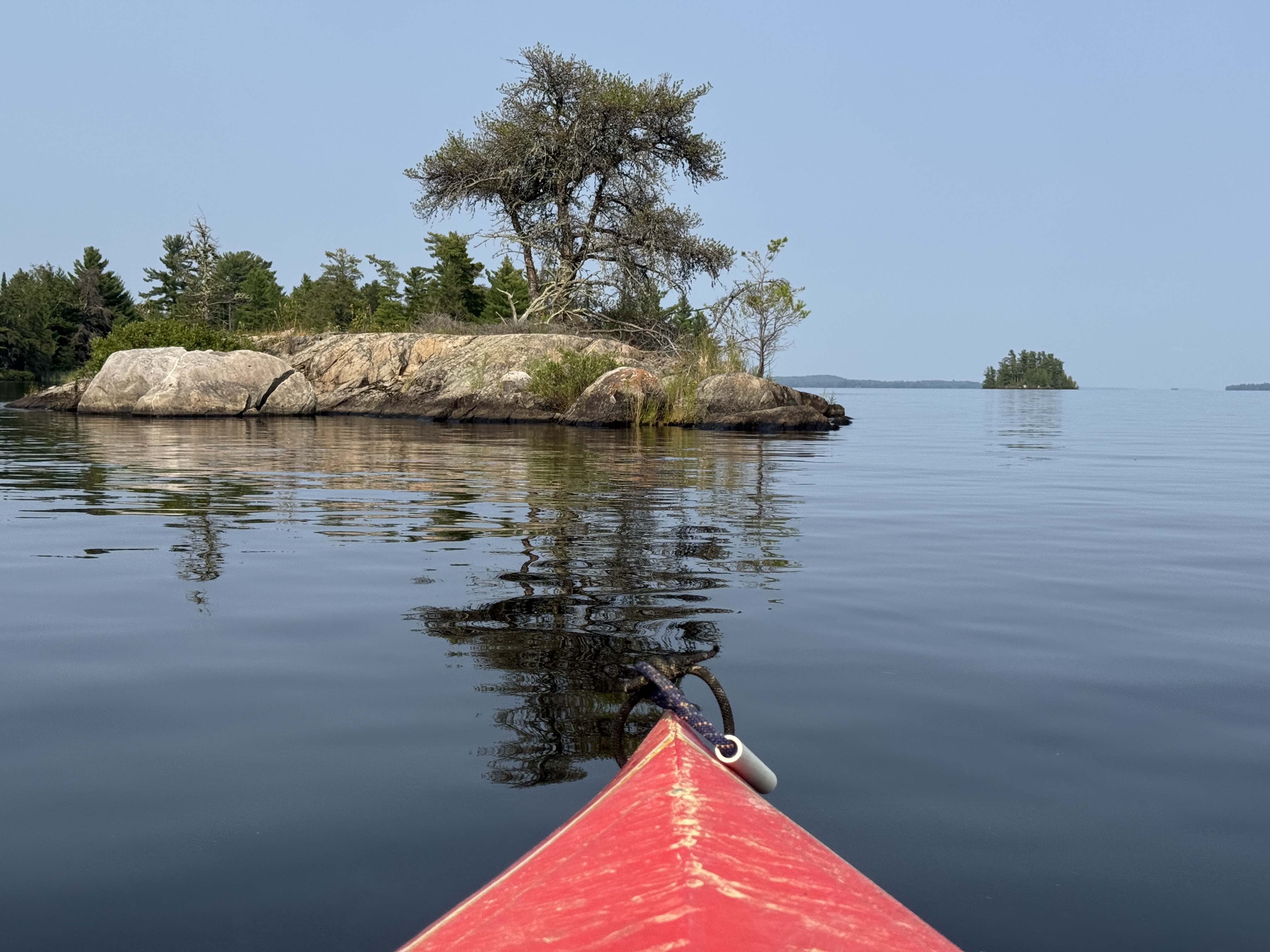
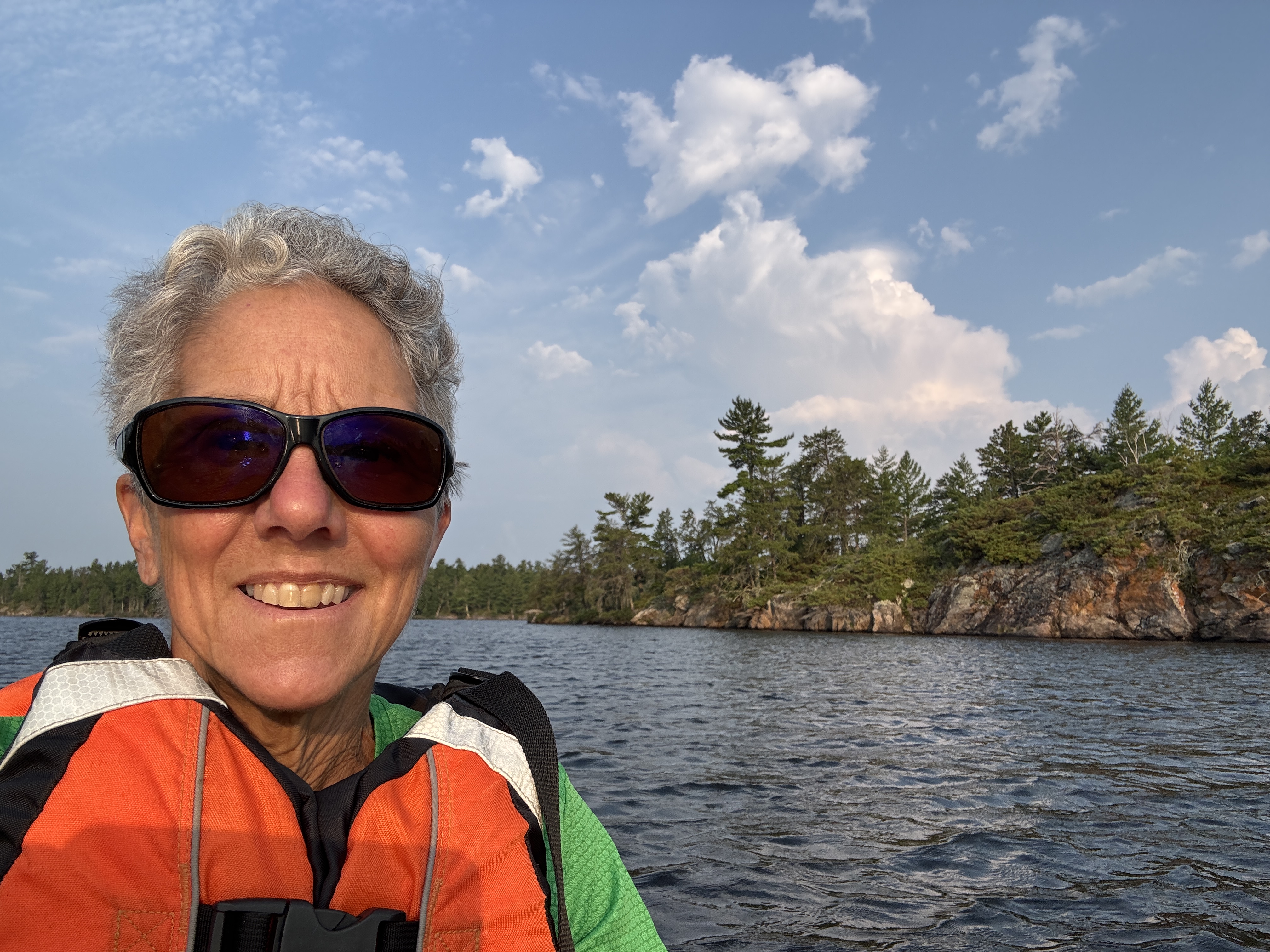
It’s no surprise that I was drawn to the kayaks resting on the dock.  Nurturing a shred of my active tendencies, I was up early the first morning and out on the water to explore the islands.  Mallard Island is part of the Review Islands, with four long slim islands owned by the foundation, tightly packed with narrow channels between, sheltering one another from the big lake. The fifth island across the ends is owned by an author.  I made my way around and between them all, attempting to get my bearings and drinking in the peace and quiet.  It was only the first of many forays on the water, gradually exploring further afield yet always respecting the vast expanse of the lake and its open waters.  It fulfilled my need to “do something” while giving me space, solitude and beauty in keeping with the week’s intent.

We had five full days on the island, basically a blank slate.  It wasn’t long before I discovered that I was comfortable going to bed without a plan for the next day.  I’d see what it brings, what I’m moved to do when I get up.  Very out of character for me, but so liberating!  It was hard to feel rushed on the island.  All activities were optional and our mantra was “there is no late.” 

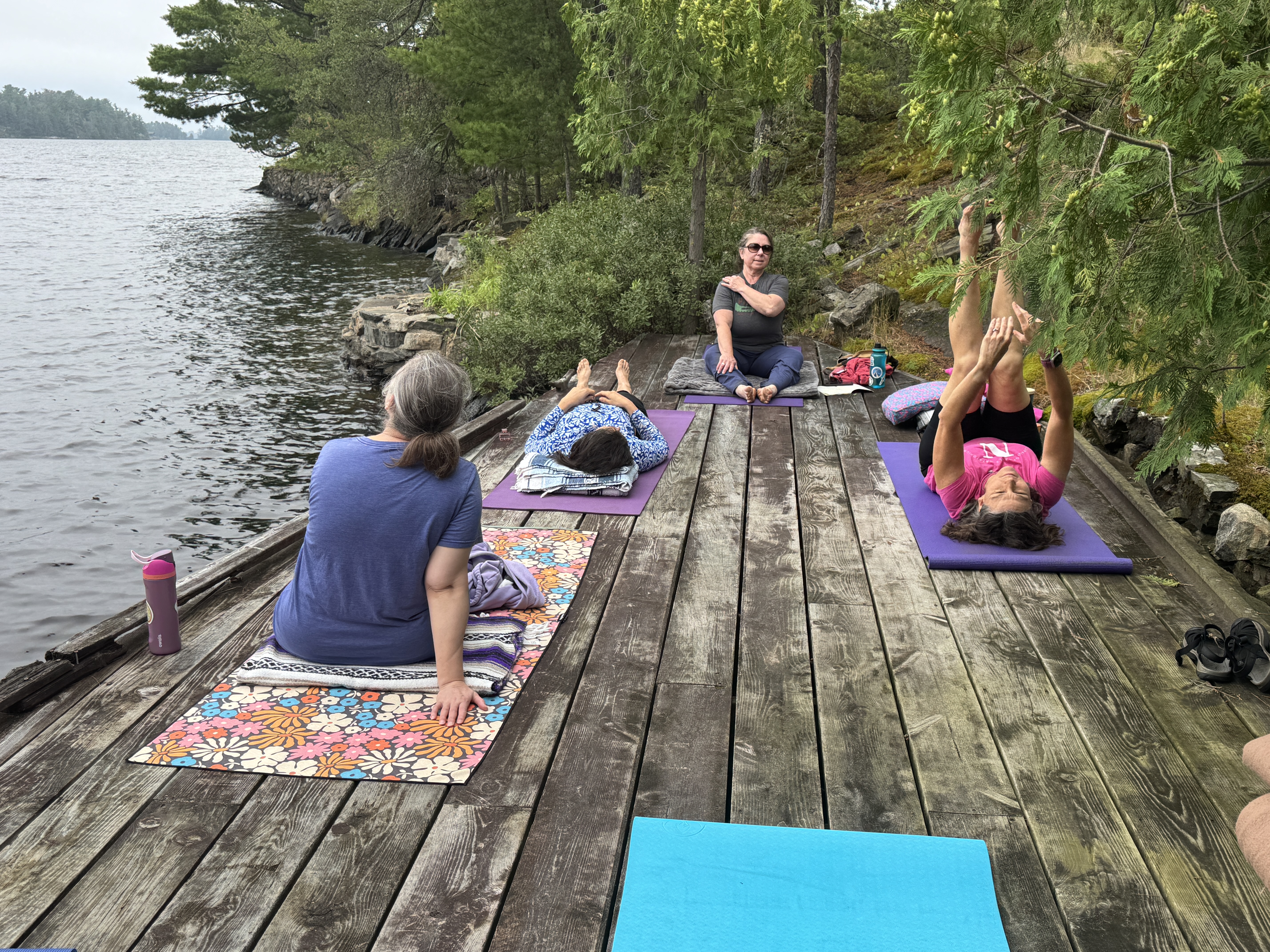
One option I immediately embraced was the opportunity to join others for yoga or movement sessions on the dock mid-morning each day.  There were no pretzel poses or requirements, only the calming guidance to “do what feels good to you.”  How I welcomed loosening and stretching my surgery-scared body, feeling it relax under the influence, becoming at ease with the process.  Mother duck and ducklings would swim by, loons called and wind stirred the leaves of the trees, a perfect accompaniment to our movements.

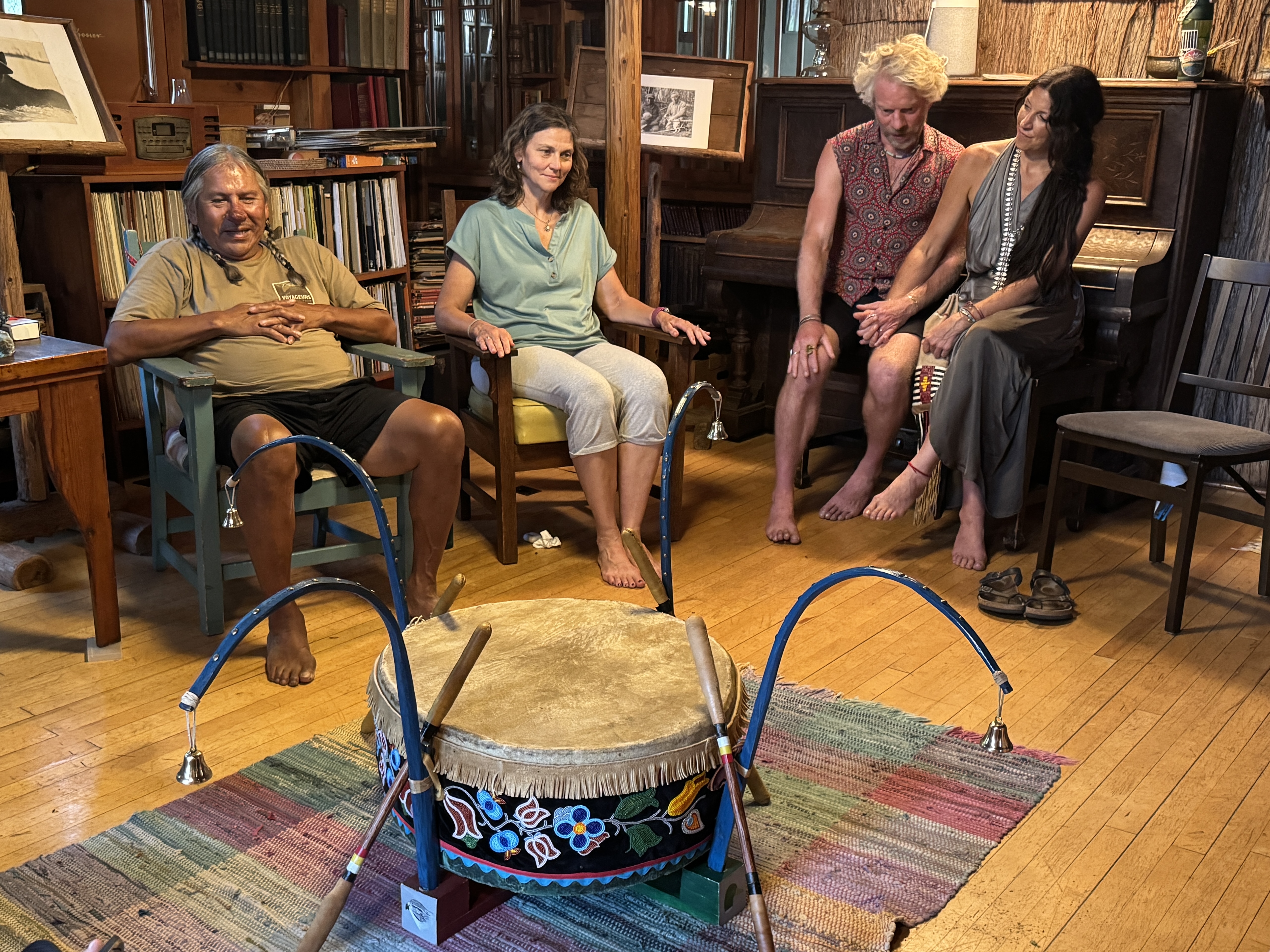
Ober’s strong attachment to the Anishinaabe people continues to this day.  Pebaam, a tribal elder related to those in Ober’s time, is a frequent visitor to the island, and freely shares his tribal roots.  He made his way to our dinner table several times, sharing his humor, captivating us with his experiences.  I couldn’t help but respect his native wisdom reflected in the deeply lined features on his face, and gray braids that rested over his shoulders.  When he invited us to participate in a Drum Ceremony, we eagerly accepted.

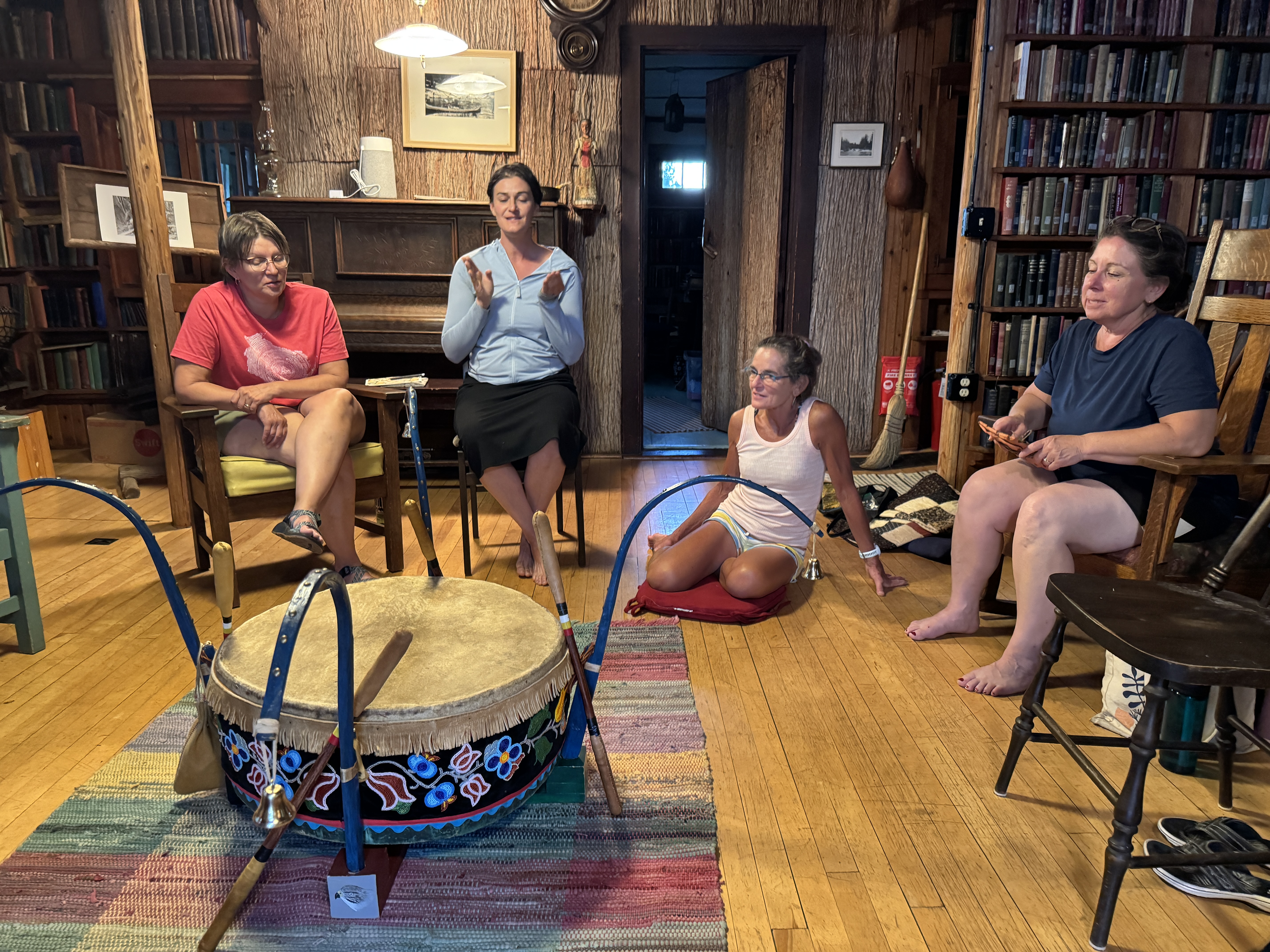
Gathering in the Drum Room of Ober’s Big House, he led us through the ritual of setting up Mother Drum, handed around tobacco to hold in one hand, and gave each of us a turn drumming during the incantations.  Along the way, he explained the significance and meaning behind it all. It was a sacred and spiritual experience that touched us all, with reverence for the Anishinaabe ways.  Yet another gift from the island.

I came with only the vague idea that I would pursue my writing and try to reinvigorate my skills in drawing and watercolors.  The island is rich in writing spots.  Each house includes one or more nooks with a desk in front of windows, benches and chairs in hidden spots provide el fresco privacy, and screen porches are fair game.  We have electricity throughout the buildings, rendering laptop use possible, despite the absence of wifi.  Early on I settled into a desk in our house to start this blog post.  I managed a few paragraphs, but it felt forced.  I couldn’t get into the flow.  Another day I toted my laptop in a backpack in search of a spot to try again, but the weight felt burdensome.  The technology didn’t fit.  I never opened it again.

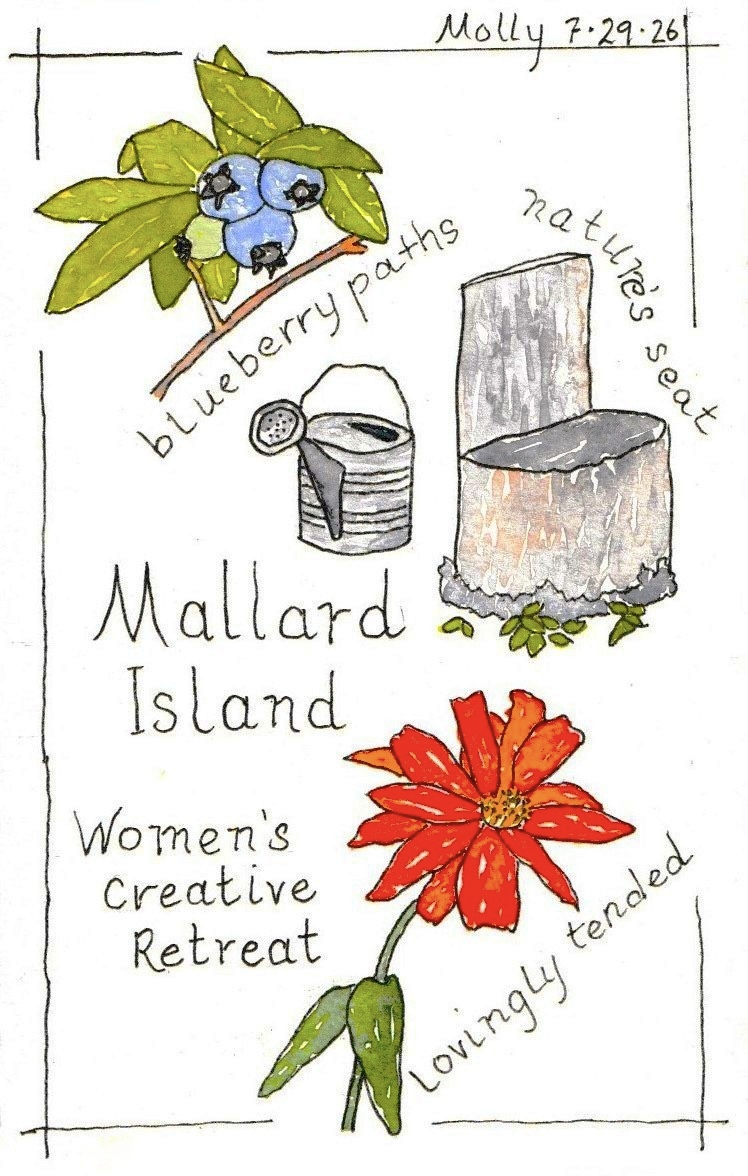
Instead, I took out my pencil and paints.  After several years’ neglect, I was nervous.  But I forged ahead, drawing a small collection of symbols that represented the island to me, pursuing the journal-style art I’d learned.  Over the next couple days in various locales I inked the drawings, painted them (the most intimidating part!), added the words and frame.  It was a triumph, just to be able to complete it, and better yet to yearn to do more. The magic of the island.

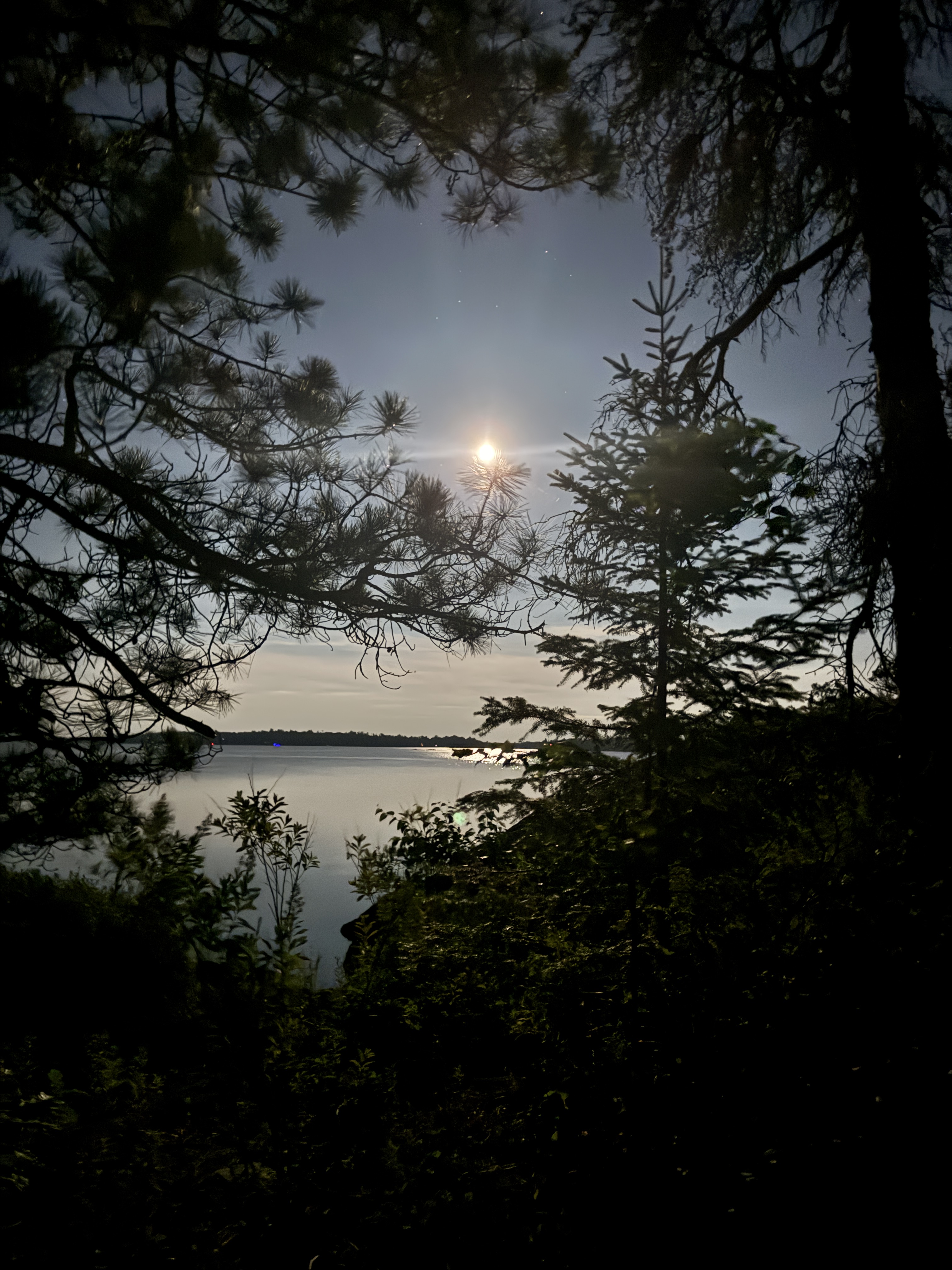
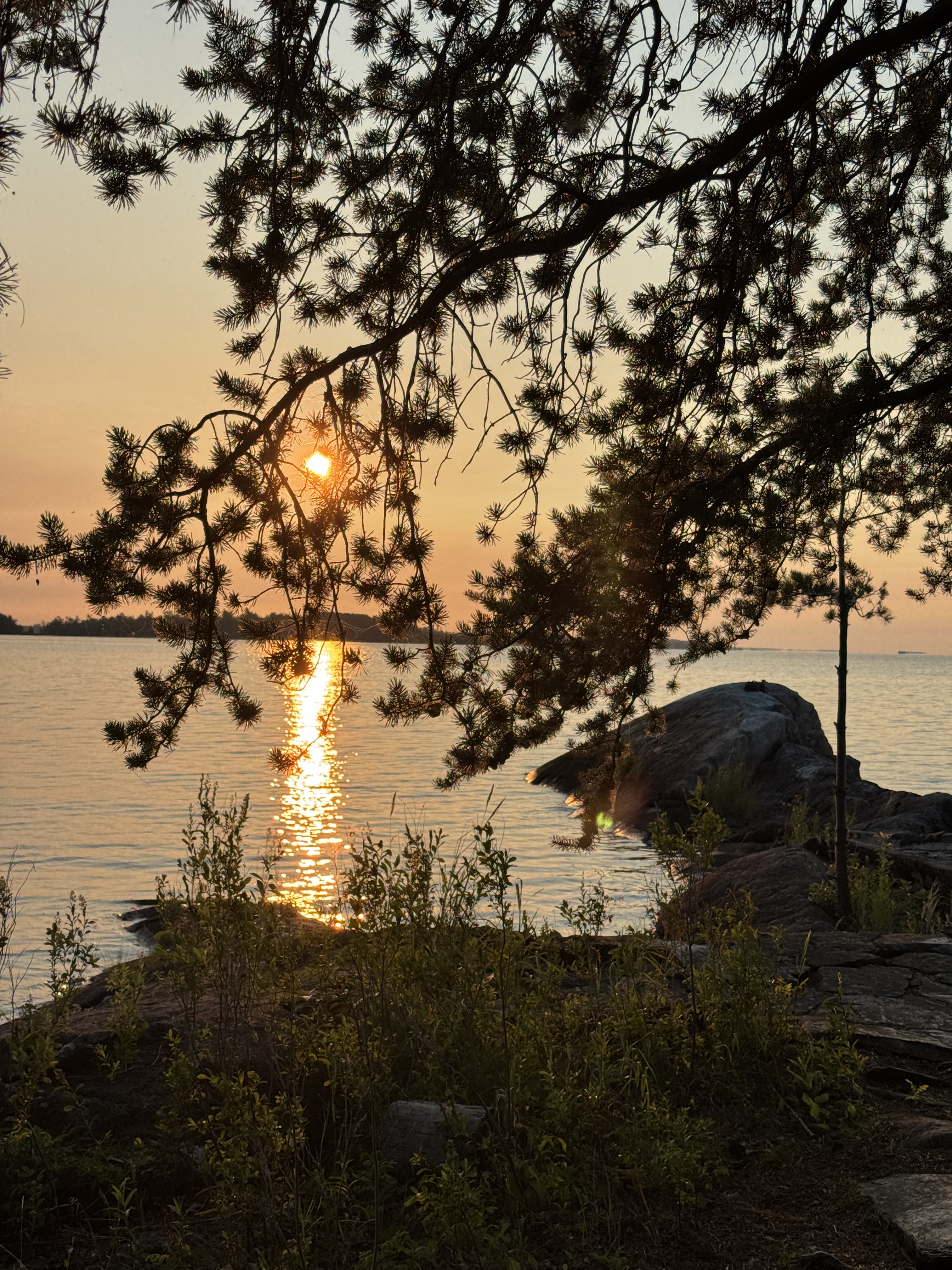
At the center of it all, was the simplicity of life here.  While there is a water filtration system, we had no running water which meant toting water for drinking and washing up.  There were three composting privies on the island, and fortunately one was directly behind our house.  I made regular visits there in the middle of the night, reveling in the glow of the moon, feeling the still-warm air caress my skin, savoring the stillness.  Some mornings it got me up for the sunrise.

Our weather was incredibly hot most days, and the water super calm – not the tumultuous Rainy Lake I’ve usually known.  In the sheltered passageways between the islands, we all swam frequently, cooling off in the refreshing water often multiple times a day.  Surprisingly, I found no need to use the solar shower, and only washed my hair with a pitcher of water in the woods once.  How easily we adapted!

Best of all, was detaching from life off-island.  I had good cell service, and admit to reading texts and emails sporadically, but never answered any of them and made no phone calls. I admit to posting my paddling excursions on Strava, but that was my limit.  I was answerable only to myself, accountable to no one.  It was a unique and freeing feeling, fostered by the island.

On the flip side, the camaraderie, support, and friendships we established organically throughout the week sustained us.  We gained insights into one another’s lives gradually, drew inspiration from others’ strengths and honesty, learned and formulated new ideas from their example.  For nine people who were mostly strangers at the beginning, we formed a cohesive and caring community by the end.

For our final evening, we saved one craft presentation that helped embody our week’s experiences, and provided us with a written gift to remember it all at a future date.  For our closing, we reversed the order of setting up Mother Drum, respectfully putting her away.  One more time we went around the circle and spontaneously shared what this week meant to us.  At the completion, a silence fell on the room, sustained and meaningful.  The hush a contented closure.  A thank you and farewell to Mallard Island.

Puffins in Abundance

Today is the day Rich has been waiting for all year!  He turned 70 this spring, and we each get to plan a trip of our choice on our decade birthdays.  We are in Iceland for a week, traveling the Ring Road and taking in all its beauty.  But the whole reason for coming is to see puffins.  His ultimate destination was the Hafnarholmi preserve, home of the nesting grounds for thousands of Atlantic puffins every summer.

The drive to get there took us up and over mountain ridges with vistas of green hillsides flanked by lava peaks pocked with snow, twisting and winding around switchbacks and ultimately reaching the sea.  That only added to the magic as we anticipated our destination.

The area has long been home to nesting puffins, and thanks to local farmers who donated their land to BirdLife Iceland, a safe viewing area has been constructed to watch these wonderful birds.  We got there early in the morning, some of the first to arrive.  The preserve is on a peninsula beyond the harbor, where wooden stairs and boardwalks enable visitors to get up close to the puffins. 

We started by mounting a tall staircase up the high outcropping of land, and as soon as we turned the corner, there they were!  Right next to us!  Puffins dotted the hillside, each patrolling the patch of land around their burrow.  Rich quickly nabbed the best spot for photography, and we stayed glued to the sight for ages. 

The birds were so entertaining!  They aren’t very good on land, waddling around, popping in and out of their burrow, flexing their wings, and finally getting up the courage to fling themselves over the edge and fly out to sea to catch fish for their young.  Watching them come back in for a landing was equally comical.

We were there at just the right time, when the birds were very active, all out on the hillside and within feet of us.  We were up close and personal to say the least!  As the morning wore on, more people arrived but it never felt crowded.  And there was a definite hush among the viewers, talking in whispers not wanting to break the spell.

While Rich the bird photographer put his camera through its paces, I snapped away with my iPhone, just as pleased to get enough photos for good memories.  And I took in more than just puffins.  I was equally enamored with the surrounding scenery.  It had turned into a stunning sunny morning, and the sea was perfectly calm.  Having been prepared for chilly, windy and wet Iceland it felt like a huge gift! 

There were several different spots for viewing and we tried them all.  Rich particularly liked the blind for its view of puffins against the blue of the sea. At long last, after over two hours of puffin watching, we were finally ready to tear ourselves away. But Rich found one more spot at the bottom where he could catch puffins up top preparing for flight against the deep blue sky.

I knew the day was truly a success when Rich said it far exceeded his expectations. And given all the hype, distance traveled and anticipation, that meant a lot! Especially for a 70-year-old who has seen and photographed his share of birds. Which you can find in abundance, including these puffins on his website. Believe me, his photos are far better than mine!

By the way, I turned 70 last year and spent my week with a good friend from England on a Greek island! I had so much fun, I never got around to blogging about it.

Heavenly Sleep

Have you ever thought about your bed? What it means to have one? Or like me, do you take for granted the soft mattress, warm covers and comfy pillow? And even more importantly being off the floor? Just think what it would be like to sleep on the floor night after night. That discomfort would permeate your life. So how would it feel to be a kid in that situation? Lacking not only the comfort but the safety of having their own bed.

That might never have crossed my mind, if it were not for my long-time high school friend, Julie. Last year she and her husband, Craig, learned about Sleep in Heavenly Peace (SHP), a nationwide non-profit organization that builds and delivers beds to local children who need them. It’s easy to think that it’s not a problem in our community. But the truth is that the estimated need in Duluth is 2,400 beds. They dove right in and started a new chapter in Duluth, the only one of 5 chapters in Minnesota north of the Twin Cities.

As a bit of background, SHP was started in 2012 when Luke Mickelson and his family built a bed for a family who needed it. That grew into a national movement to ensure that “No Kid Sleeps on the Floor in Our Town.” There are now over 450 local chapters that build and deliver beds for their own community. Their second mission is to build community by hosting volunteer opportunities to build the beds.

I began hearing about this from Julie, when we baked our annual candy cane cookies, when we got our East High gals together for breakfast, whenever I saw her, actually. I might never have joined the cause had it not been for technology. Befuddled by the computer systems they were required to use, Julie began coming to me with questions. Then she asked if I’d be their IT consultant. From there it wasn’t a big leap to join the Core Team. There I learned that the biggest reward was not solving their technical issues, but joining in the real cause. Building beds to get children off the floor.

Last week we did a “Build” with First Lutheran Church volunteers. It was my first introduction to the full experience, from set-up to clean-up. Our SHP chapter provides all the lumber, tools, supplies, work tables and other materials, which we laid out in workstations in their parking lot. When the 30+ volunteers recruited by the church arrived, Julie held a short training session then they split up into teams to begin the sanding, drilling, stapling, pounding, and assembly work, with core team members overseeing each station. Soon it sounded like a busy beehive as the sanders buzzed, background music to the other tasks.

I was amazed at how quicky these volunteers learned their jobs and jumped into the work. There was something for everyone to do. Supervised youth assembled the slats or threaded washers on large screws. More experienced folks manned the drill press. Everyone else pitched in wherever there was a need.

As components moved down the line, we began stockpiling side rails, headboards, safety rails and slats. Then more fun began. The main parts required staining in custom-made troughs. I filled in at that station, donning the heavy rubber apron and gloves needed for the messy task, and soon found my rhythm lifting, dunking and wiping.

The final touch was branding the headboards with an SHP logo. The youth especially liked this part, taking the red-hot branding iron from the fire and burning in the logo.

In just over three hours, components for 20 beds were completed by this amazing crew!

But it doesn’t stop there. Every bed is delivered complete with mattress, mattress protector, sheets, pillow and quilt – ready to be slept in right away. All at no cost to the recipient. The church held a bedding drive, sewing quilts, donating sheets and pillows and ordering mattresses. So these beds are ready for delivery.

It was a long day’s work for the team, but more rewarding and energizing than I could ever have imagined. I didn’t think I could add much to the process, but was swept along to pitch in on various tasks. And I can’t wait for the next Build, including one at my own church later this year.

So far our chapter has delivered 17 beds – quite a feat for our start-up year. I have yet to go along on a delivery, but I’m told it is a heartwarming experience. Like the teen who called from school to thank them for his new bed. The smiles on the faces tell it all. In the words of the organization’s mission, “At SHP, we fully believe that a bed is a basic need for the proper physical, emotional, and mental support that a child needs.”

Our goal for this year is to build and deliver 80 beds. We find kids through social workers, schools, churches, first responders, or anyone who hears of a child who needs a bed. Any adult can apply for a bed for a child on our website if they meet these criteria: Ages 3-17, lives in our delivery area, does not have a bed. All applications are fully vetted then assigned to a delivery team. And before long, another child has a bed to call their own, a spot to snuggle and sleep, trade secrets with a best friend, or lie down and read a good book.

Funny how opportunities find us and enrich our lives. In this case I not only got drawn in to assist in a good cause, but now work with a team of amazing folks I’d never met before. Julie and I have regained the close relationship we had all through Jr and Sr High, along with our fellow Girl Scout friend, Sue. So many rewards.

There are so many ways to get involved. We are so thankful for all the grants we have received, and for donations made on our website. There are many ways to volunteer, including participating in public Builds. Bedding items can be purchased from our Amazon Wishlist, and sent to us directly with no tax or shipping. Wondering if there is a chapter in your area? Check this list. Have questions for us? Email us at mn-duluth@shpbeds.org. You never know, you might run into an old high school buddy!

Meet my new friends

I’ve been spending a lot of time with my friends in Quebec recently. I’ve gotten to know them intimately, see them grow and change, and learn all about their little village of Three Pines. I am deeply attuned to the sound of their voices, their inflections, the nuances of their lives, the troubles they face, and their successes. I love the diversity of the townspeople, embracing their quirky character traits, the bonds of friendship they share, and how they care for one another.

And yet it’s all a work of fiction. Literally. These are the characters in Louise Penney‘s mystery series featuring Chief Inspector Gamache, delivered to me via my ear buds as I go about my day. They accompany me on walks, make long drives more interesting, keep me company while sewing (yes, Grammy Jammies!), and provide entertainment while I prepare dinner. With 20 books in the series (soon to be 21) it feels like an endless bounty.

It started with the first book in the series, Still Life. Back in 2015 I read it for my book club. I keep a list of books I’ve read, and short notes about them. At the time I wrote, “Easy read murder mystery about a small town in Quebec province involving a group of local artists and the nuances of small town life. It captured my interest but was not outstanding.” Oddly, the same book club read it again in 2021. I didn’t realize I’d read it before until I got into it, but as often happens I didn’t remember what was coming next so I finished it again.

It wasn’t until 2024 that I returned to Three Pines. I had adopted the habit of listening to audiobooks while I did menial tasks, and during my months of chemotherapy I indulged even more often. When stuck for a new book to listen to, I look for available audiobooks to borrow from the library on Libby. This time I found book #17 The Madness of Crowds and listened. A year later I tuned in to #18 A World of Curiosities. Still just one-off sessions. Last fall marked the beginning of my love affair with the characters who inhabit these stories.

I soon found myself specifically searching for audiobooks in the series. Instead of listening methodically from one to 20, I clung to the books nearest to those I just finished, flushing out characters as they were in that time period. I listened before and after, learning both what came before and happened after. Penny’s books each have self-contained mysteries, so they can be read independently, as I was doing. However, she does recommend reading sequentially in order to observe the character development through time.

Armand Gamache, the Chief Inspector and his second in command Inspector Jean-Guys Beauvoir naturally are prominent characters, along with Gamache’s beloved wife Reine-Marie. The remaining central cast of characters is comprised of individuals living in Three Pines, the small village in the province of Quebec, not found on any map and beyond the reach of cell towers. I laughed out loud at Ruth Zardo, the sarcastic and often profane old poet who dispenses hidden wisdom. I empathized with Clara Morrow and her lack of confidence in her ability as an artist and the worth of her paintings. I learned to trust Myrna Landers the bookseller, with her insights as a former psychologist.

The Bistro is always featured as the village meeting place as well as a favorite of Gamache. There confidences are exchanged, theories proposed, seemingly casual interviews conducted, and keen observations made. But the food is the real star. Every meal is sumptuously described, with fresh ingredients, pungent cheeses, strong coffees, fresh crusty bread or flaky pastries, and succulent casseroles – all infused with native Quebec cuisine. Even the meals served in the villagers’ homes rate as top culinary delights. How I’d love to sit at their tables!

The plots are always intriguing, never straightforward. What seems obvious is ultimately disproven with creative twists and new developments that send the story in a different direction. Just when I think it’s nearing the finish, I notice there are still several hours of narration left! Endings reveal new details and events that often lead to surprising conclusions. And to add to it all, Gamache is not infallible! But his “deep brown eyes” and kind nature will win over any listener or reader.

By this point I was solidly in the audiobook camp for this series. There was something about having someone read them to me and hearing the voices in my ears that brought them to life. And I soon fell in love with the narrator, Robert Bathurst. The resonance in his voice and his ability to distinguish each character orally led me to explore all 8 books he narrated (11-18). As it happened, the last one I listened to, book #11 The Nature of the Beast, was the first he narrated. I was fascinated by Penny’s introduction at the start of the recording that explained the difficulty of replacing the original narrator, Ralph Cosham, who had recently died. He was beloved by his listeners, and considered the “definitive voice of Armand Gamache.” She interviewed hundreds of candidates before selecting Bathurst as someone she trusted to carry on his legacy.

It was with some misgivings that I went back to the earlier books. This time I listened to them mostly in order, beginning with book #2, A Fatal Grace. I readily admit to having a hard time adjusting to the narration by Cosham. His quiet, soothing voice – often called “buttery” – puts a different flair on the characters and action, and I longed to hear Bathurst. But the more books I heard, the more I took to his style, his interpretation of Gamache, and his spin on the characters. Now that I have only a few left, I’m thoroughly under his spell. I can no longer hear Bathurst in my head. Both narrators have won top Audie awards for their performances, and now I hesitate to pick a favorite.

But I face a new challenge. The last two books in the series, #19 The Grey Wolf and #20 The Black Wolf, have yet another new narrator, Jean Brassard. As a native of Quebec, he is said to bring authentic regional accents and pronunciation to the prose. Their similar titles make these books stand apart from the others, and I wonder if Penny has changed something more than the narrator? While her other books came out at least annually, the first of these had a gap of two years. And I recently discovered that #21 Miss Wolcott’s Ghost is to be published in October. Who will narrate that?

Despite that, I rest assured that Gamache and my other old friends will continue to feature heavily in the remaining stories. I can count on their personality quirks and antics, their boundless appetites for good food, surprising elements of intrigue in the confines of their little village, and Gamache’s grace and warmth as well as his brilliant sense observation and deduction. Live on Chief Inspector Gamache, my friend.