Emptying Two Lifetimes

As long as Mom’s house was on the market, there was a semblance of continuity. It was still “her” house. While we wanted it to sell, until it did we had a reprieve. We didn’t have to deal with the contents. We didn’t have to face handling every single item in the house and determine its disposition.

Everyone knows about the stages of grief. This was about the stages of letting go. First there was the funeral. Formal, a fitting tribute, and surrounded by friends. It came so soon after death that a feeling of numbness was inevitable. Next came the task of dividing Mom’s treasures. Mom and Dad’s, really. Deciding who wanted what was congenial and healing and we knew they would be pleased that family heirlooms were staying in the family. And then the final task, clearing out the house. Sure, we had made decisions about the big pieces of furniture and major possessions but that left a lot of, well, stuff yet to be dealt with.

It was daunting. Mom and Dad were married for 51 years, and Mom lived another 17 years after Dad’s death. That’s a long time in which to accumulate things. Opening boxes, pulling out drawers, unearthing trunks, scanning shelves and peering in cupboards all revealed bits and pieces of the lives that Mom and Dad led.

It was a good reminder of who they were and what they did. It wasn’t about the later stages when heart disease and Alzheimers robbed them of their former vigor and wit. It was about the active and social lives they led. We found their classic old Schwann bicycles in the garage, which were brought to life when we unearthed a photo of them on the bikes at Canal Park. Seeing their wooden cross country skis brought back memories of family ski trips. By their later years they would ply the trails while we zoomed down the slopes. Mom’s golf clubs were a testament to all the years they spent on the golf course, and the many friendships they made in the process. The old canvas tent – I only remembers using it once. Camping wasn’t Mom’s thing. All the silver, china and crystal? A living memorial to the active and full social lives they led. Mom set a gracious table, and they entertained in style. Those pieces weren’t for show, they were used regularly. The bookshelves full of volumes of classics mixed in with modern fiction were evidence of Mom and Dad’s continuing pursuit of knowledge and active minds.

We absorbed as much as we could into our own homes. For the rest, we tried our best to find good homes for the many possessions. We preferred to gift them than sell. It just felt right.

It was a lot of work, but once we committed to the task we surprised ourselves by how quickly we finished. It felt odd, seeing the house empty, no longer filled with familiar things. No longer Mom and Dad’s home. The dining room table where we gathered so often was missing. The books on the shelves we’d peruse and borrow were gone. The bed we surrounded when Mom was slipping away from us was absent. It was just empty rooms.

We’d emptied the house of two lifetimes. Two beloved parents. Two people devoted to each other. They will live on in our memories. We don’t need a house full of possessions to preserve that love.

Canoe Route – By the Stats

Having waxed eloquent on my last two posts about this Boundary Waters canoe trip, I think it’s time to delve more into the raw details of the trip. For those of you interested in routes, logistics and statistics, this post is right up your alley.

Overview:
48.5 Total Miles
28 Portages
2,201 Rods of Portaging (6.88 Miles)
Net Elevation Change +313 ft

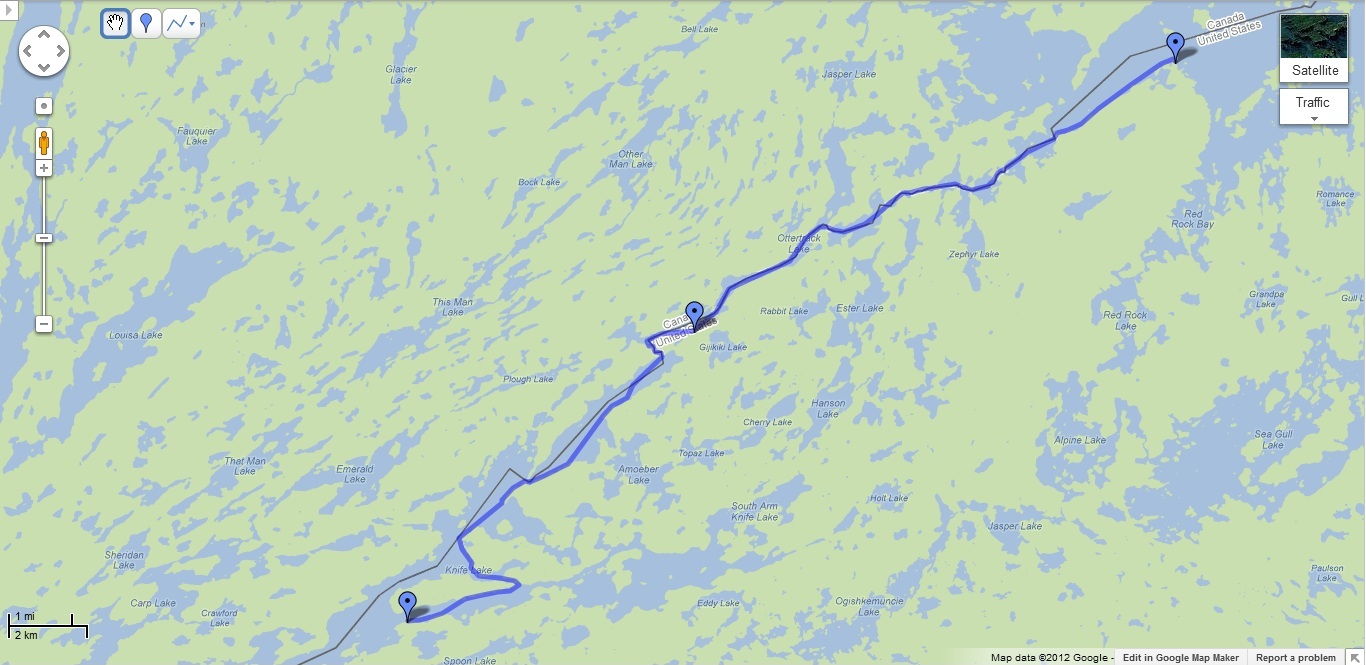
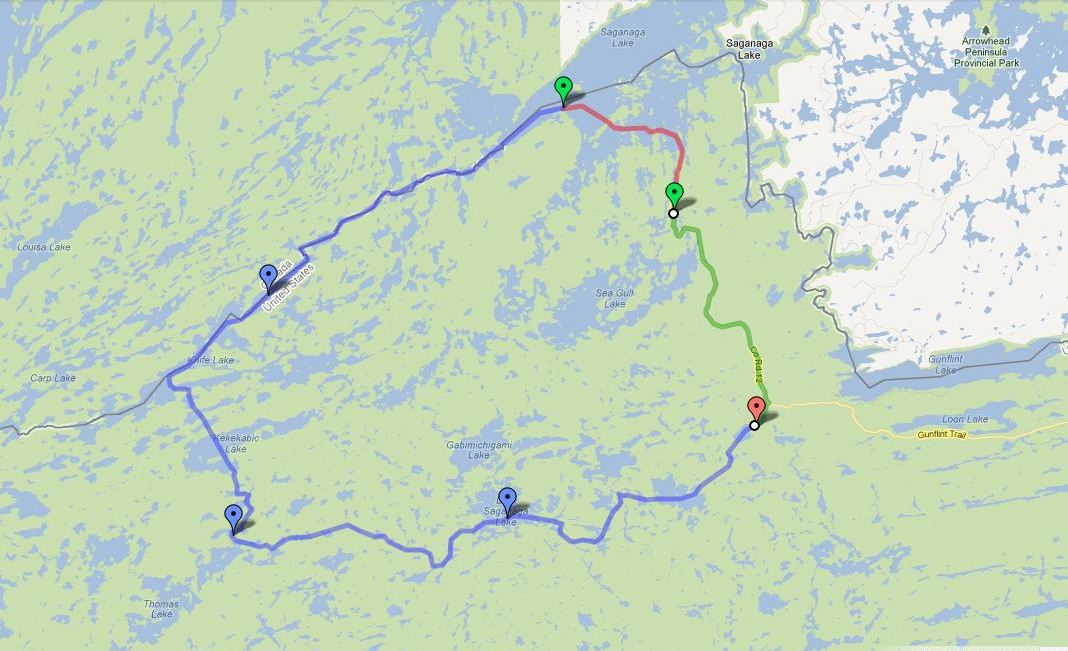
This was a four-day trip, starting with an overnight stay in a bunkhouse at Tuscarora Lodge.  After a hearty breakfast there, we took advantage of their tow to American Point on Saganaga Lake. It gave us a good head start on a huge lake, and allowed us to venture further afield.  The route took us in a circle that followed the Canadian border, then dipped south to travel through smaller lakes and head back east again to finish on Round Lake at the lodge.

Day 1:
18.1 Total Miles
4 Portages
95 Rods of Portaging (0.28 Miles)
Net Elevation Change -49 ft
Major lakes – Saganaga, Ottertrack, and Knife

This was our longest day of paddling and fewest portages. We were fortunate to have calm waters, which made for rapid progress and easy navigation through big lakes. We were on the popular border route, with Canadian shores on our right, and US soil on the left. Other canoes were common, but it was far from crowded, and there was no danger of coming up short when it came to finding an available campsite. Much of the area we traveled through was “burn zone” from earlier forest fires. Regrowth was evident and healthy, but the tall barren trunks of charred trees still towered over the new greenery. While not exactly attractive, particularly in contrast with untouched forest, it was a measure of reality and the natural forces of nature. It was fascinating to see the stark boundaries of the burn zone, leaving the mystery of why some areas burned and adjacent trees did not.

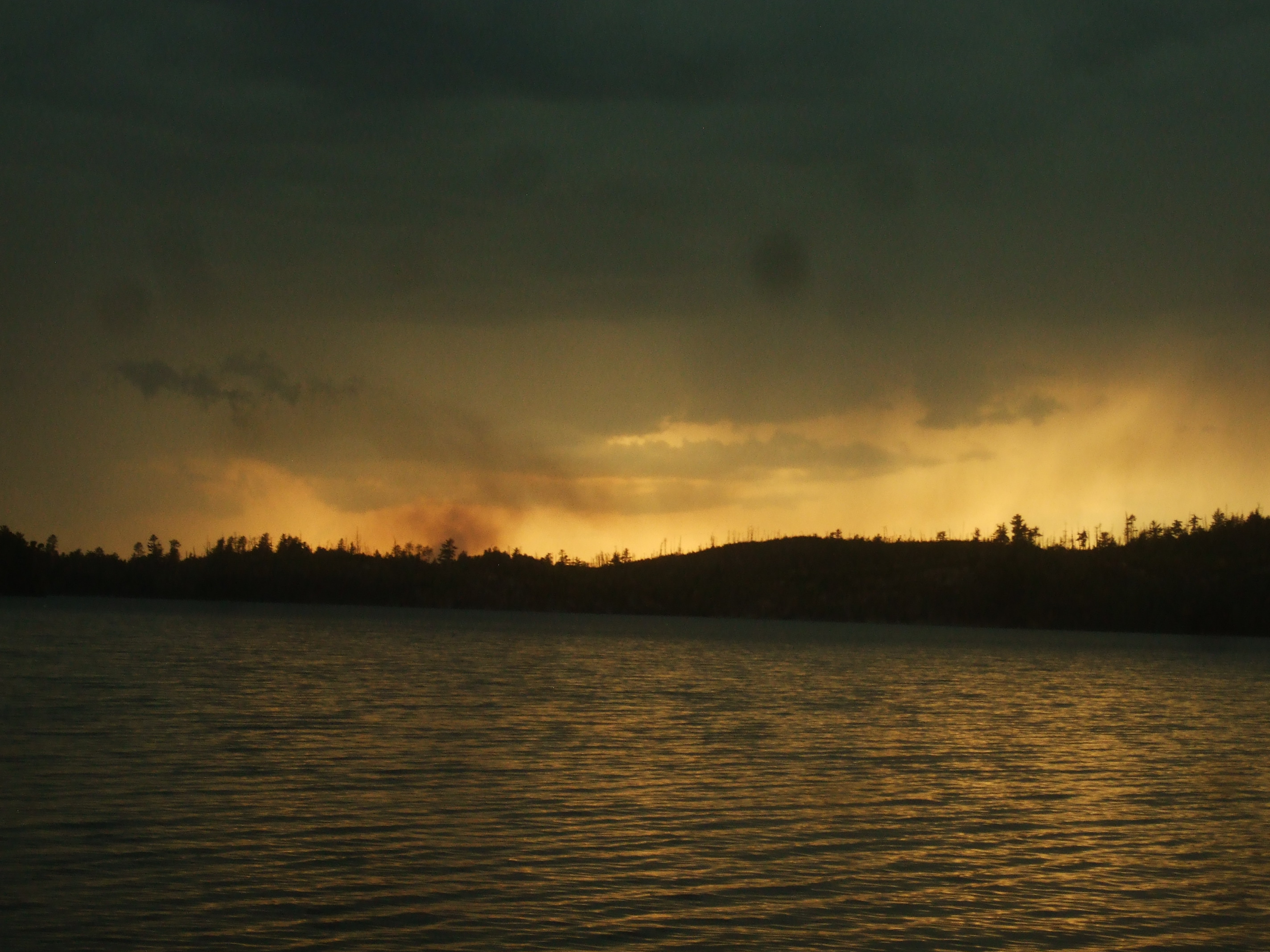
We camped on Knife Lake and set up camp just in time to see and hear thunderstorms rolling in all around us. We watched the skies, waiting and wondering if it was going to come our way. To our North, the sky turned yellow below the clouds. A dark form developed and rose into the sky, looking unmistakably like smoke. Our suspicions were confirmed at the conclusion of our trip when we learned that the storms had ignited forest fires on the Canadian side. Rain did come our way, but later gave way to a clear and calm evening with a deep red sunset. Our final reward of the day was a green display of Northern Lights that mimicked the shape of the island opposite us, moving and undulating along that wavy line.

Day 2:
7.6 Total Miles
9 Portages
393 Rods of Portaging (1.23 Miles)
Net Elevation Change +148 ft
Major lakes – Knife, Kekekabic, and Fraser

We awoke to a strong wind, which remained with us throughout our paddling this day. We were mostly on smaller lakes, however, which helped reduce the impact of the wind.  The exception was Kekekabic Lake, which challenged us with stiff resistance and big waves.  We had more portages, but they were still fairly short. It was gradual training for what was to come in later days. We had hoped to canoe out of the burn zone, but it persisted on at least some shores all day. In selecting our campsite on Fraser Lake, we made sure that it was not within our view. We had left the border route, but we were still within close enough range that canoes were still a fairly common sight.

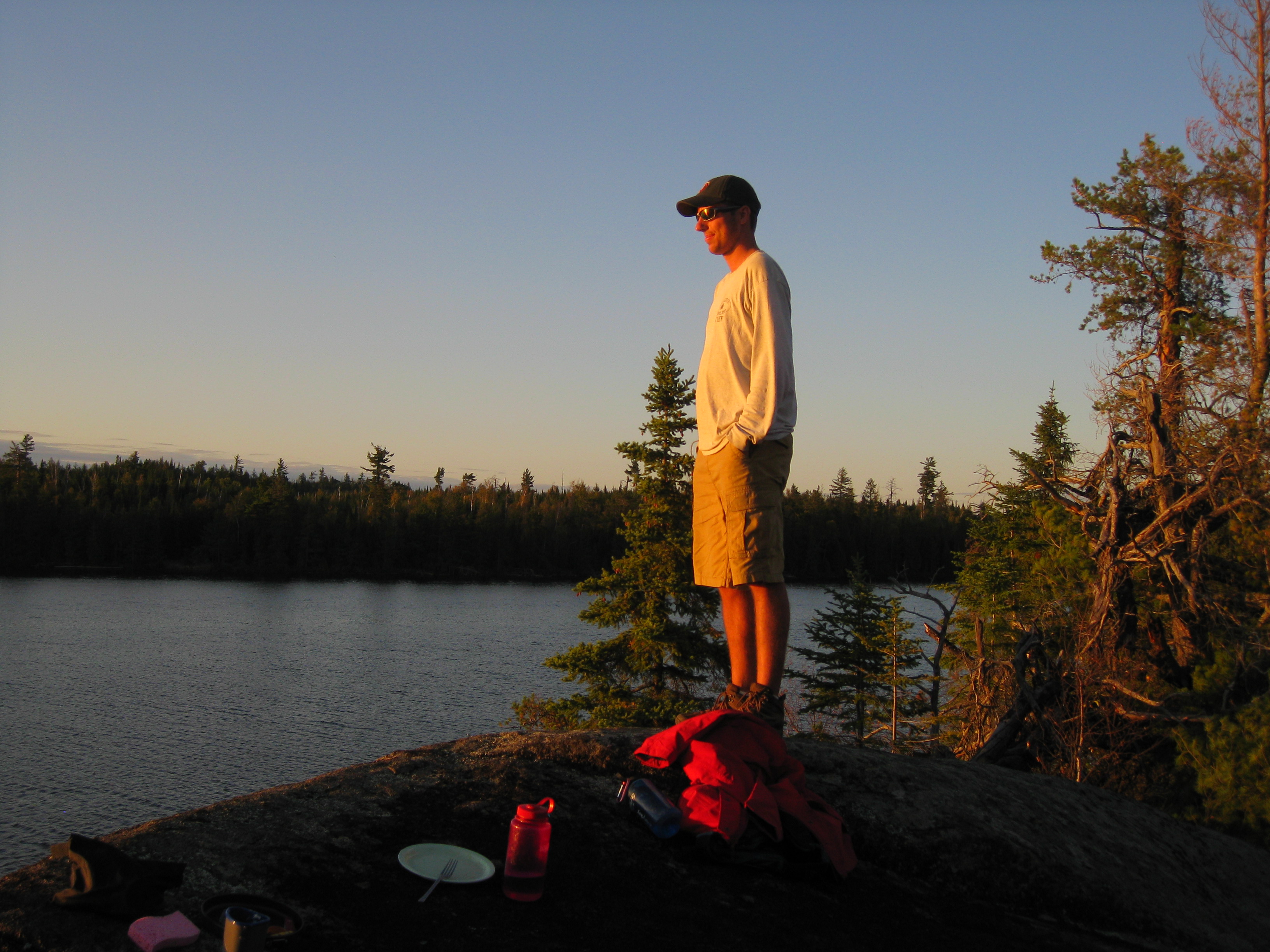
This was our shortest day of canoeing, both in distance and time. We reached our campsite by 12:30, leaving us a lazy afternoon in which to hunker down alongside the lake with a good book. All intentions to go for a swim waned as the day cooled off. So instead, we roused ourselves for a short paddle across the lake to have our dinner and watch the sunset from a large rock outcropping high above the lake. We did find one advantage to being in the proximity of the burn zone – firewood was plentiful and dry. Our campfires ignited instantly and never lacked for fuel.

Day 3:
10.9 Total Miles
11 Portages
925 Rods of Portaging (2.89 Miles)
Net Elevation Change +64 ft
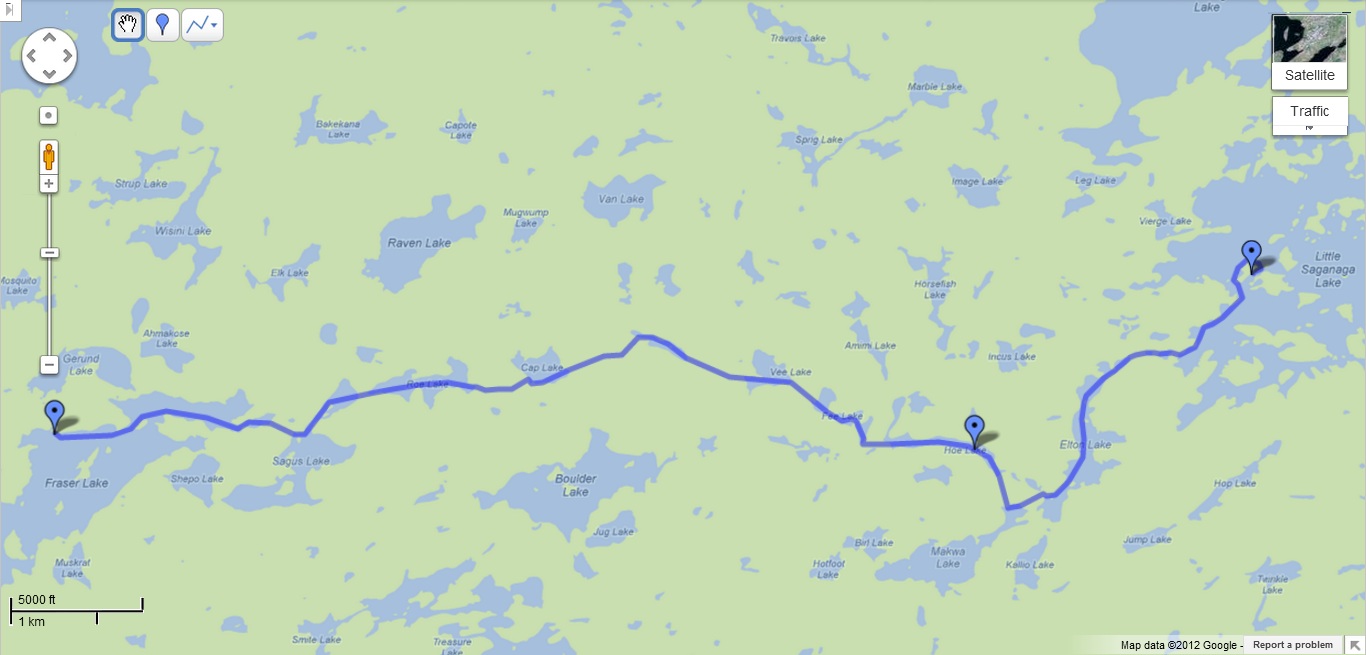
Major lakes – Fraser, Sagus, Makwa, Elton, and Little Saganaga

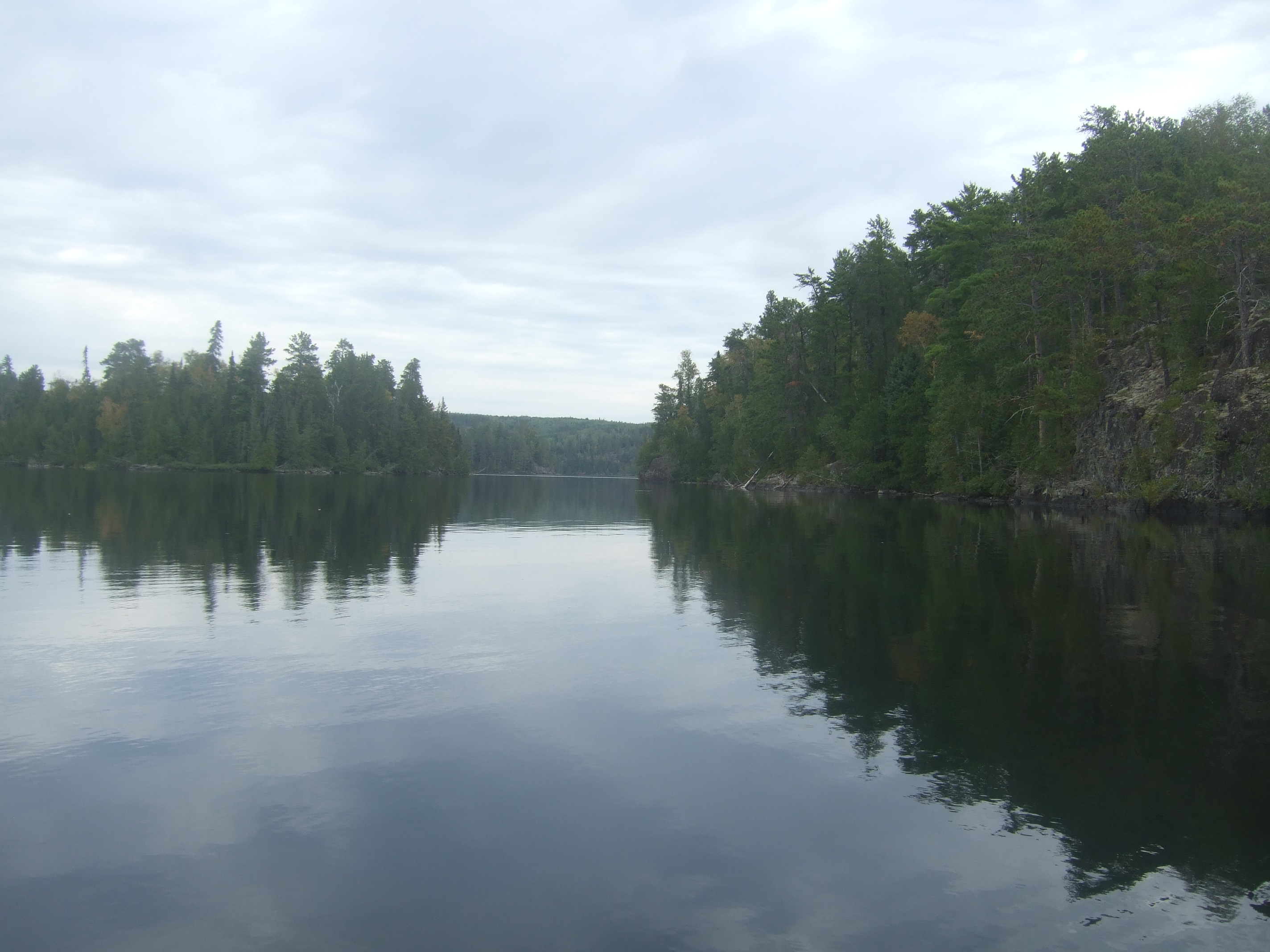
The morning was clear, chilly and calm with mist rising off the lake and the sun’s golden glow on the opposite shore.  It was beautiful to be out on the water in the early morning hours.  Today’s route included numerous small lakes linked by frequent portages, and growing in length.  By this time, we’d left all other canoeists behind and enjoyed the solitude of tree-ringed lakes, alternating pine and deciduous forests.  Portages bore the mark of infrequent use, overgrown with bushes and branches that challenged the height of the overturned canoe as it navigated the path.  Fall began to manifest itself, with golden leaves carpeting the surface of one trail.  To us, the added impediments were worth it for the isolation.

Our lesser traveled route also presented other challenges.  What appeared to be the long arm of a lake on the map felt more like a marshland.  But it was navigable.  What looked like it should be a clear blue lake was shallow and filled with lily pads.  We canoed over them.  What should have been a portage wasn’t.  It was a swamp.  So we canoed through it, dodging dead trees.  We ultimately found a path to the next lake, but not where it was marked on the map.

We finished up on Little Saganaga Lake.  It was a beautiful lake filled with enough islands to make it especially attractive but confusing to navigate.  Paddling around islands and peninsulas we located a beautiful campsite that afforded us expansive views.  At sunset, we had colorful displays in multiple directions.  We were also serenaded by a lone wolf, who howled continuously and was answered only by the loons on the lake.  He repeated his performance in the middle of the night.

Day 4:
11.9 Total Miles
7 Portages
793 Rods of Portaging (2.48 Miles)
Net Elevation Change +150 ft
Major lakes – Little Saganaga, Mora, Crooked, Tuscarora, and Round

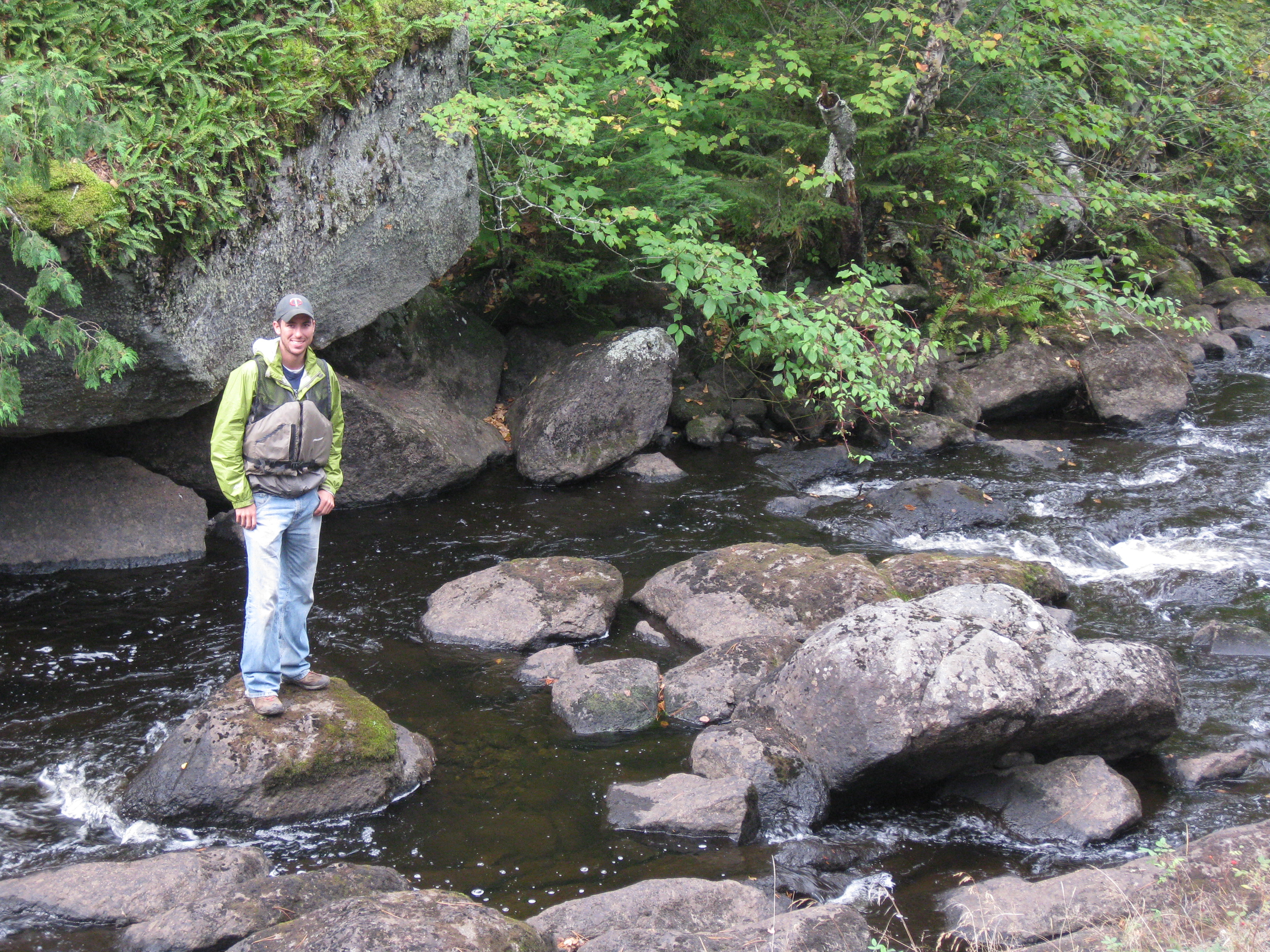
Our final day provided a wide range of weather.  While the morning was calm and misty, the wind came up by the time we launched our canoe, and clouds filled the sky.  We pushed our way across the open waters of Little Saganaga, and moved on into smaller lakes.  We traveled along Carl’s favorite portage, from Little Saganaga to Mora Lake.  Covered in pines and following alongside a briskly flowing river that tumbled over rocks, it was definitely the most scenic of our trip.  The further we went that day, the more we re-encountered burn zone and reached more populated lakes.  It wasn’t the kind of day that encourage lingering, so we paddled on in quiet appreciation of our surroundings.

Reaching Tuscarora Lake, we hit a double-whammy.  The rain began in earnest, and the wind whipped across the wide expanse of water.  Fortunately the shower was short in duration, although it provided a good drenching – the first of our trip, so we couldn’t complain. By hiding behind islands, we avoided as much wind as possible.  And our reward?  The Tuscarora portage.  The Big One.  Approximately 428 rods in length with uphill to start and mud in the middle.  Its length defines its difficulty.  But it’s also a badge of honor to complete.  We encountered a veritable traffic jam at its start, with a solo canoeist following in our footsteps (he was glad to talk to us after 10 days on his own), and four heavily laden guys completing the portage from the other direction.  We were back in civilized territory.

We conquered the portage, which left us just two lakes and a lesser portage to our final destination.  It was bittersweet to paddle that section – a feeling of completion and satisfaction over the success of our trip mixed with the sad reality that it was coming to an end.  We had a shower, dry clothes and a good meal to look forward to.  But we both would have traded it all for another four days of canoeing in our grubby gear.

Making Memories in the BWCA

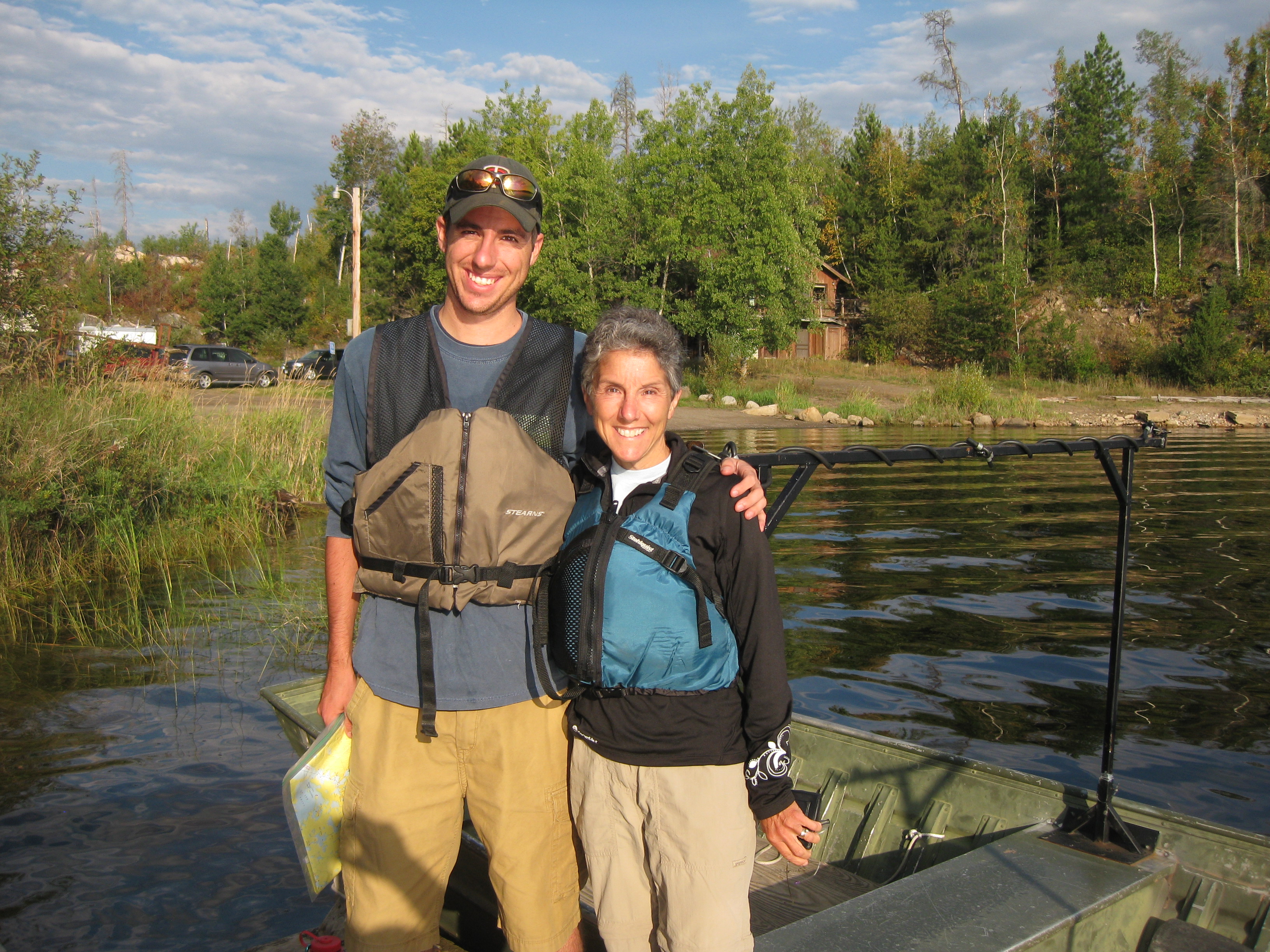
This canoe trip was a gift from the three men in my life.  My husband, Rich, graciously supported me in venturing off with our son for four days in the BWCA – a place he also adores and would much rather have been than staying home and putting in long, grueling days on a big project approaching its go-live at work.  I’m not sure I could have buried my envy as well as he did.  Our youngest son, Erik, generously offered up his new hiking equipment, the latest in backpacking technology.  I clearly benefited from his warm yet compact down sleeping bag and sleep mat, and we relished the way his lightweight tent practically assembled itself each night.  And finally, our oldest son Carl, who shared four days with me in his favorite wilderness and made the whole trip possible.

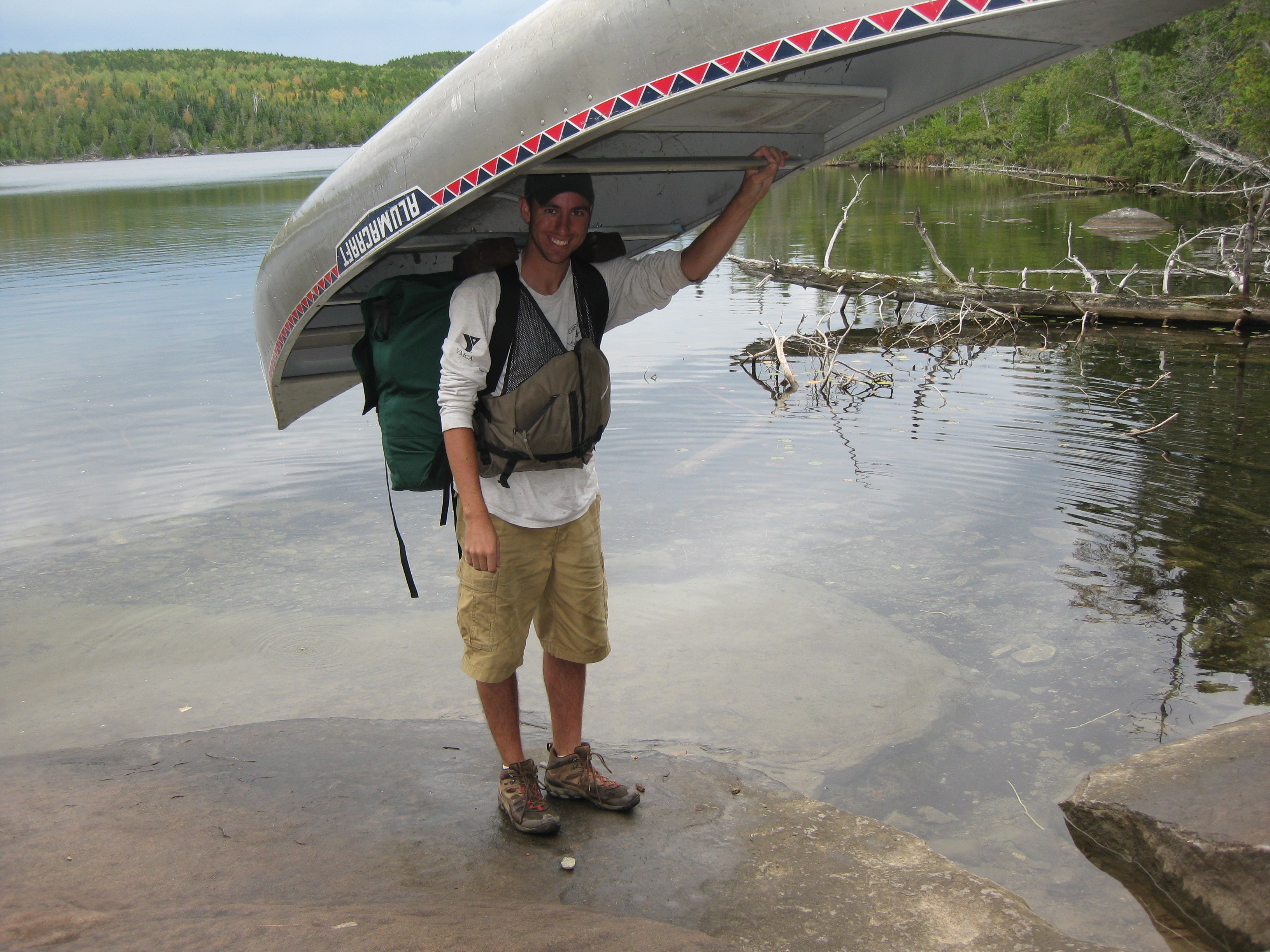
Despite the fact that I am passionate about exercise and religiously run, cycle, swim or ski significant distances nearly every day, my fitness level does not necessarily translate to physical strength.  And size has to figure into this as well – at 5’1″ I was no match for Carl’s over 6′ frame.  So when it came time to divide up our carefully selected gear, Carl stacked the deck by strategically placing all the heavier equipment and food in his large “Duluth Pack,” leaving me the clothing and lighter weight fill for my backpack.  Add to that the fact that he portaged the canoe as well, he really carried a load – nearly 100 lb. he figures, which probably compares to about 25 lb. for me.  It amazed me how he could swing that canoe overhead in a single motion to rest on his shoulders which already bore the weight of his pack.  Ah, youth!  Down the portage trail he would hike, at a rigorous pace which left me following at a much slower and deliberate speed.

Balance has never been a strong point for me, and at first the added weight distribution of the backpack left me teetering over rocks and clumsily choosing my footing among the frequent roots crossing the trail.  But Carl showed infinite patience, waiting for me at the next lake with a cheery greeting for my efforts.  But it didn’t end there.  He loaded and unloaded my pack from the canoe at each juncture, and held it out for me to slip into, just like he was helping me into a mink coat.  And he always positioned the canoe so I had the best vantage point for getting in and out without slipping.  While I longed for the days when that was not necessary, I chose to relish being pampered and so well looked after.

We canoed long miles and tackled numerous portages, one as long as 425 rods.  I was amazed to learn after the fact that we paddled 18 miles on our first day out!  It helped that we had calm waters and traveled through large lakes with few portages to interrupt our progress.  Another day was the opposite – it felt like hiking with a bit of canoeing to tie the bits of land together.  But we were both eager to go the distance.  To explore.  To see new lakes and forests.  To just be in the Boundary Waters.  Energy and endurance were never an issue.  We always had capacity to do more.  Even if I knew Carl’s paddling strokes were doing more to carry us forward than mine, I was still eager to do my part and earn my keep in the canoe.

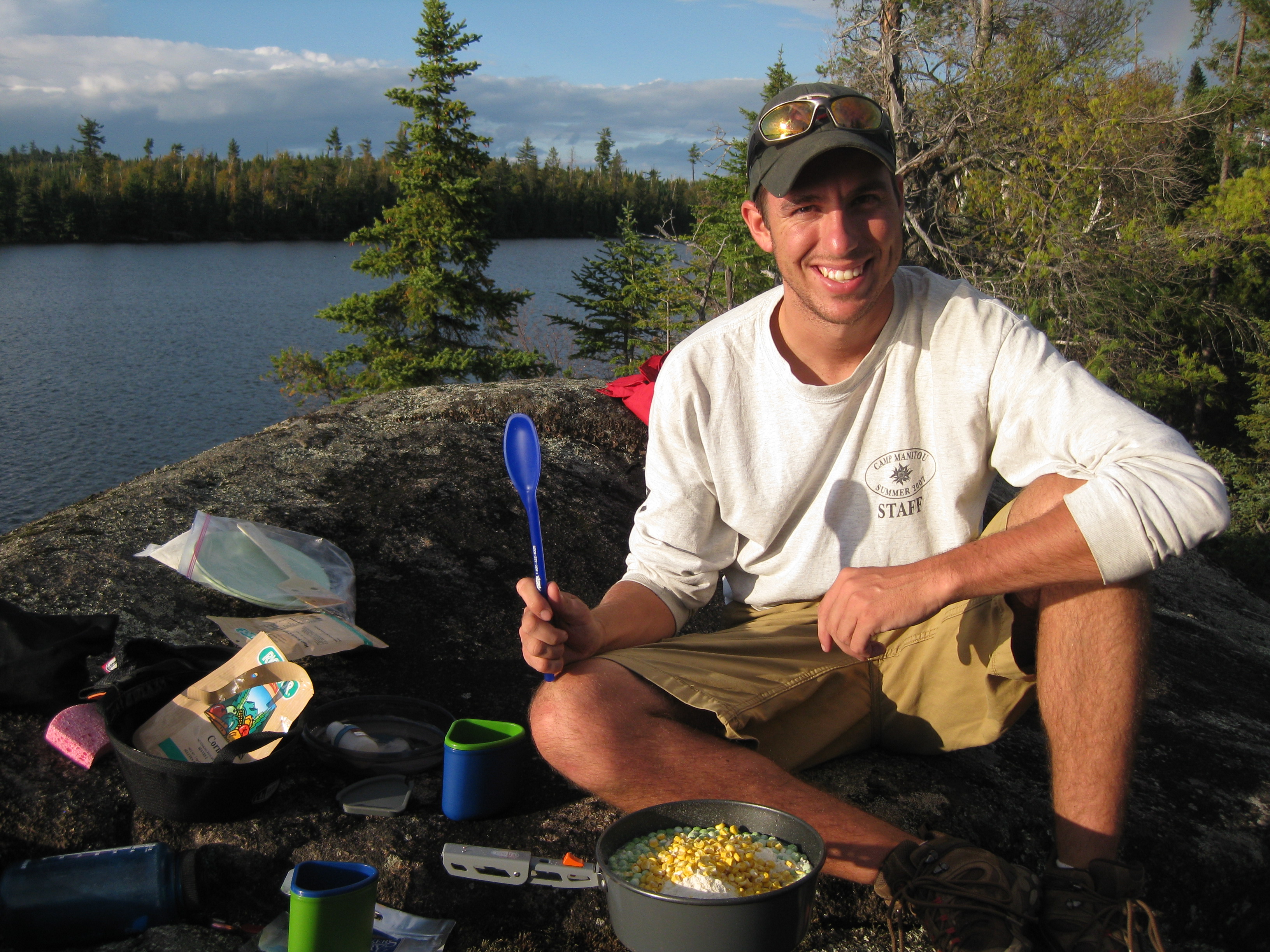
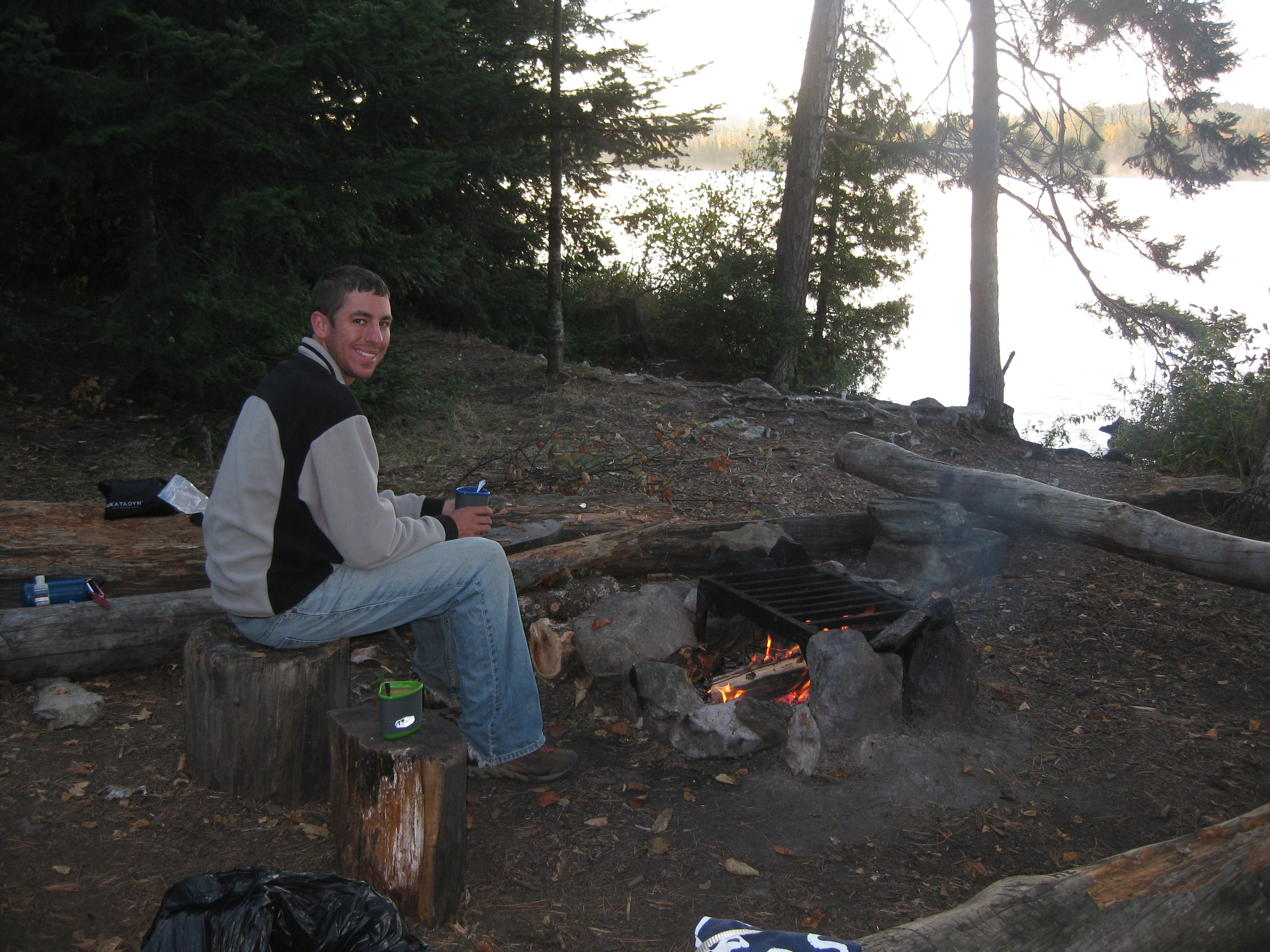
Camp time was equally important as that spent on the water.  Carl displayed his prowess in building fires, creative cooking over the camp stove, and carving out time to relax and read in beautiful surroundings with views of the water.  Mornings, while I packed our gear in the tent, Carl would start a fire and announce “Hot water is ready for coffee.”  What great service!  One afternoon he proposed a “remote dinner” which took us across the lake to an enormous rock rising out of the lake.  We scaled up the back to perch on the edge towering over the water – a glorious site for our dinner and nightly sunset.

And speaking of sunsets, they were both prolific and memorable.  Each night was different.  Each night was special.  And we never grew tired of watching the sun paint colors in the sky that reflected in the pure waters below.  The brilliance of the sun was matched only by the campfires that followed.  We spent hours staring into the coals, watching them glow, flicker and spark.  I think evenings were our favorite part of the day.

When I thought about it, Carl probably carried as much and worked as hard as he would on one of his solo canoe trips.  So perhaps from that perspective it was like doing a solo trip with a companion.  But the shared experiences and resulting memories can’t be measured.  The mutual enthusiasm over the trip, the wonder in admiring our surroundings, the camaraderie when faced with challenges, the unspoken agreement over the division of chores, the prevailing positive attitudes, the companionable silences, the good company – they will remain with me forever.

Boundary Waters Basics

Trees, rocks, water and sky.  And a canoe in which to explore it all.  That’s all it takes, and it’s all one needs.  Okay, a few extras like a tent, camp stove and freeze dried food come in handy.  But completing our fourth day in the Boundary Waters Canoe Area today really drove home how it’s all about simplicity and back to the basics.

I loved how we were able to reduce our lives to only the essentials that we needed and could carry on a single portage.  (No double portaging for this duo!)  Getting up in the morning consisted of wriggling back into the same clothes in the warmth of a sleeping bag.  A quick brush of my teeth and running a damp wash cloth over my face constituted my daily makeup routine.  Question: If my hair looks a mess in the Boundary Waters and there is only my son to see it, is it still messy?  Answer: It doesn’t matter!

Life’s biggest concern was weather.  Is it calm or windy?  Is it sunny or raining?  Is it warm or cold?  We had some of each every day.  And we enjoyed it all.  Our greatest decisions were selecting a campsite.  Requirements were 1) a good view, 2) nice environs, 3) a fire ring with ample sitting benches,  4) open to the breeze to keep the few bugs away, 5) a good sunning rock.  We canoed further if necessary in search of one that met our criteria.  Meals were easy –  which flavor bagel to have, or what dinner packet to open.  It all tasted fantastic.

Long periods would go by in silence.  That is the beauty of it all.  Conversation is not necessary.  It is enough to be lost in one’s own thoughts.  And there is plenty of time for thought when spending all day in the outdoors.  Silence also invited in nature’s sounds – the flapping of a hundred geese’s wings flying overhead in impeccable V-formation, the lapping of the water against the shore, the melodic cry of the loons, and even the howling of a lone wolf at dusk.

Sunsets were the highlight of our days, and the evening’s entertainment.  If our campsite didn’t afford a good view, we canoed to a spot that did.  Campfires were our bedtime stories.  Filled with movement, color, heat and a mesmerizing glow, they lulled us into sleepiness.  The only things that could draw us away were splendid showings of Northern Lights or skies filled with brilliant stars.  And we saw both.

The longer we were there the better it got.  Everything else melted away and assumed a status of insignificance.  The Boundary Waters Canoe Area is a national treasure.  But more important is the personal treasure it gives in return.  Trees, rocks, water and sky.  And a return to basics.

From Pedals to Paddles

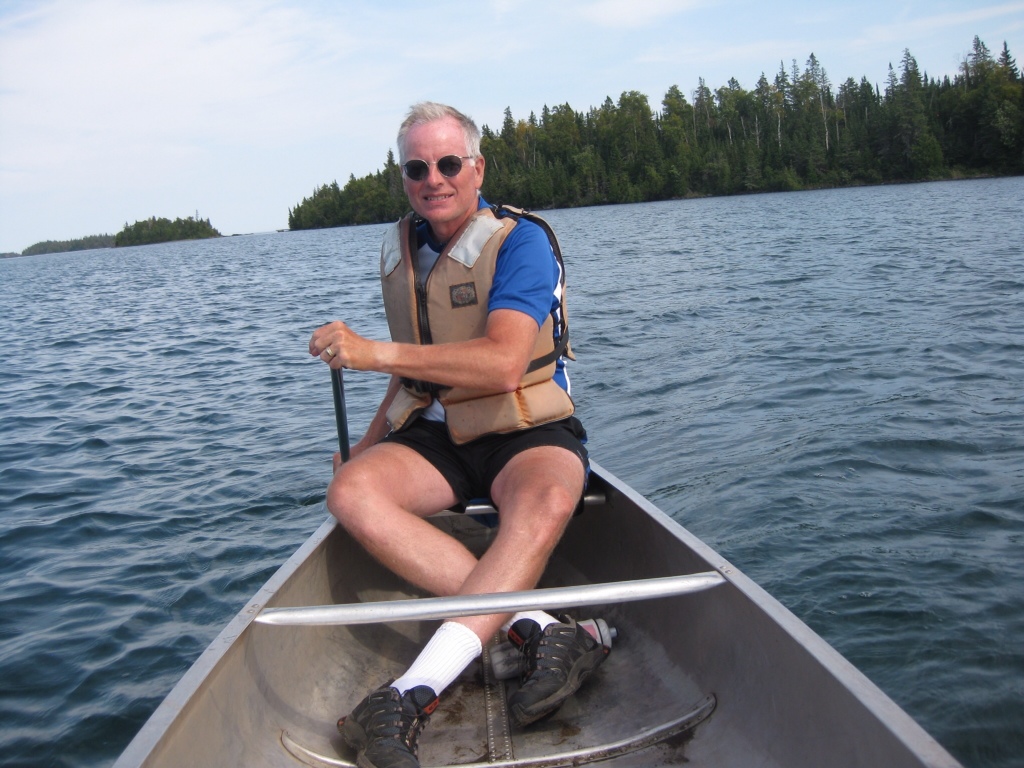
We’ve been home from our bike trip less than a week, and I’m already packing again for another adventure.  I’m trading in my husband’s company for that of our oldest son, Carl, and switching from pedaling to paddling.  Having immersed himself in the Boundary Waters Canoe Area for four months last summer by working at Tuscarora Lodge and Canoe Outfitters and spending every day off work out on the water in a canoe, Carl developed a new passion.  Now that he is a working man with a real job out in DC, his opportunities to canoe are much rarer.  So when he decided he wanted to come home for a canoe trip and was looking for others to join him, I volunteered immediately.  There is a lot to be said for this retired status!

I will readily admit that I am not as well conditioned for this one as for the cycling trip.  The closest to training I’ve come is a couple of mild kayak outings at our cabin.  But somehow I’m sure I will manage.

I fee like I’m going on a trip with a real guide.  After all his experience last summer, Carl knows the ropes well – what gear to bring, how best to pack, what dried foods taste the best, and how to portage efficiently.  I know I’m in good hands.  He’s already done all the planning for the route.  All I need do is pack my stuff, hop in the car and shove off with him.

We’ll be starting off at Tuscarora Lodge – of course.  After a night in a bunk house, and availing ourselves of a hot and plentiful French Toast breakfast, we will begin our trip.  Carl has arranged for us to get a tow to our starting point.  So first we get a ride to Saganaga Lake (the green line), then they tow us in with our canoe to a remote staring point (the red line) – cool, I’ve never done that before!  From there, we will spend four days canoeing back to Tuscarora on Round Lake (the blue line).  I haven’t delved into the details too much (I’ve been a bit distracted with that little bike ride we did) but I’m sure it is an aggressive route.  Carl wouldn’t want to do it any other way, and I’m game.

I’m looking forward to unplugging.  Even on our bike trip, we each hunkered down with our iPads and wrote blog posts each night.  There’s no choice on this trip.  Any posts will have to wait until after we’re back to civilization.  Carl may do a little fishing.  If it stays warm enough, we’ll hop in for a swim.  We’re bringing paperback books and a deck of cards.  Evenings are for staring into campfires and stargazing.

I feel very privileged to be going on this trip.  How many twenty-something guys are willing to go on a canoe trip with their mom?   I’m glad mine is.

Cycling – It’s all about the Food

We certainly ate our way around the Trans-Superior Cycling Tour, but with all the cycling I still lost weight!  And each night, we stayed in a different motel or B&B.  So I thought it would be fun to put together reviews of each of the places we ate or stayed.

The lodgings were all booked well in advance.  My husband, Rich, poured hours into researching motels and making the reservations, and deserves huge kudos for his excellent choices.  Our criteria included reasonable cost, nice but not fancy, and convenient location to both our route and to places to eat.  That last one was critical – who wants to cycle additional miles at the end of the day to find dinner?  We also allowed ourselves a couple of splurges on more special places to stay.

The restaurants and ice cream venues were all chosen en route.  Some just jumped out of us and we made spontaneous stops.  For others we’d often get recommendations from other travelers, motel staff or other restaurants.  No one steered us wrong.

So here they are – enjoy!
Ruxy’s Cottage Cafe, Port Wing WI – A spontaneous mid-morning break.  I don’t know why Rich talked me into splitting a cinnamon roll. Big mistake. They were wonderful. Fresh, soft, just sweet enough and not oversized. I should have insisted on having one all to myself.

Big Water Coffee Roasters, Bayfield WI – The sign outside said “Smooth Move.”. That’s all it took to get me inside to find out I had correctly interpreted the message. We enjoyed Lake Berry Breeze smoothies at the end of our day’s 80 mile ride. Oh, did they taste good! The food delivered to the other customers at their outside tables looked mighty fine too.

Ethel’s at 250, Bayfield WI – Hungry for a good dinner, we took the recommendation of a local who sent us here and it did not disappoint. The ambiance and the food were both fresh and tasteful. We sat outside on the balcony and enjoyed the sliver of lake view as well as the balmy evening. My pesto pasta with fresh whitefish was excellent, and Rich enjoyed a juicy burger.
Seagull Bay Motel, Bayfield WI – Not in the center of town, but at a better price than the lodgings that are. We had a beautiful lake view from our room, and there was a lovely yard and garden out back. A nice garden path took us right into town, just five blocks and no hills. The opposite direction offered 2 miles along the water. Our room was simple but clean and comfortable and included a refrigerator and microwave. (And enough room for our bikes.) It was an excellent value.

Tap Roots Coffee Shop, Ashland WI – We didn’t go here but I wanted to. It was my kind of place – lattes and other espresso drinks, yummy looking scones and other baked goods, and an eclectic interior. But Rich needed a “real breakfast” and I couldn’t argue with that given all our cycling. But I’d stop here in a heartbeat if I were on my own.

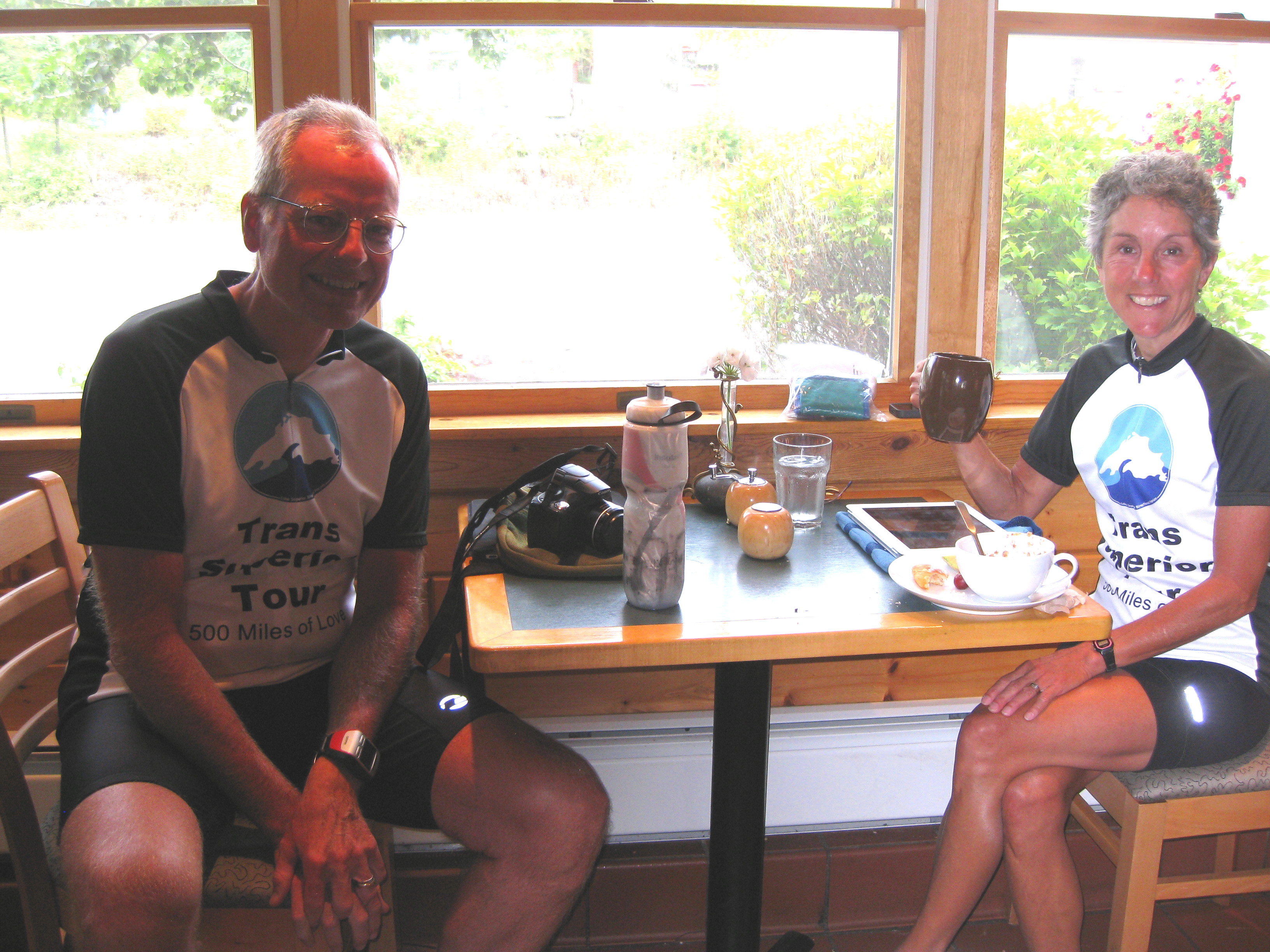
Maple Creek Restaurant, Ashland WI – It wasn’t the humble local cafe we were seeking, but it turned out to be better than that. Not usually a lover of buffets, I could see the value in this breakfast buffet. They had a nice selection of fresh fruits and yogurt in addition to the cooked foods. Rich could fill up on the eggs and bacon he craved, and I could add a couple pancakes and a sliver of coffee cake to my healthier choices. It hit the spot for both of us and the quality was good, particularly for a buffet.

Black River Crossing B&B, Bessemer MI – Truth be told, we were return customers. We had stayed there last winter and been thoroughly charmed by both the B&B and our hosts, Sue and Stan. Returning in the summer, it was great fun to see the yard in full bloom. The flowers, multiple decks and patios, waterfalls and ponds were gorgeous and provided a peaceful afternoon’s rest. They had stocked the fridge for any post-cycling food we might need, and included us in their evening barbecue with friends. It was like returning to stay with old friends. And the jacuzzi room on the second floor was luxuriously appointed and comfortable.
Syl’s Cafe, Ontonagon MI – They specialize in pasties, so since we were famished after the day’s cycling, we split one for an appetizer. It was hot, flavorful and moist. We each had grilled sandwiches on homemade sourdough bread, which were nice and crisp on the outside and had generous portions of fillings. Everything was freshly prepared and the cafe was typically appointed for a Mom and Pop place, but sparkling clean with friendly wait staff.

Scott’s Superior Inn, Ontonogan MI – They have both motel units and cabins near the lake. Our motel room was plain but functional, if a bit dated and tired looking.. It had only one outlet, which presented a challenge for today’s array of rechargeable electronic devices. They did have access to the lake, with a section of the beautiful sand beach. The price was very reasonable, it was quiet and our tired bodies had a good nights sleep.
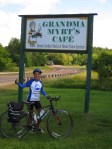
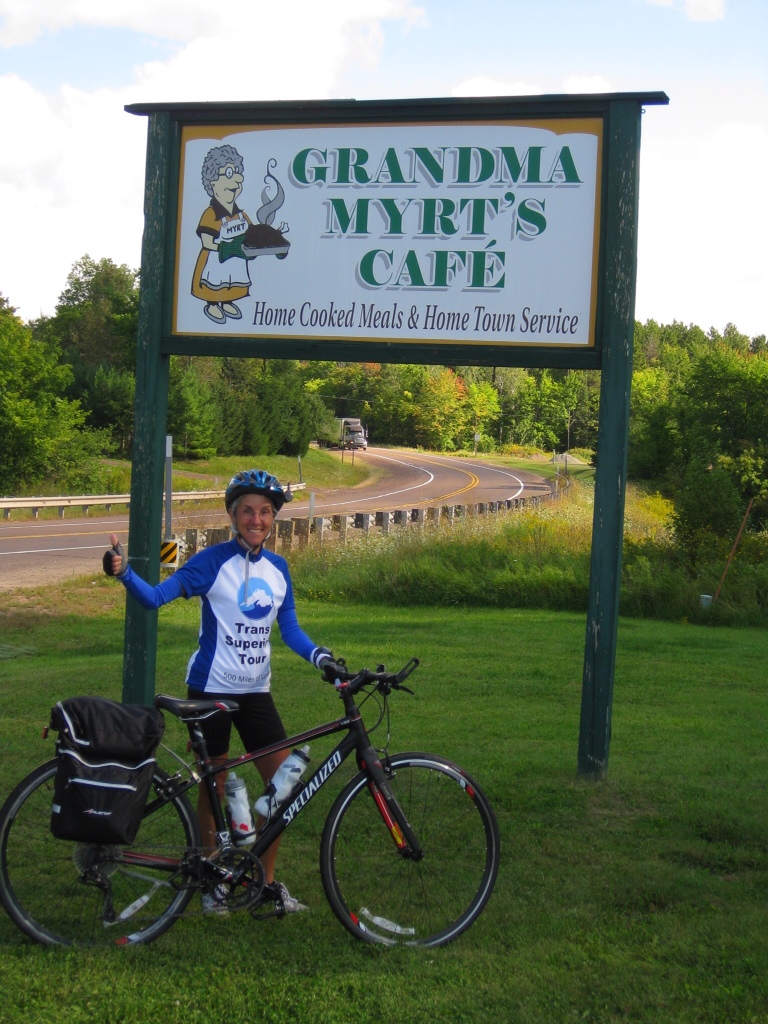
Grandma Myrt’s Cafe, Mass City MI – This was recommended to us as the only real option for a full breakfast on our route from Ontonagon. But it more than fit the bill. There were loads of cars outside, and the plain interior was filled with locals as well as motorcyclist travelers. The cook/waitress was a busy young woman filling dual roles, but she delivered the most delicious food. Rich had a Farmer Omlette filled with sausage and peppers along with all the side trimmings, which he said was excellent. I had divine Cinnamon French Toast made with homemade cinnamon bread – it had a crisp eggy exterior and a firm but soft interior.
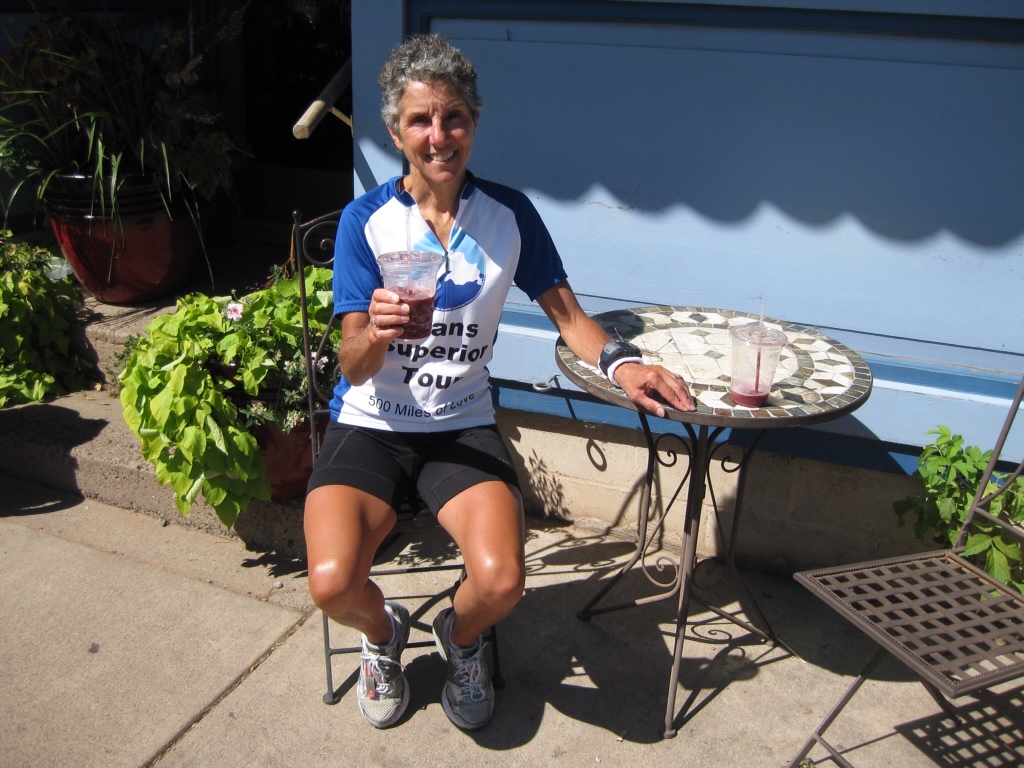
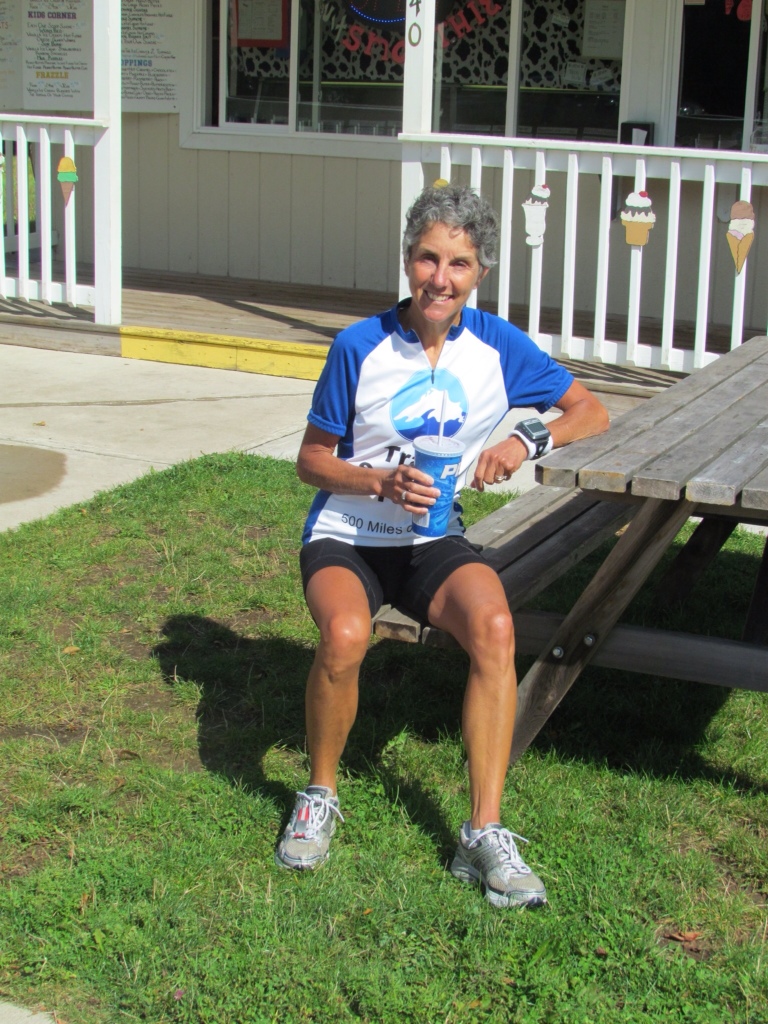
Treats Ice Cream, Chassell MI – We had the most enormous smoothies here. They must have been 16 oz. There were numerous flavors to choose from, including the option of mixing them. I had blackberry-raspberry, and Rich went with straight blackberry. They were so thick, it was hard to suck them up through our straws, but we managed. The big waffle cones that others walked away with looked good too.

The Library Restaurant and Brew Pub, Houghton MI – My son reminded me that we had eaten here when on a college visit five years ago, and I agreed that it was worth repeating. We were able to get seats with a view of the water in the setting sun in the pleasant dining room. The food was as good as I remembered. Rich had a good steak, and I enjoyed a salmon topped with grilled salmon.

Super 8 Motel, Houghton MI – This has to be the best Super 8 I’ve ever stayed in. It is located right down on the water, and in fact the bike trail that we took into town led us right there. In addition to nice rooms, it has a large deck outside by the water, as well as a pool, sauna and hot tub. They even had a coin laundry for guests. Their “Super Starter” breakfast was not as complete as others, but it covered the basics pretty well.
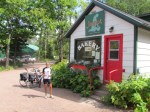
Jampot Bakery, Eagle Harbor MI – This bakery is a bit of a local legend. It is the outlet for the labors of the Society of St. John Monastery, which was founded on the nearby shore by a small group of monks in 1983. Their initial penchant for picking wild berries and baking soon turned into a venture able to support their little community. We were served by a pleasant monk who happily described the plethora of decadent flavors of muffins, and left with a heavy bag of muffins. They also sell jams, breads and cookies. We consumed two muffins immediately at a nearby picnic table in the woods, rich and delicious. Be sure to notice their monastery building just down the shore – unique architecture with beautiful gardens.

Harbor Haus Restaurant, Copper Harbor MI – Another guest at our motel recommended this restaurant as having the best food in town. Although we had no frame of reference, we were sure our dinners were proof. They had an extensive menu, which looked expensive, but when we considered all the courses it included, we felt it was justified. Rich’s flank steak and my Lake Superior trout were cooked to perfection, and the sides were fresh and outside the ordinary offerings.
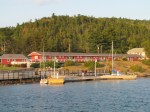
Bella Vista Motel, Copper Harbor MI – This was a well maintained little motel perfectly situated right on the edge of the harbor. Our room was tastefully decorated and included a deck with chairs in a garden setting overlooking the harbor. Not only could we watch the harbor activity, but we could see lake freighters beyond the break front. The price was reasonable, and it was just a short walk from there to the ferry.

Rock Harbor Lodge, Isle Royale MI – This is the only lodging available on Isle Royale, and while it is pricey, it is a worthwhile splurge if you are not the camping type, or just care to indulge yourself. The rooms are in a set of 2-story buildings along the edge of the harbor, with Lake Superior’s water lapping at the harbor shore just outside the windows. Furnishings are a simple modern style and the rooms feel recently updated. No TV, no Internet, no cell phone reception. This is a wilderness park after all.

Greenstone Grill, Isle Royale MI – There are two restaurant choices at Rock Harbor, and they share the same building.  This one is the more informal of the two, although how formal can you get on a wilderness island?  They serve simple fare which is pretty good  considering everything has to be brought over by ferry.  We had tastefully prepared sandwiches and burger, although the portions were not huge. They also make box lunches for the ferry which you can request the night before.  It’s not well advertised, just ask the wait staff.

My Sister’s Place, Grand Marais MN – It wasn’t my choice of restaurant. (For the record, my personal favorite in Grand Marais is the Angry Trout, but Rich thinks their food is too “weird” for his more plain tastes.) It did have the advantage of being just a block from our motel. And it was full, had lively and friendly wait staff, and fairly quick service. It’s definitely a bar/restaurant with a menu to match. My wild rice salad was undistinguished, and the dressing too syrupy for my taste. But Rich had a good burger and fries, so he was happy, and he’s more the type of customer they seek to please.

Mangy Moose Motel, Grand Marais MN – This hotel has been under new ownership for a year, and they have done a wonderful job of renovating a deteriorating older motel. It is conveniently located on the highway near the center of town. The units are a bit back from the road, and all have been completely remodeled. Our room was small, but they made efficient use of the space using modern materials with simple clean lines. We were most impressed by the power strip that easily accommodated all our chargers – a brilliant addition on their part. The price was very reasonable, especially for this artsy and often expensive town.

Coho Cafe, Tofte MN – This is an old favorite of mine. I’ve been stopping here for latte and baked goods for years, and have had the occasional lunch. Everything is fresh and artfully presented, and menu options are unique and flavorful. Rich had a hearty breakfast sandwich and I had the Trail Mix breakfast with yogurt and granola as well as a sinful cinnamon twist. I’m only disappointed that I haven’t seen scones there for some time – my personal favorite. Their breads are well worth purchasing to take home.

Big Dipper, Beaver Bay MN – We already knew that they made great smoothies from a prior visit. And they did not disappoint. The perfect ending to our hottest day of cycling.

Camp 61 Motel, Beaver Bay MN – This is another renovated motel. These owners have resurrected not only an old motel but a restaurant as well. The interior has been completed refurbished, and they have a wonderful lobby furnished with lodge style furniture, old photographs and memorabilia. It was a very pleasant place to sit in the evening. Our room was small but freshly remodeled, clean and comfortable.

Camp 61 Restaurant, Beaver Bay MN – This was a big surprise to me. I expected the usual burger or sandwiches and fries fare. Instead, we found a broad menu with tasteful dinner options. I had a delicious walleye, wrapped in leaves and marinated with an Asian flair, served on a wild rice pilaf. Rich enjoyed one of their specials, a thick pork chop with hearty camp potatoes. Due to a slight mix-up, they insisted on serving us complimentary desserts, which we otherwise would have declined. Both the mixed berry pie and decadent chocolate cake, both with ice cream, were heavenly.

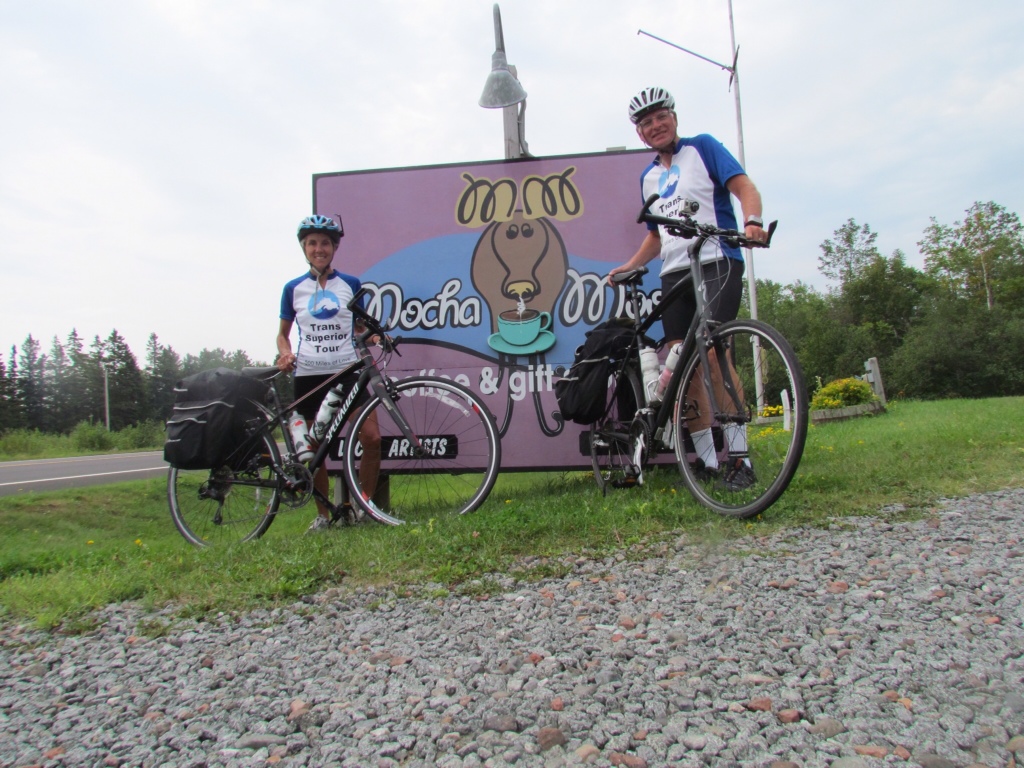
Mocha Moose, Two Harbors MN – We’ve been here many times, and love the eclectic interior, the gregarious and lively owner, and the pastries as well as the latte. We both had hearty breakfast turnovers, mine vegetarian, Rich’s with ham and cheese. Light and fluffy as well as ample fillings fed us well. This is a favorite cycling destination or mid-ride stop, not only for us but other cyclists from Duluth.

Grandma’s Box Car, Duluth MN – Our finale ice cream cones!  It was pricey but convenient to our finishing destination in the heart of Canal Park.  And who was going to argue?  The ice cream was good, although the only choices were huge waffle cones or cake cones sold as “kid’s cones”  but in reality were a perfectly adequate adult sized cone.
Cycling the Home Stretch

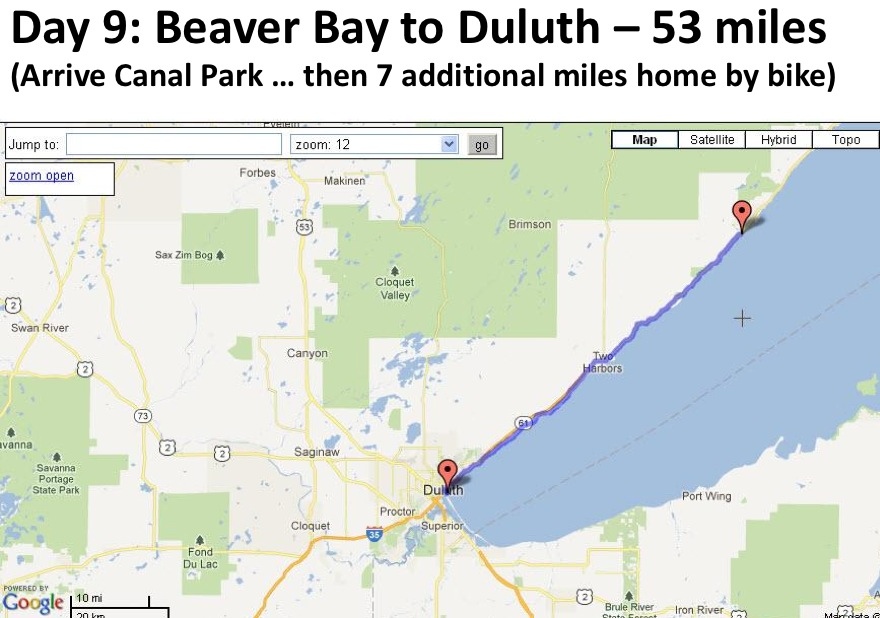
We were up early and on our way while the sun was still making its way up through the trees. It was refreshing to be out at that hour, when the sky was an indeterminate color of blue, few people were stirring and cars had not yet crowded the highway. It was cool but held the promise of a warm day to come.

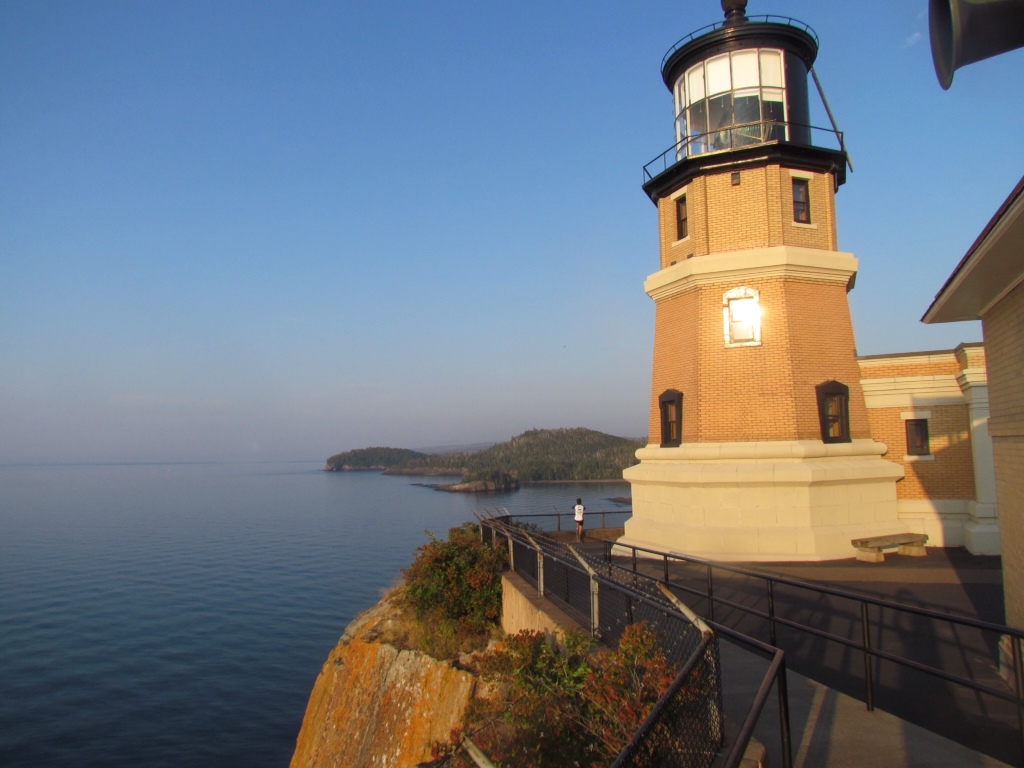
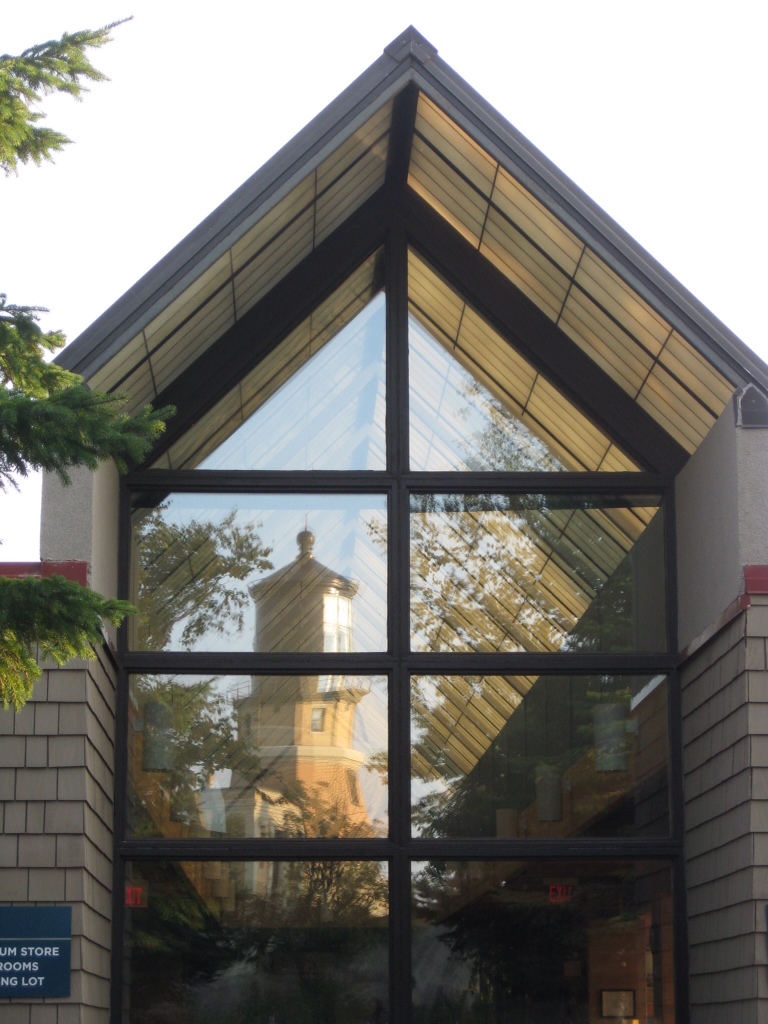
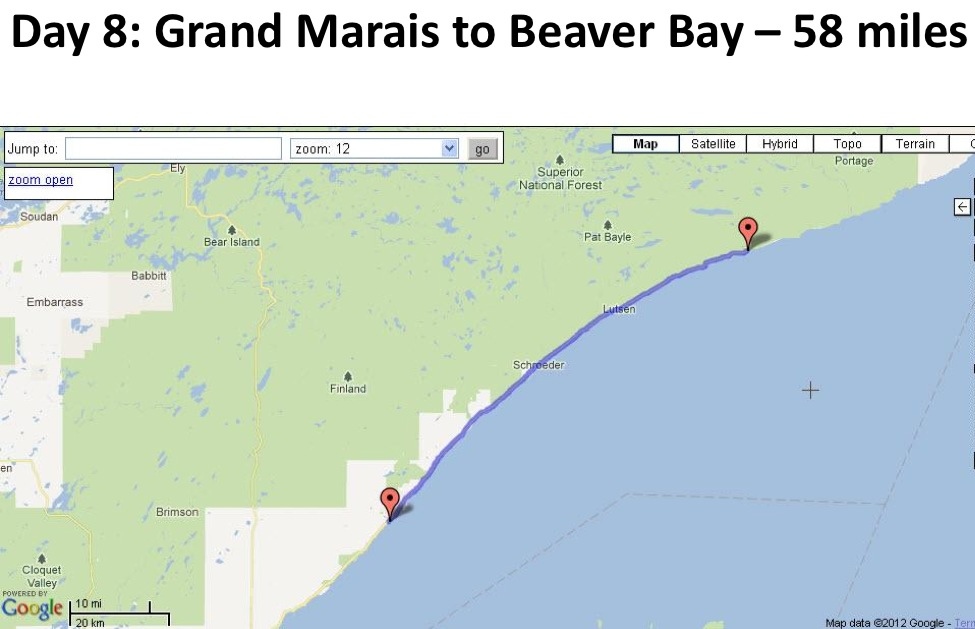
From Beaver Bay, the sights came early in our route. Within half an hour we were cycling up to Split Rock Lighthouse. The park was deserted and we were thankful that park rules were not so stringent as to require locked gates. We had our own private viewing of the lighthouse and its surroundings, able to take in the beauty of the buildings and shoreline in the golden sun of early morning. I’d recommend it to any tourist! In fact, we accidentally discovered a unique view of the lighthouse, reflected in the vaulted windows of the visitor center.

Our next pause was at Gooseberry Falls. While most of the rivers we passed along the shore had minimal flow, Gooseberry at least had enough water to provide a good display on the upper falls.

For that entire section of the shoreline, we were able to follow the Gitchi-Gami State Trail, a bicycle trail that aspires to connect Two Harbors to Grand Marais along the North Shore. Although it is still discontinuous, the sections like this that are complete are marvelous. In addition to relieving cyclists from highway travel, the trail is routed through the woods and periodically winds down toward the lake for additional views unavailable to those on the highway. It is well worth the additional hill climbs to take advantage of the trail. I learned too late that there were new portions of trail competed above Schroeder that would have benefited us yesterday.

One very small section of the Gitchi-Gami trail that is not to be missed is at Silver Cliffs. The trail follows the old highway around the tunnel, clinging to the edge of the rocks with stunning views of the lake and shoreline.

Despite having to travel 31 miles before eating, we were determined to stop at the Mocha Moose for breakfast. Not only did it represent truly reaching home turf, being on the Scenic Highway portion of 61, but it was also a key element in one of our earliest training rides. Back in March on a chilly day in the 40s, it was our turnaround point for a ride up the shore and back. That day we desperately needed the warming stop and loved the friendly atmosphere. Today we didn’t need warming, but we still got “moosinated” and enjoyed hearty breakfast turnovers.

From there on we were on extremely familiar territory. The landmarks seemed to fly by. Restaurants, lodgings, houses, rivers and viewpoints came in rapid succession. Was it because we had become immune to the distances that once seemed a stretch? Certainly we had come a long way since that early training ride.

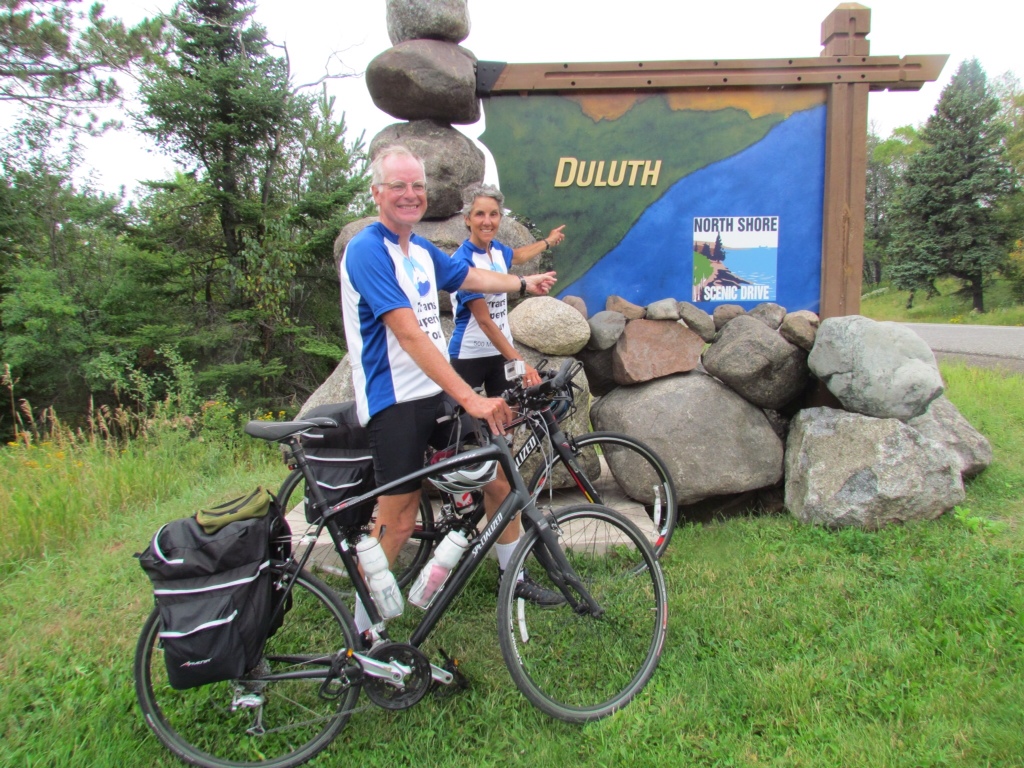
At McQuade Harbor we were joined by my friend Myra who came out to ride to the finish with us. It was great having her support and company for the final miles. Upon reaching Duluth, we were able to follow the Lakewalk to Canal Park, our chosen destination point. After traveling at reasonable speeds on highways for 9 days, it was quite a change of pace when we reached the more populated sections of the trail where it is rightfully dominated by tourists, pedestrians, runners and four-wheeled cycle buggies. It made for tricky navigation, slowing and dodging the populous, but had a festive flavor at the same time.

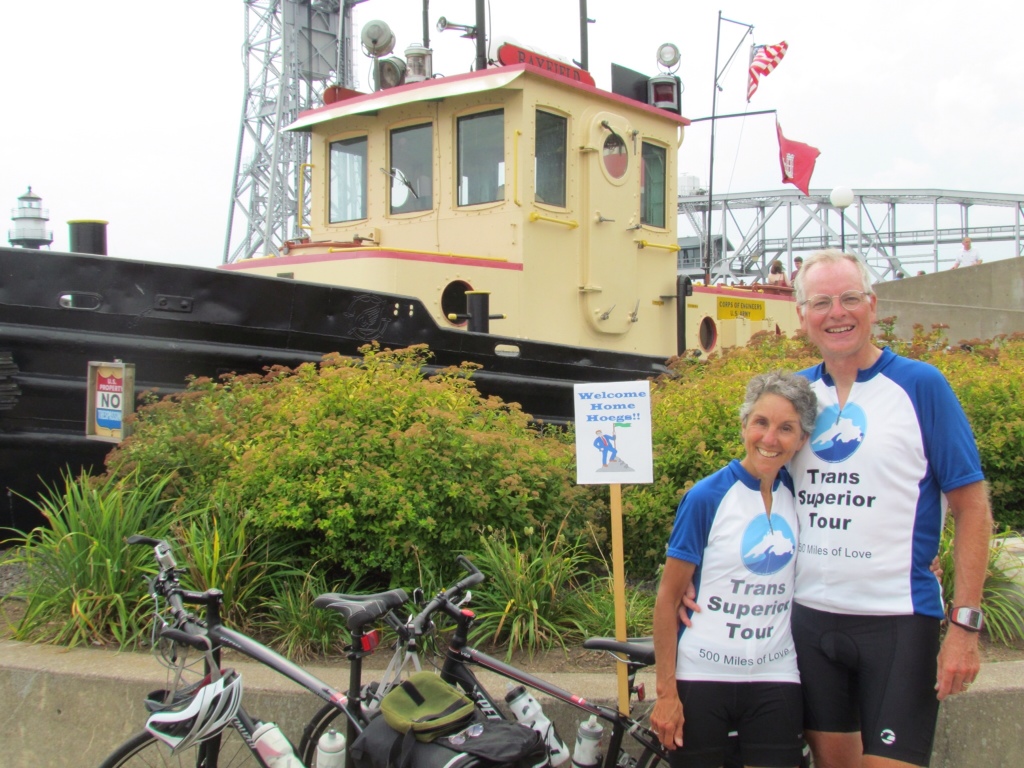
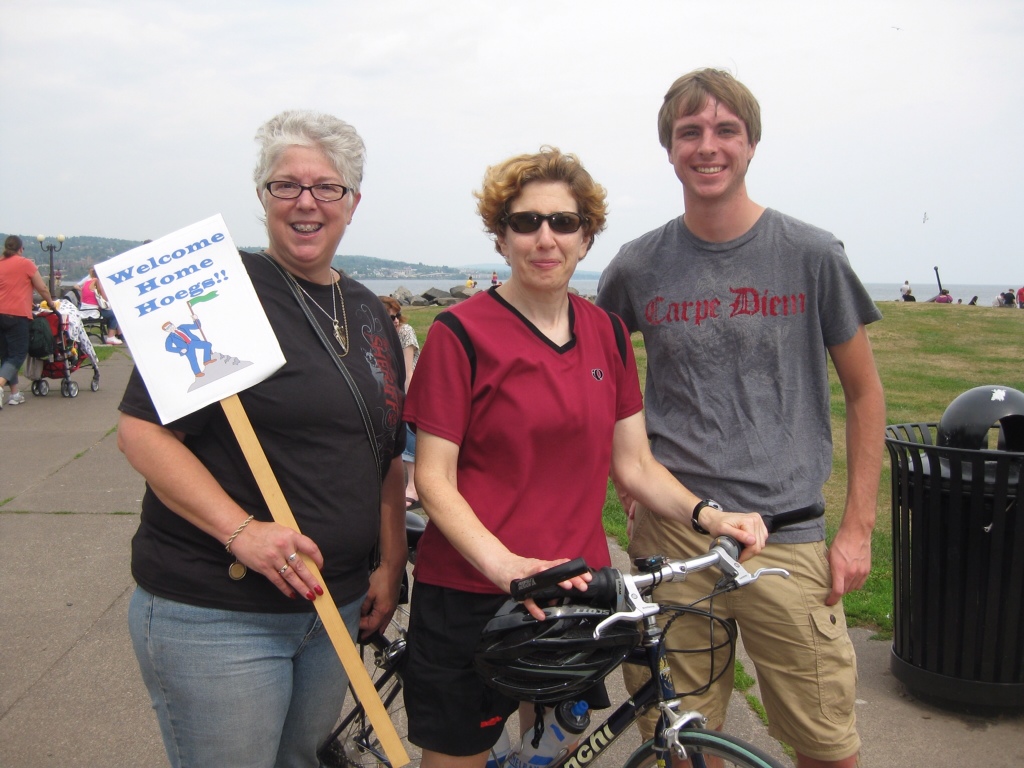
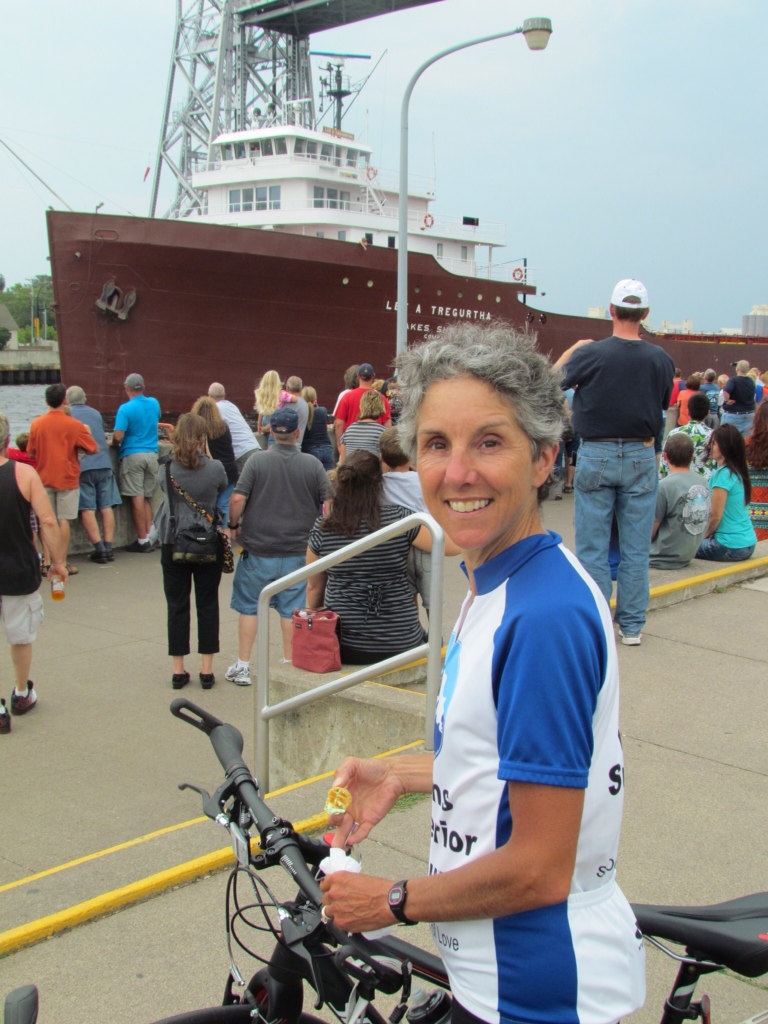
Our end point was the Marine Museum by the Aerial Bridge. There we were met by our son, Erik, and my sister, Susie, who formed a rousing welcoming committee, including a sign. After the obligatory photos, it was ice cream cones for everyone (of course!). To make the celebration complete, we were honored with an oar boat that came through the bridge heading out into the lake – the ultimate Duluth experience. It was the perfect ending to our trip.

We weren’t really done cycling, though. We still had to ride home, seven final miles. As we returned along the Lakewalk, the now cloudy skies began to produce rain. It wasn’t a sustained rainfall, however, and actually felt kind of good, breaking the heat of the day. It was a leisurely ride, lacking the same sense of purpose we’d had on the rest of our tour. After all, we’d already celebrated our finish. We’d passed the 500 mile mark just before entering Duluth. And we had completed the circle around our end of the lake.

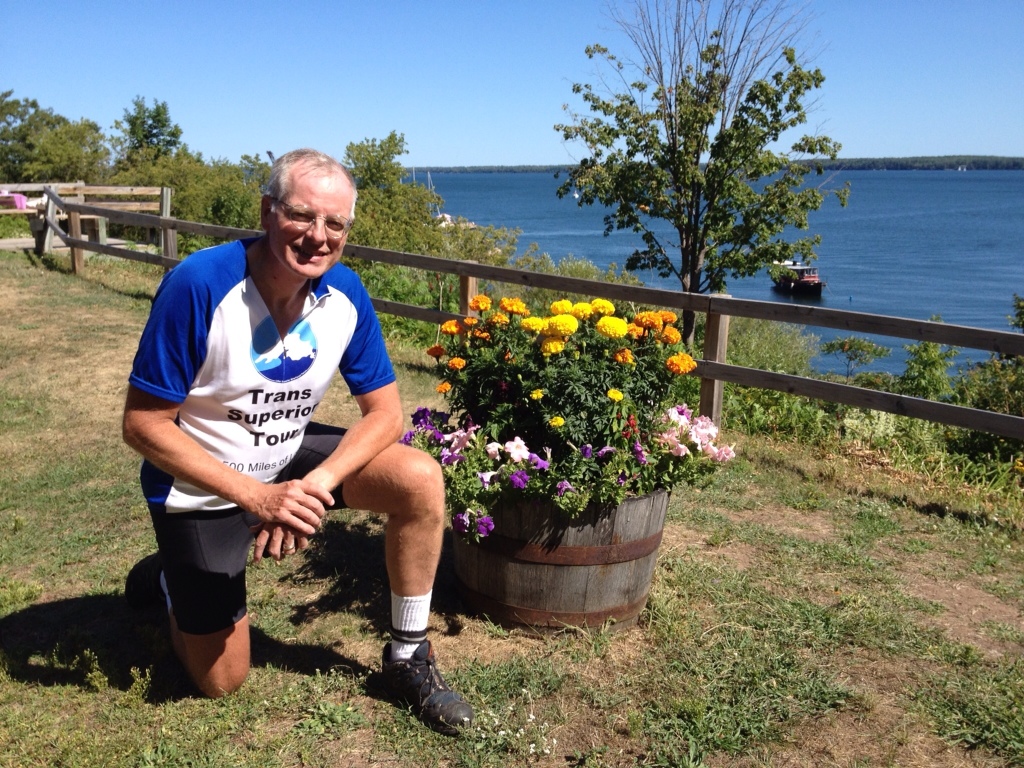
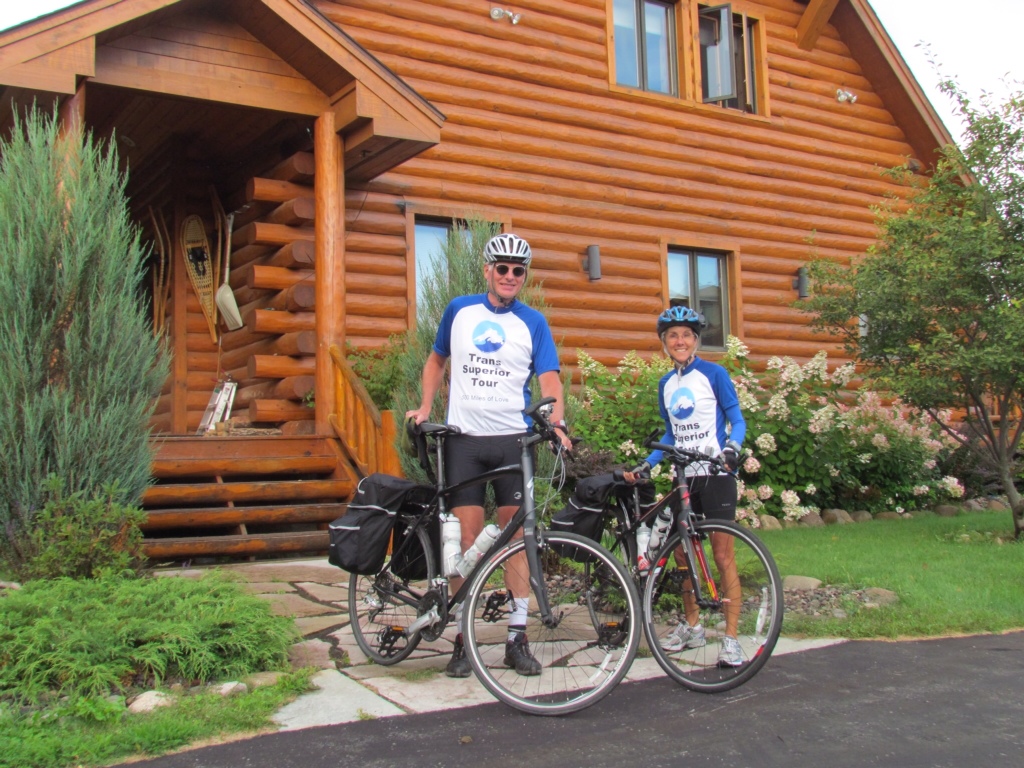
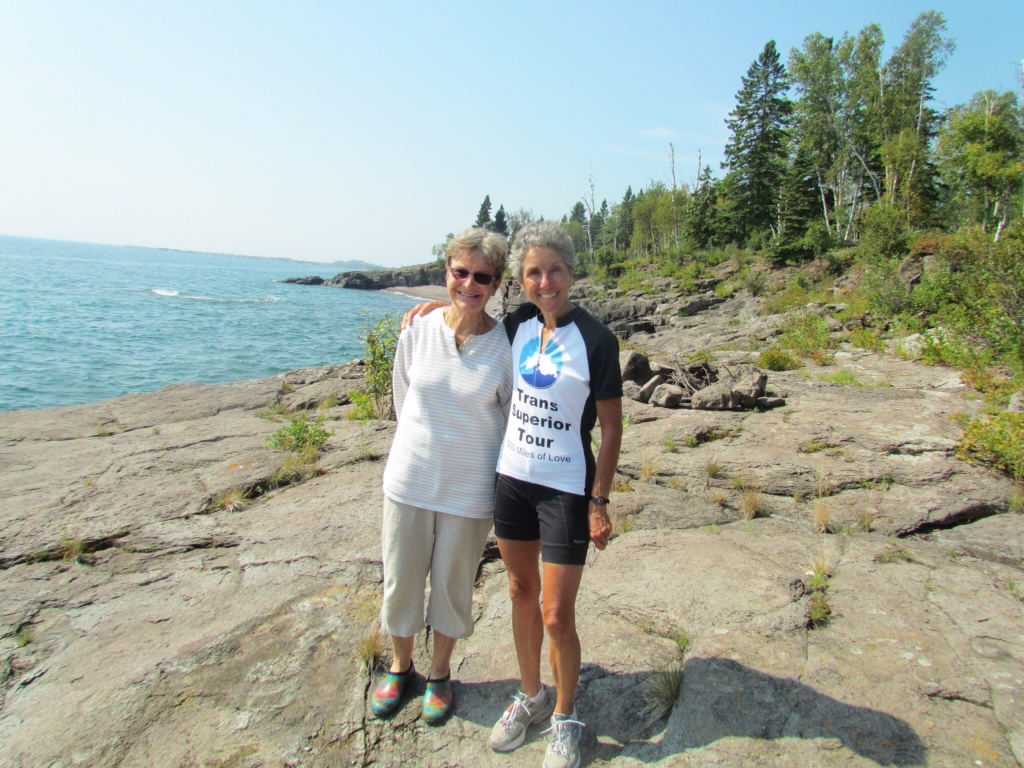
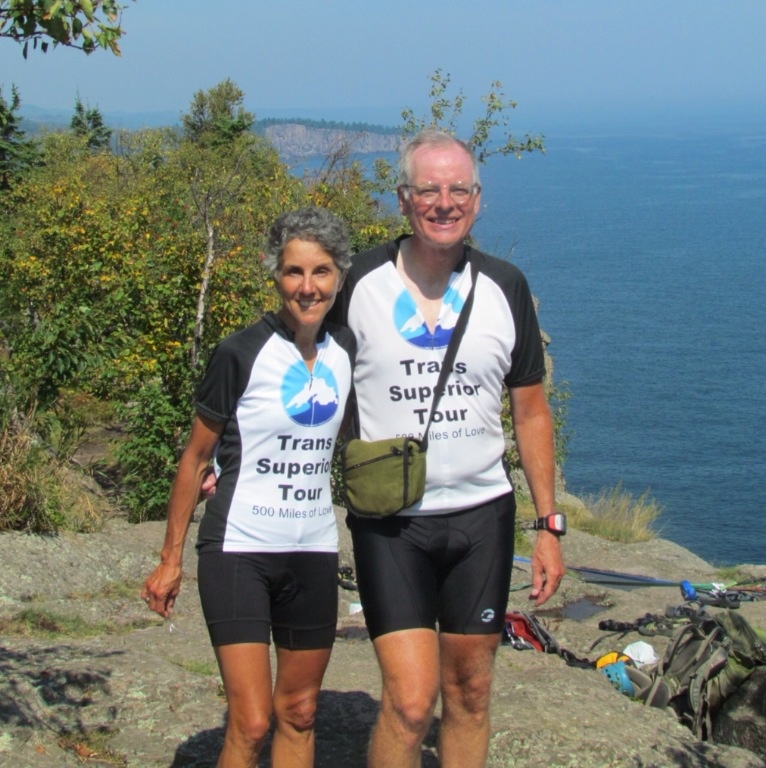
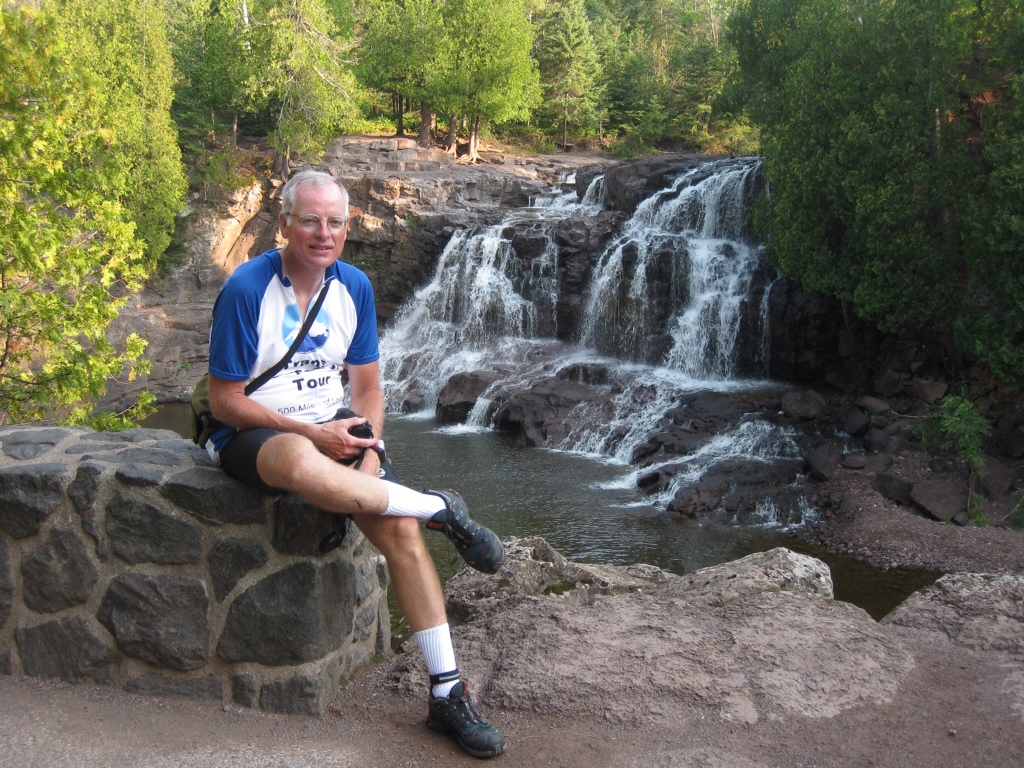
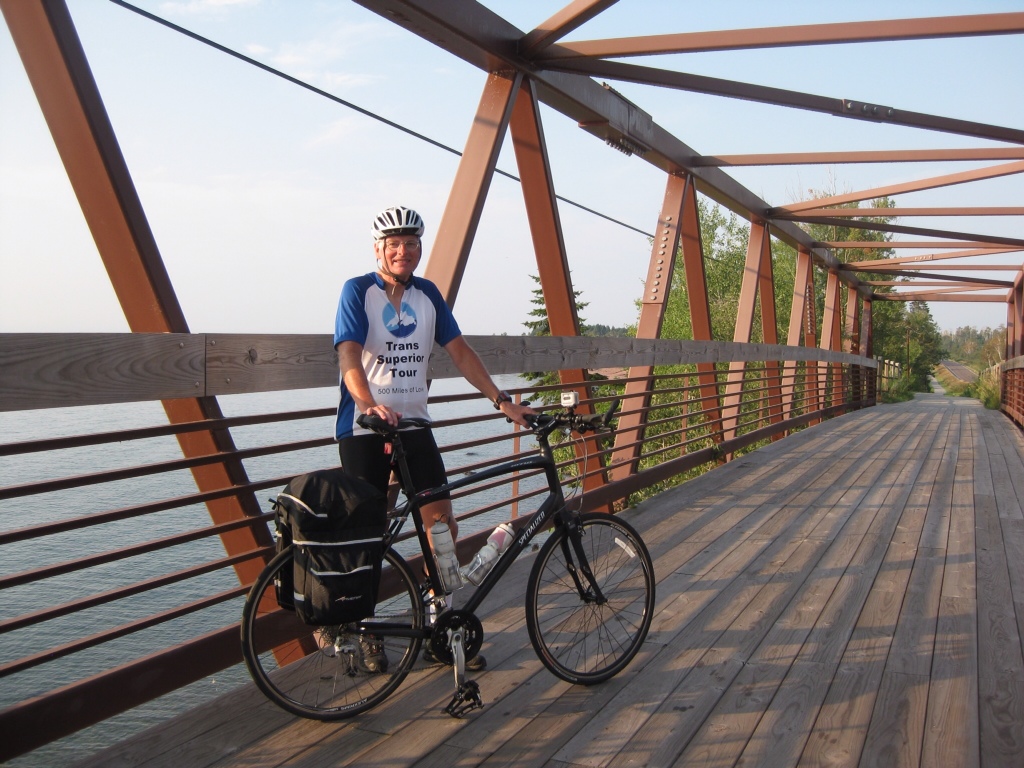
It truly was 500 miles of love, just like it says on our shirts. I can’t wait to plan the next trip.

Cycling Familiar Territory

We awoke to the sound of wet tires swishing on the pavement after additional overnight thunderstorms. Given that we had a shorter distance to travel today, there was little reason to rush the start of our ride. Our only concern was the narrow shoulders along today’s stretch of highway 61. But we counted on having less traffic heading south on a Friday to ease that issue. In fact, the situation was not quite as bad as we expected. Recent roadwork had improved the width and surface of the shoulders in many places. However, between the Cascade State Park Headquarters and Lutsen ski resort they were truly terrible. We had two feet at most, and the pavement was crumbling. We took to weaving between road and shoulder, depending on whether there were cars coming or not. It was nerve wracking, even with weekday traffic. The worst incident was a big SUV passing a car in the opposite direction, which put him on our side of the road. He passed within 18 inches of us – very unnerving! We dubbed that 9 mile section of road the “least pleasant” of our whole trip.

I don’t think I had really thought before about which sections of the North Shore had more parks and sights than others. When traveling by car, one passes through them in a short enough span that it makes little difference. On a bike it is a lot more apparent. Today’s miles included few such attractions. So we made up for it with stops of our own making.

First was breakfast. We’ve taken to putting 20-30 miles behind us then stopping for a good breakfast. Today at my insistence we hit an old favorite of mine, the Coho Cafe in Tofte. In addition to tasty meals (and a latte at last for me), we fed our internet-starved cravings. We have been mostly devoid of internet and cell phone coverage the last three nights, which was not entirely a bad thing. But we were eager to update our blogs, so we each got a posting up during breakfast.

Next we visited friend and author Beryl Singleton Bissell. I read her first book, The Scent of God, a number of years ago, then was reintroduced to her work when she put out A View of the Lake about being a transplant from the Twin Cities in Schroeder MN. I was enthralled with both books, and thrilled when she accepted my invitation to meet with my book club last fall. She provided a wonderful evening of discussion and sharing abut her writing. Being able to see her in her North Shore home surroundings was a real treat. By then the day had turned warm and sunny, and we had a lovely visit on her deck overlooking the lake. A highlight was seeing her little red writing shed, which she used on a writing retreat and ultimately was able to move to her own yard. It was an uplifting and inspiring visit.

The sun grew warmer and the day hotter. In fact, this was our warmest day yet. So when Rich suggested we cycle up to Palisade Head, I was astounded. But game! It was a short distance to the amazing overlook area, but had the steepest inclines we had yet to encounter. I was determined not to walk my bike, but it did require standing up to surmount some of those hills! The view was worth it, though. Not even the slight haze in the distance could detract from the vistas. Two rock climbers were there scaling the vertical drop. While their endeavors seemed unfathomable to us, we were fascinated by it and completely floored when the woman climber completed the trip down and back up again in less than 10 minutes.

We completed our day with an interview with a reporter from the Lake County News-Chronicle. I’d done a “media blitz” the day before we started our trip, contacting the local newspapers in the cities where we were going to be staying. Several of them followed up on it, some without our even knowing it. We learned from some other cyclists near Copper Harbor that they’d read about us in the paper! We felt quite the celebrities.

Just in time Cycling

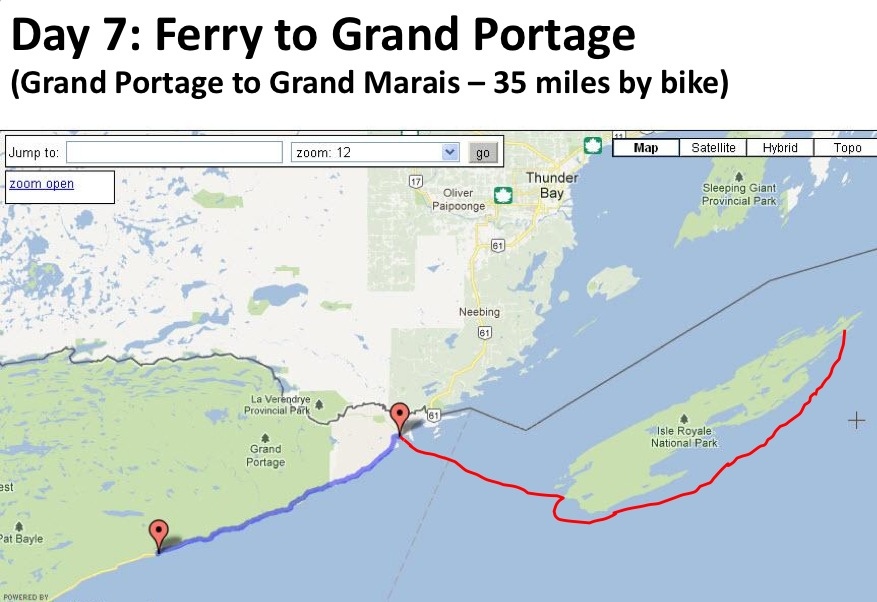
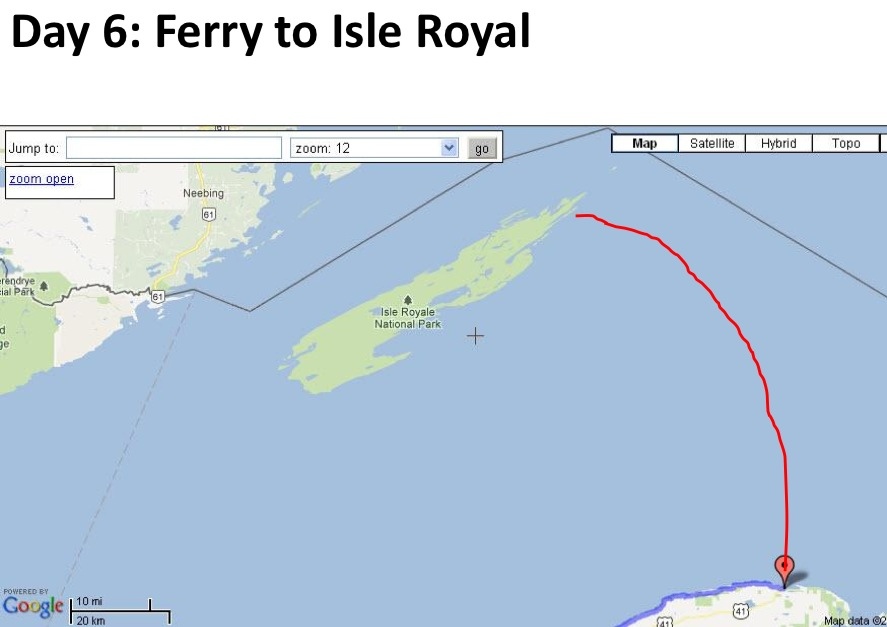
The ferry to Grand Portage was a totally different experience from yesterday’s boat from the Michigan side – in more ways than one. First of all, it was a much different boat. This was the U.S. Mail boat, not primarily a passenger vessel. It was a lot smaller and was a 2-person low key operation. Highly efficient and seaworthy, but bare bones. Secondly, in addition to making mail quick stops around the island, it also picked up and dropped off hikers from various points on the island. Hence, it clung to the shore and made numerous stops on the island before heading back to the mainland. In fact, the actual crossing took less than two hours out of our 6 1/2 hour trip. And finally, and most importantly, I felt just fine. Hurray!!! The winds were much less, and the most we had were 1-3 foot swells, with much of the trip being even calmer than that. It was so nice to be able to enjoy the trip this time.
Molly on the ferry - feeling good!It was a long day on the ferry, and highly relaxing given the slow nature of the trip. Venturing into the inlets to pick up hikers was very pretty, and traveling the deep recesses into the island reminded us of the archipelagos of Scandinavia. Beyond that we entertained ourselves by talking to other passengers, trading our cycling stories for their hiking tales. We did quite a bit of reading, but I will admit to doing more snoozing than reading. Unlike yesterday, the boat’s motion kept lulling me to sleep. I didn’t mind a bit.
It was close to 4:00pm by the time our bikes were unloaded from the boat and we were ready to head down the North Shore. After hours of forced inactivity on the boat, it felt good to be doing something physical again. We had renewed energy in our cycling, pushing the pace faster than usual. We were pleased to find that that section of highway 61 had enormous shoulders, which lasted all the way to Grand Marais. Given the late hour, this was not the day to stop for sightseeing. But there were plenty of lake views in that section of the North Shore to welcome us back to Minnesota.

Try as we might, we couldn’t ignore the rain clouds overhead which dropped a few sprinkles on us. Soon they were producing lightening strikes over the lake. When the rumbles of thunder became closer and more insistent, we pressed on even harder. Rain began to fall In earnest as we entered Grand Marais. Before we got too wet, we found our motel, checked in and stashed our bikes in the room. Just minutes later, heavy thunderstorms and rain blanketed the area. Boy, did we time that right! Even better, after showering and settling in, the rain let up and allowed us to go out for dinner, make a trip to DQ and walk around the harbor.

The trip seems to take on a different feel from this point on. Our long distances are behind us, as are the hills. So it feels like we can practically coast home. In addition, we are now on familiar territory. No more surprises in our route – we know what the North Shore will throw at us. That is both reassuring and a disappointment. Seeing new places and exploring different parts of Lake Superior has been a highlight of the trip. It’s different cycling it than driving it in a car though, and I’m sure our remaining two days will provide us with ample experiences. And heaven only knows what must-see sights Rich will find along the way.

I’d Rather be Cycling

Our day off. We had a respite from cycling to take the ferry from Copper Harbor to Rock Harbor on Isle Royale National Park. Rich was like a little kid, he was so excited. It was his first time on Isle Royale and he’d never crossed the middle of Lake Superior before. My anticipation took a slightly different angle. I was looking forward to returning to Isle Royale after a visit 40 (ouch!) years ago. And I was game to take the ferry, even though I have consistently been prone to seasickness. After all, it was an adventure.

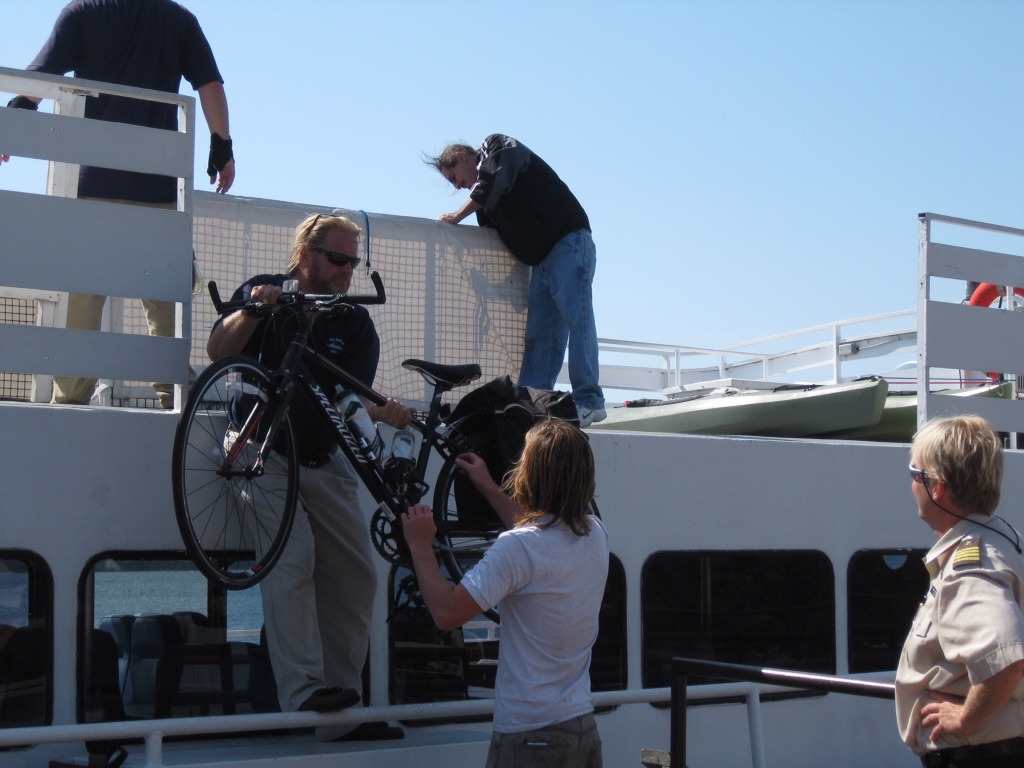
The first sound I heard upon waking this morning was the lines of a nearby sailboat clanking against the mast, and the wind whistling through our open windows. I chose to think positively and put my faith in the Bonine that I took prior to boarding the boat. The sun was shining, we watched in amazement as they hoisted our bikes, panniers and all, with a single hand up to the top storage deck, and mingled with the hearty hikers boarding the boat.

It was a four hour crossing, and I made it less than an hour inside the cabin. As soon as we cleared the harbor, we were in deep swells. I watched wide-eyed as the horizon alternately dipped then rose out of sight on the opposite side. Wow, I’d never been in seas like this before! But my confidence remained high, and surprisingly I was not scared as the boat pitched and tossed at wild angles. Before long, however, I took stock of my body and gamely trained my eyes on the horizon on our side of the boat. It was much more stable in comparison. But the water won.

Soon I was dashing out the door onto the back deck of the boat. There I firmly gripped the railing and leaned over the side as advised by the crew. When that first wave of retching subsided (and it was only the first of many) I determined that I was there to stay. I firmly planted my feet apart, tightened my noose-like hold on the railing, and set my sights on the disappearing Michigan mainland straight being us. I used my legs to absorb the sway of the boat, desperately working to keep my upper body as verticle as possible. The fresh air that blew around me felt good, if only it hadn’t been tainted by diesel fumes.

It was an interminable three more hours. I found weak fascination in watching the clashing waves and gusty spray that created myriad patterns behind the boat. But that’s about all I had to engage my brain. Looking left or right was not an option, nor was talking. Not that my companions were interested in lively conversation. I had plenty of company out there, all in the same state. It’s no wonder, as we were in 6 foot swells. The crew described it as “worse than average” but not out of the norm for this time of year. If standing under the trees shivering in the pouring rain was miserable, this was abject agony. I would much rather have been cycling, even struggling up the steepest hill.

Rich suffered no such affectation, wouldn’t you know. On his visit out to commiserate with me, he was bouncing all around, looking at everything and clearly enjoying himself. All I wanted was to block him from my peripheral vision – I couldn’t handle the additional motion. He spent time out on the front deck, hanging on for dear life, getting hit by the spray, but loving it. I had to rely on his pictures to relive the scenic entrance to Isle Royale after the fact.

It took a nap and a few bites of salty crackers to restore any semblance of normalcy once we reached shore. But I was relieved to rally enough to get outside to explore our small area of the island and take a canoe out with Rich to paddle the pristine waterway in Tobin Harbor. Ironically, I didn’t mind being back out on the water. It was flat and calm there, and shore was only a few strokes away. We paddled in search of the cabin still owned by a friend, the last generation of his family to be allowed to hold private property in the park. In the vast expanse of wilderness here, we saw little harm that the remaining cabins posed.

Isle Royale is a beautiful place. Its deeply forested terrain and rocky shores bordered by deep blue waters were especially nice on a sunny, warm day like today. I would like to have gotten out for a short hike, but Rich was dedicated to keeping it a rest day, and certainly my body needed it. So like the other lodge guests, who are staying in relative luxury compared to the hikers, we took advantage of the amenities while still appreciating the nature all around us.

Tomorrow it’s back to cycling again. But not until I brave another ferry ride over to the Minnesota side. Some travelers who arrived on that boat today clued me in to the first mate, Kirk. They vouched for him as a venerable seasickness coach. Kirk, I’ll be looking for you tomorrow morning.